mardi 29 mars 2022

The first launch of Long March-6A


CASC - CZ-6A Y1 (Long March-6A) Mission patch.


March 29, 2022

Long March-6Acarrying Tiankun-2 (天鲲二) & Pujiang-2 (浦江二) liftoff

The first Long March-6A launch vehicle launched two satellites, Tiankun-2 (天鲲二) & Pujiang-2 (浦江二), from the Taiyuan Satellite Launch Center, Shanxi Province, northern China, on 29 March 2022, at 09:50 UTC (17:50 local time).

The first launch of Long March-6A

According to the China Aerospace Science and Technology Corporation (CASC), Long March-6A is a new generation medium-launch vehicle, with a liquid-propelled core booster and four solid-fuel side boosters, designed to send a payload of up to 4 tons into a 700km Sun-synchronous orbit.

Long March-6A (CZ-6A)

For more information about China Aerospace Science and Technology Corporation (CASC), visit: http://english.spacechina.com/n16421/index.html
 
Images, Video, Text, Credits: China Media Group(CMG)/China Central Television (CCTV)/China Aerospace Science and Technology Corporation (CASC)/SciNews/Orbiter.ch Aerospace/Roland Berga.

Best regards, Orbiter.ch

Station Crew Changes Commanders Live on NASA TV


ISS - Expedition 66 Mission patch.


March 29, 2022

NASA Television coverage of Russian cosmonaut Anton Shkaplerov’s hand over of the space station to NASA astronaut Tom Marshburn will begin at 9:45 a.m. EDT during a change of command ceremony. The event will air live on NASA TV, the NASA app, and the agency’s website.


Image above: NASA astronaut Tom Marshburn (above) assumes command of the International Space Station from cosmonaut Anton Shkaplerov. Image Credit: NASA.

Mark Vande Hei, along with Russian cosmonauts Anton Shkaplerov and Pyotr Dubrov, will close the hatch to the Soyuz MS-19 spacecraft to begin the journey back to Earth. The Soyuz will undock from the Rassvet module, heading for a parachute-assisted landing Wednesday, March 30, on the steppe of Kazakhstan, southeast of the remote town of Dzhezkazgan.

Coverage of the crew’s farewells, undocking, and landing will air live on NASA TV, the agency’s website, and the NASA app at the following times (all EDT):

- 11:30 p.m. Tuesday, March 29 – Farewells and hatch closure (at 12 a.m., Wednesday, March 30)
- 2:45 a.m. Wednesday, March 30 – Undocking (at 3:21 a.m.)
- 6:15 a.m. Wednesday, March 30 – Deorbit burn and landing (landing at 7:28 a.m. / - 5:28 p.m. Kazakhstan time)

Vande Hei and Dubrov launched April 9, 2021, on Soyuz MS-18, and will wrap up a 355-day mission spanning 5,680 orbits of Earth and more than 150 million miles. During the long-duration mission, Vande Hei broke the record for longest single spaceflight by an American astronaut, previously held at 340 days. Vande Hei will wrap up his second spaceflight with a total of 523 days in space. Shkaplerov launched on Soyuz MS-19 on Oct. 5, 2021. This was Dubrov’s first flight. Shkaplerov is ending his fourth mission with 708 cumulative days spent in space.


Image above: NASA astronaut and Expedition 66 Flight Engineer Mark Vande Hei peers at the Earth below from inside the seven-windowed cupola, the International Space Station's window to the world on Feb. 4, 2022. Just outside the cupola is the Soyuz MS-19 crew ship docked to the Rassvet module. Image Credit: NASA.

At the time of undocking, Expedition 67 will formally begin aboard the station, with new station Commander Tom Marshburn, NASA astronauts Raja Chari and Kayla Barron, ESA (European Space Agency) astronaut Matthias Maurer, and Roscosmos cosmonauts Oleg Artemyev, Denis Matveev, and Sergey Korsakov.

After landing, the Soyuz MS-19 crew will split up, as per standard crew return practice, with Vande Hei returning to his home in Houston, while the cosmonauts fly back to their training base in Star City, Russia.

Related links:

NASA TV: https://www.nasa.gov/live

Expedition 66: https://www.nasa.gov/mission_pages/station/expeditions/expedition66/index.html

Rassvet module: https://www.nasa.gov/mission_pages/station/structure/elements/rassvet

Space Station Research and Technology: https://www.nasa.gov/mission_pages/station/research/overview.html

International Space Station (ISS): https://www.nasa.gov/mission_pages/station/main/index.html

NASA/Mark Garcia.

SpaceX - Starship Could be Ready for an Orbital Flight in May


SpaceX - Starship Orbital Demo (SN-20) patch.


March 29, 2022

SpaceX has enjoyed a lot of wins in the past few years. In addition to successfully glide-testing and landing multiple Starship prototypes, they’ve rolled out its first Super Heavy boosters, test-fired the new Raptor Vacuum engines, and assembled the “Mechazilla” launch tower at Boca Chica, Texas. They also unveiled the first fully-furbished orbital test vehicle (SN20) that was stacked with a first stage booster for the first time on its launch pad (image below).

Starship at Boca Chica launch-pad

Given the prodigious rate of progress, few were surprised when Musk announced that the first orbital flight test could take place as soon as January 2022. Unfortunately, this date had to be pushed back to an environmental assessment and the usual bureaucratic rigmarole. However, Musk recently announced on Twitter that in light of his company’s success with the new Raptor engines, they could be ready to conduct the long-awaited orbital test flight this May.

The tweet was posted on Monday, March 21st, in response to a story by Michael Sheetz, a space reporter with CNBC. Sheetz cited a recent report (by Quilty Analytics) that showed how Russia’s decision to cut ties with the international space industry (in response to sanctions) would affect the U.S. space sector. This report indicates that SpaceX will be “the clear winner” as the absence of Russian launch services means more business will come their way.

Elon Musk on Twitter

According to Sheetz, this is exemplified by the recent announcement that OneWeb – a Starlink competitor – announced that it had terminated its launch agreement with Roscosmos and signed a deal with SpaceX. Musk responded via Twitter and said that he didn’t expect to see a dramatic increase in launch services for his company, which was already launching two-thirds of the world’s satellites.

According to their original plans, said Musk, SpaceX would account for 65% of the market share for launch services. The termination of Russian launch services was likely to increase this to 70%, only slightly higher. He added that this would not affect the development of the Starship, which could be ready for its long-awaited orbital test flight by May (at the earliest). This estimate is largely based on the production of the new Raptor 2 engine.

The Raptor 2 is an updated version of the Raptor 1 and is simpler and more powerful than the original. Production began in December 2021 at SpaceX’s new engine development facility near McGregor, Texas. At the annual Starship Update hosted in February, Musk spoke about the capabilities of the Raptor 2, which included 230 metric tons (510,000 lbs) of thrust at sea level. Based on their current production rates (7 per week as of March), Musk estimates that they will have 39 engines ready by April.
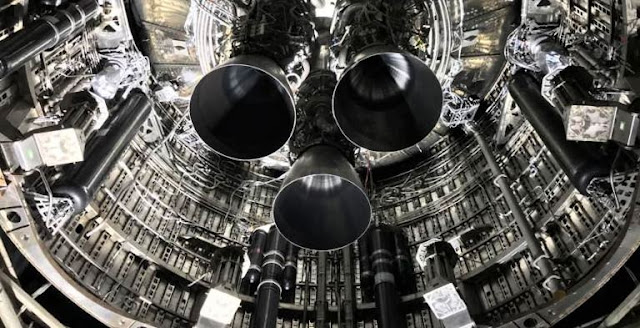
The engine compartment of the Starship, showing three Raptor engines. Image Credit: SpaceX

The is enough to equip one Super Heavy booster, which relies on 29 Raptor engines optimized for sea-level, and one Starship, which relies on three sea-level optimized and three vacuum-optimized engines. Add a few weeks to integrate them into the spacecraft, Musk added, and the entire system should be ready to fly by May at the earliest. But knowing Musk’s tendency to provide optimistic timetables, the flight may happen sometime this summer.

According to the flight plan filed with the FAA in May 2021, the orbital test flight will see the fully-stacked Starship and Super Heavy launch together and separate 170 seconds into flight. The booster will then perform a partial return and make a soft splashdown roughly 32 km (20 miles) offshore in the Gulf of Mexico. The Starship will then achieve an altitude of 200 km (~125 mi) above sea level before performing a targeted soft splashdown about 100 km (62 mi) off the coast of the Hawaiian island of Kauai.

If this test flight goes as planned, SpaceX will be ready to embark on its first commercial flights, including a lunar flyby planned for 2023 (the #dearMoon project). As part of NASA’s Artemis Program, the Starship was also selected to land astronauts on the Moon for the first time since the Apollo Era. This will be the Artemis III mission, which is currently scheduled to occur sometime in 2025.

Beyond that, the Starship and Super Heavy launch system are integral to SpaceX’s long-term goal of making regular trips to the Moon and Mars and establishing a permanent human presence there. As always, things may not be happening according to the original timeline. But they are coming together nicely!

Check out this latest animation of the Starship reaching Mars, courtesy of SpaceX:

Starship Animation

Related articles:

SpaceX rapidly stacks Starship and Super Heavy with ‘Mechazilla’
https://orbiterchspacenews.blogspot.com/2022/03/spacex-rapidly-stacks-starship-and.html

SpaceX is stacking its giant Starship
https://orbiterchspacenews.blogspot.com/2022/02/spacex-is-stacking-its-giant-starship.html

Related link:

SpaceX: https://www.spacex.com/

Images, Video, Text, Credits: SpaceX/Orbiter.ch Aerospace.

Greetings, Orbiter.ch

lundi 28 mars 2022

China Space Station (CSS) - Tianzhou-2 undocking and departure


CMS - China Manned Space logo.


March 28, 2022

Tianzhou-2 undocking

The Tianzhou-2 cargo spacecraft undocked from the Tianhe Core Module of the China Space Station on 27 March 2022, at 07:59 UTC (15:59 China Standard Time). According to China National Space Administration (CNSA), the Tianzhou-2 spacecraft is in good condition and will reenter into the atmosphere under ground control.

Tianzhou-2 undocking and departure

Tianzhou-2 (天舟二号) performed “China’s first fast automatic rendezvous and docking”, autonomously docking to the Tianhe Core Module (天和核心舱), the first and main component of the China Space Station (中国空间站), on 29 May 2021, at 21:01 UTC (30 May, at 05:01 China Standard Time).

Related articles & link:

CSS - Robotic Arm Transposition Test on China Space Station
https://orbiterchspacenews.blogspot.com/2022/01/css-robotic-arm-transposition-test-on.html

China Space Station - Shenzhou-13 astronauts complete second spacewalk
https://orbiterchspacenews.blogspot.com/2021/12/china-space-station-shenzhou-13_27.html

China Space Station - Shenzhou-13 mission’s second spacewalk begins
https://orbiterchspacenews.blogspot.com/2021/12/china-space-station-shenzhou-13.html

China Space Station - Shenzhou-13 crew space lecture highlights
https://orbiterchspacenews.blogspot.com/2021/12/china-space-station-shenzhou-13-crew.html

China Space Station - Shenzhou-13 astronauts complete first spacewalk
https://orbiterchspacenews.blogspot.com/2021/11/china-space-station-shenzhou-13.html

China Space Station - Astronaut Wang Yaping begins first spacewalk
https://orbiterchspacenews.blogspot.com/2021/11/china-space-station-astronaut-wang.html

What’s next for the China Space Station (CSS)
https://orbiterchspacenews.blogspot.com/2021/10/whats-next-for-china-space-station-css.html

China Space Station (CSS) - Shenzhou-13 hatch opening
https://orbiterchspacenews.blogspot.com/2021/10/china-space-station-css-shenzhou-13.html

China Space Station - Shenzhou-13 mission
https://orbiterchspacenews.blogspot.com/2021/10/china-space-station-shenzhou-13-mission.html

For more information about China National Space Administration (CNSA), visit: http://www.cnsa.gov.cn/
 
Image, Video, Text, Credits: China Media Group(CMG)/China Central Television (CCTV)/China National Space Administration (CNSA)/SciNews/Orbiter.ch Aerospace/Roland Berga.

Best regards, Orbiter.ch

Trio Set to Go Home Wednesday; First Private Astronaut Mission Nears


ISS - Expedition 66 Mission patch.


March 28, 2022

Three Expedition 66 Flight Engineers are returning to Earth in less than two days as four private astronauts prepare for their mission to the International Space Station. The crew activities haven’t stopped the ongoing space research as the orbital residents studied biology, botany, and physics on Monday.

NASA astronaut Mark Vande Hei is nearing the end of his missions as he prepares to return to Earth on Wednesday after a NASA-record breaking 355 days in space. Soyuz Commander Anton Shkaplerov will lead Vande Hei and Flight Engineer Pyotr Dubrov inside the Soyuz MS-19 crew ship when they undock from the Rassvet module at 3:21 a.m. EDT on Wednesday. The trio will parachute to a landing just over four hours later.


Image above: The Soyuz MS-19 crew ship, in between the Cygnus cargo craft and the Prichal module, that will take three Expedition 66 crew mates home is pictured docked to the Rassvet module. It was pictured before the Soyuz MS-21 crew ship docked to Prichal on March 18. Image Credit: NASA.

The next mission to the orbiting lab will be the Axiom Space-1 mission, or Ax-1, carrying a former NASA astronaut and three U.S. crew members. Commander Michael Lopez-Alegria will be making his fifth visit to space and his third visit to the space station while commanding the first private mission for Axiom Space. He will lead first time space visitors Pilot Larry Connor and Mission Specialists Eytan Stibbe and Mark Pathy aboard Endeavour, during the vehicle’s second mission to the station.

NASA teams supporting the Artemis I mission polled “go” today to proceed with the wet dress rehearsal, planned for Friday, April 1, through Sunday, April 3, on Launch Pad 39B at NASA’s Kennedy Space Center in Florida. NASA, Axiom and SpaceX are now looking at no earlier than April 6 for the launch of Axiom Mission 1 (Ax-1), the first  private astronaut mission to the International Space Station, pending range approval. For an April 6 launch, Ax-1 static fire would take place April 4. NASA’s SpaceX Crew-4 mission remains scheduled to launch no earlier than Tuesday, April 19.

Science is always ongoing aboard the station whether its crew members tending to experiments, or scientists uploading commands, or even investigations that are designed to run autonomously.

Monday’s research program aboard the station covered human research, space botany and glass optics. NASA Flight Engineers Raja Chari and Kayla Barron helped researchers understand how astronauts manipulate objects possibly informing the design of spacecraft interfaces for a variety of gravity environments. The duo also joined astronauts Tom Marshburn of NASA and Matthias Maurer of ESA (European Space Agency) for a standard vision test using an eye chart.

Chari also harvested cotton cultures grown for the Plant Habitat-05 experiment and prepared them for return analysis back on Earth. Marshburn serviced samples for a physics study exploring using artificial intelligence to improve the development of advanced glass optics with implications for Earth and space industries.

International Space Station (ISS). Animation Credit: NASA

The orbiting lab’s three newest crew members spent the day on a variety of activities in the Russian segment including an exercise study, ventilation maintenance, and station familiarization activities. Cosmonauts Oleg Artemyev, Sergey Korsakov, and Denis Matveev are in the second week of a six-and-a-half-month mission that began on March 18.

After successfully completing a spacewalk March 23 at the International Space Station, a thin layer of water was discovered on the inner surface of the helmet and on an absorption pad inside ESA (European Space Agency) astronaut Matthias Maurer’s helmet following airlock re-pressurization. The water found was more than normal. The space station crew expedited Maurer’s helmet removal and then gathered data in coordination with ground support teams. The space station team is looking into the cause, and any possible fixes that might be needed. The station crew members remain in good health, and they are continuing their daily activities of science and maintenance. Key objectives were completed during the spacewalk, and there are no planned U.S operating segment spacewalks in the near future as a part of normal station operations. Crew safety is a top priority for NASA. The agency and our international partners are constantly identifying and mitigating risks of human spaceflight.

Related links:

Expedition 66: https://www.nasa.gov/mission_pages/station/expeditions/expedition66/index.html

Rassvet module: https://www.nasa.gov/mission_pages/station/structure/elements/rassvet

How astronauts manipulate objects: https://www.nasa.gov/mission_pages/station/research/experiments/explorer/Investigation.html?#id=1188

Plant Habitat-05: https://www.nasa.gov/mission_pages/station/research/experiments/explorer/Investigation.html?#id=8341

Advanced glass optics: https://www.nasa.gov/mission_pages/station/research/experiments/explorer/Investigation.html?#id=8383

Space Station Research and Technology: https://www.nasa.gov/mission_pages/station/research/overview.html

International Space Station (ISS): https://www.nasa.gov/mission_pages/station/main/index.html

Image (mentioned), Text, Credits: NASA/Mark Garcia.

Greetings, Orbiter.ch

Rover ready – next steps for ExoMars


ESA - ExoMars Mission logo.


March 28, 2022

In brief

ESA’s ExoMars rover is confirmed technically ready for launch, and a fast-track study is under way to determine options for bringing the mission to Mars.

Rover eyes

In-depth

The ESA-led Rosalind Franklin rover has a unique potential to search for evidence of past life on Mars thanks to its drill and laboratory. It will be the first rover to drill 2 m below the surface, and the first to use novel driving techniques, including wheel-walking, to overcome obstacles.

Although the 2022 launch window for the mission is no longer possible following the suspension of cooperation with Roscosmos, the mission’s System Qualification and Flight Acceptance Review took place as planned in March. The Review Board confirmed that the spacecraft would have been ready for the timely shipment to the launch site and the programme had a sufficient time margin for the original launch opportunity opening on 20 September 2022.

Amalia's wheels

Due to the suspension of the 2022 launch, the Exomars elements are now being prepared for storage at a Thales Alenia Space site in Italy awaiting further instruction.

The Review Board members specifically expressed their appreciation and thanks to the review team for the exhaustive work performed over the past months.

Based on the decision by ESA Member States at its March Council meeting, a fast-track industrial study will now start to better define the available options for a way forward to implement the ExoMars rover mission in a future launch.

The teams will be looking for the earliest possible launch depending on how quickly technologies can be developed to support a European-led mission, or in collaboration with other international partners, and the availability of compatible launchers and launch site.

Front view of the ExoMars rover

“I hope that our Member States will decide that this is not the end of ExoMars, but rather a rebirth of the mission, perhaps serving as a trigger to develop more European autonomy,” says David Parker, Director of Human and Robotic Exploration at ESA.

“We count on brilliant teams and expertise across Europe and with international partners to reshape and rebuild the mission. The team is dedicated and focused on setting out the next steps to ensure we bring this incredible rover to Mars to complete the job it was designed for.”

Meanwhile, the ExoMars Trace Gas Orbiter (TGO) continues to relay the majority of data from Mars, from NASA’s Curiosity and Perseverance rovers as well as its Insight lander. TGO has considerable fuel onboard meaning it could also support data relay from the ExoMars rover in the future as well the Mars Sample Return campaign.

Related article:

ExoMars suspended
https://www.esa.int/Newsroom/Press_Releases/ExoMars_suspended%20

Related link:

ExoMars: https://www.esa.int/Science_Exploration/Human_and_Robotic_Exploration/Exploration/ExoMars

Images, Text, Credits: ESA/Thales Alenia Space.

Best regards, Orbiter.ch

NASA Orders Additional Cargo Flights to Space Station


NASA logo.


Mar 28, 2022

International Space Station (ISS). Image Credit: NASA

NASA has ordered 12 additional missions under its Commercial Resupply Services-2 (CRS-2) contracts to ensure continuous science and cargo delivery for the agency and its international partners to the International Space Station.

The 12 additional missions ordered – six each to Northrop Grumman and SpaceX – will provide resupply services to the station through 2026.

In 2016, NASA awarded three American companies CRS-2 contracts to resupply the International Space Station so crew members can continue to conduct science research and technology development that benefits people on Earth and supports human missions to the Moon and Mars.

While the maximum potential value of all contracts is $14 billion, NASA orders missions as needed, and the total prices paid under the contract will depend on which mission types are ordered.

On Oct. 16, 2020, NASA ordered two additional missions from Northrop Grumman, and three additional missions from SpaceX beyond the minimum guaranteed.

With this action, a total of 32 missions have been ordered by the agency for cargo resupply missions under the CRS-2 contracts with 14 missions to Northrop Grumman, three missions to Sierra Nevada Corporation (now Sierra Space), and 15 missions to SpaceX.

For information about NASA’s commercial resupply of the space station, visit:

https://www.nasa.gov/commercialresupply

Related link:

International Space Station (ISS): https://www.nasa.gov/mission_pages/station/main/index.html

Image (mentioned), Text, Credits: NASA/Sean Potter.

Greetings, Orbiter.ch