mardi 5 avril 2022

Commercial Research Expands Aboard the International Space Station


Axiom Mission 1 (Ax-1) patch.


April 5, 2022

The International Space Station has spent more than two decades in low-Earth orbit serving as Earth’s orbiting laboratory. Groundbreaking research aboard the station in its unique microgravity environment has led to benefits back on the ground and paved the way for future deep space missions.

SpaceX Crew Dragon docked at ISS. Image Credit: NASA

As NASA sets its sights once again on the Moon and eventually on Mars, low-Earth orbit is playing an even more critical role for achieving humanity’s ambitions in outer space. NASA has long supported commercial research aboard station sponsored by the ISS U.S. National Laboratory and has now even opened the space station for commercial activities such as private astronaut missions as part of its plan to develop a robust and competitive space economy.

Explore recent and upcoming commercial research aboard the orbiting laboratory:

Creating future space habitats


Image above: Axiom Mission 1 astronauts, left to right, Larry Connor, Mark Pathy, Michael López-Alegría, and Eytan Stibbe. The astronauts are approved by NASA and its international partners for Axiom Space's first private astronaut mission to the International Space Station. Image Credits: Chris Gunn - Axiom Space.

Axiom Space’s first private astronaut mission to the space station, Axiom Mission 1 or Ax-1, is targeted to launch Friday, April 8, from NASA’s Kennedy Space Center in Florida. Private astronaut missions are privately funded, fully commercial flights to the International Space Station on commercial spacecraft. The Ax-1 crew will fly on a Crew Dragon to and from the space station on a mission dedicated to commercial research, outreach, and approved commercial and marketing activities.

During their eight days aboard the orbiting laboratory, the crew will conduct many Ax-1-specific experiments, including TESSERAE Ax-1. The study further tests self-assembly and docking of an autonomous, self-assembling robotic swarm of tiles in microgravity. The study builds on a previous test aboard station in 2020 in which seven tiles successfully self-assembled in microgravity. The investigation helps assess the feasibility of construction of satellites and space habitats in orbit to support future missions to the Moon and Mars and space tourism in low-Earth orbit. The ISS National Laboratory sponsors the experiment.

Robotic helpers


Image above: Complete configuration of the GITAI S1 inside the Bishop Airlock mock-up. The Nanoracks-GITAI Robotic Arm study demonstrates the versatility and dexterity in microgravity of a robot designed by GITAI Japan Inc. For the demonstration, the robot conducts common crew activities and tasks via supervised autonomy and teleoperations from the ground. Image Credit: NASA.

Nanoracks-GITAI Robotic Arm successfully demonstrated the versatility and dexterity in microgravity of a robot designed by Japanese company GITAI Japan Inc. The experiment was conducted under the pressurized environment inside the Nanoracks Bishop Airlock, the space station’s first commercial airlock. Results could support development of robotic labor to support crew activities and tasks as well as servicing, assembly, and manufacturing tasks while in orbit. Robotic support could lower costs and improve crew safety by having robots take on tasks that could otherwise expose crew members to additional hazards. The technology also has applications in extreme and potentially dangerous environments on Earth, including disaster relief, deep-sea excavation, and servicing nuclear power plants. The ISS National Laboratory sponsors the experiment.

Toward lunar laundromats


Image above: In support of the PGTIDE study, Kristi Niehaus, Tide scientist, Strategic Innovation & Technology at P&G, displays a stain set that will be used to test Tide detergent solutions aboard the International Space Station. Tide is developing a detergent solution for space that will aid in planned space travel such as the Artemis Moon missions and a crewed roundtrip Mars mission. Image Credit: P&G.

Astronauts on the space station wear an item of clothing several times, then replace it with new clothes delivered on resupply missions. Limited cargo capacity makes this a challenge, and resupply is not an option for longer missions such as to the Moon and Mars. Procter & Gamble Company (P&G) has developed Tide Infinity, a fully degradable detergent formulated specifically for use in space. Their investigation, PGTIDE, studies the performance of the detergent’s stain removal ingredients and stability in microgravity. Space station crew members are involved in storing PGTIDE samples, flown to station aboard SpaceX’s 24th commercial resupply mission (SpaceX CRS-24), and conducting stain removal activities. If the technology is proven in space, P&G says it plans to use these cleaning methods and detergent to advance sustainable, low-resource-use laundry solutions here on Earth. The ISS National Laboratory sponsors the experiment.

Commercial cancer research

The private astronauts aboard the Ax-1 mission will also work on Modeling Tumor Organoids in LEO (Ax-1). The experiment demonstrates processes for in-orbit pre-cancer and cancer cell culture confocal fluorescence microscopy, an important tool for biological research. It also seeks to provide real-time data transfer in support of future pre-cancer and cancer stem cell research. The investigation seeks to develop models that could inform and accelerate the development of countermeasures and enhance crew safety on future space missions. It could also provide tools for detection of and therapies for pre-cancer, cancer, and a variety of other diseases on Earth. The ISS National Laboratory sponsors the experiment.

Parts made in space


Animation above: The Turbine SCM experiment is installed aboard the International Space Station by ESA (European Space Agency) astronaut Matthias Mauer. Animation Credit: NASA.

The ISS National Laboratory-sponsored Turbine SCM study tested a commercial manufacturing device that processes heat-resistant alloy parts in microgravity. Alloys are materials made up of at least two different chemical elements, one of which is a metal. Researchers expect more uniform microstructures and improved mechanical properties in superalloy parts processed in microgravity versus those processed on Earth. These superior materials could improve the performance of turbine engines in industries such as aerospace and power generation on Earth. Also launched aboard SpaceX CRS-24, Turbine SCM is operated remotely by U.S. company Redwire Space.

Coming home on a private mission

The Ax-1 private astronaut mission also enables a method for NASA to return additional scientific samples and station payloads to Earth. In addition to the private astronauts, some of the payloads the Ax-1 mission’s Crew Dragon is planned to carry home include:

- Peppers grown in space as a part of the PH-04 plant experiment. Both the Crew-2 and Crew-3 astronauts performed harvests of the peppers. This investigation is part of ongoing efforts to establish ways to grow food crops on long-duration space missions.
https://www.nasa.gov/mission_pages/station/research/experiments/explorer/Investigation.html?#id=8276

- Samples from the Aging and Heart Health study conducted during Ax-1. The study analyzes human cells for genetic markers of cellular aging and explores how cardiac-like cells adapt to microgravity. A better understanding of the mechanisms of cellular aging and cardiac adaptation could support crew health and success on future space missions.
https://www.nasa.gov/mission_pages/station/research/experiments/explorer/Investigation.html?#id=8639

- An empty Nitrogen/Oxygen Recharge System (NORS) tank. These containers are used to fill the oxygen and nitrogen tanks that supply the needed gases to the station’s airlock for spacewalks, and as a secondary method to replenish the atmosphere inside the space station.
https://www.nasa.gov/content/air-supply-high-pressure-tanks-ready-for-space-station

Related links:

TESSERAE Ax-1: https://www.nasa.gov/mission_pages/station/research/experiments/explorer/Investigation.html?#id=8637

Nanoracks-GITAI Robotic Arm: https://www.nasa.gov/mission_pages/station/research/experiments/explorer/Investigation.html?#id=8321

Nanoracks Bishop Airlock: https://www.nasa.gov/mission_pages/station/research/experiments/explorer/Facility.html?#id=7420

PGTIDE: https://www.nasa.gov/mission_pages/station/research/experiments/explorer/Investigation.html?#id=8595

Modeling Tumor Organoids in LEO (Ax-1): https://www.nasa.gov/mission_pages/station/research/experiments/explorer/Investigation.html?#id=8687

Turbine SCM: https://www.nasa.gov/mission_pages/station/research/experiments/explorer/Investigation.html?#id=7859

Space Station Research and Technology: https://www.nasa.gov/mission_pages/station/research/overview.html

International Space Station (ISS): https://www.nasa.gov/mission_pages/station/main/index.html

Images (mentioned), Animation (mentioned), Text, Credits: NASA/Ana Guzman/JSC/International Space Station Program Research Office/Erin Winick Anthony.

Greetings, Orbiter.ch

lundi 4 avril 2022

Station Waits for Private Astronauts during Science and Spacewalk Preps


ISS - Expedition 67 Mission patch.


April 4, 2022

The seven-member Expedition 67 crew will wait an extra day to greet the first private astronauts who are due to launch this weekend to the International Space Station. In the meantime, the orbital residents focused on human research and physics today while gearing up for a pair of spacewalks later this month.

The first private astronaut mission, Axiom Space-1 (Ax-1), is now scheduled to launch no earlier than Friday at 11:17 a.m. EDT from Kennedy Space Center in Florida. The SpaceX Dragon Endeavour, carrying Commander and former NASA astronaut Michael Lopez-Alegria, Pilot Larry Connor and Mission Specialists Eytan Stibbe and Mark Pathy, would dock Saturday at 6:45 a.m. to the Harmony module’s space-facing port. NASA TV, on the agency’s app and website, will begin its live launch broadcast at 10 a.m.


Image above: Japan’s Kibo laboratory module is pictured as the space station orbited above the Pacific Ocean off the coast of South America. Image Credit: NASA.

The four astronauts and three cosmonauts living in space continued their activities today supporting ongoing space science and maintaining space station operations. The crew juggled a variety of microgravity investigations, packed a U.S. cargo ship, and reviewed procedures for two spacewalks to outfit a new Russian module.

NASA Flight Engineer Kayla Barron opened up the Electrostatic Levitation Furnace on Monday and swapped samples inside the research device that studies thermophysical properties of high temperature materials. Flight Engineer Matthias Maurer of ESA (European Space Agency) imaged his veins and arteries using sensors and an ultrasound device to examine the changes to blood vessels and the heart that take place in weightlessness.

International Space Station (ISS). Animation Credit: NASA

Station Commander Tom Marshburn and Flight Engineer Raja Chari, both from NASA, spent some time in the Cygnus space freighter transferring cargo. Marshburn then updated emergency procedures ahead of the Ax-1 mission and the upcoming SpaceX Crew-3/Crew-4 crew swap. Chari serviced science freezers, checked components on an oxygen generator, then inspected the COLBERT treadmill.

Cosmonauts Oleg Artemyev and Denis Matveev are getting ready for two spacewalks currently targeted for April 18 and 28. The duo is reviewing procedures to exit the Poisk module in their Orlan spacesuits and prepare Russia’s Nauka multipurpose laboratory module for the European Robotic Arm. Cosmonaut Sergey Korsakov set up the EarthKAM experiment in the Harmony module to allow students on Earth to program the camera and photograph landmarks on the ground.

Related article:

Coverage Set for Axiom Mission 1 Briefings, Events, Broadcast
https://www.nasa.gov/press-release/coverage-set-for-axiom-mission-1-briefings-events-broadcast

Related links:

NASA TV: https://www.nasa.gov/live

Expedition 67: https://www.nasa.gov/mission_pages/station/expeditions/expedition67/index.html

Harmony module: https://www.nasa.gov/mission_pages/station/structure/elements/harmony

Electrostatic Levitation Furnace: https://www.nasa.gov/mission_pages/station/research/experiments/explorer/Facility.html?#id=1536

Changes to blood vessels and the heart: https://www.nasa.gov/mission_pages/station/research/experiments/explorer/Investigation.html?#id=1664

Cygnus space freighter: https://go.nasa.gov/3sVhFfN

Poisk module: https://www.nasa.gov/mission_pages/station/structure/elements/poisk-mini-research-module-2

Nauka multipurpose laboratory module: https://www.roscosmos.ru/tag/nauka/

EarthKAM: https://www.nasa.gov/mission_pages/station/research/experiments/explorer/Investigation.html?#id=87

Space Station Research and Technology: https://www.nasa.gov/mission_pages/station/research/overview.html

International Space Station (ISS): https://www.nasa.gov/mission_pages/station/main/index.html

Image (mentioned), Animation (mentioned), Text, Credits: NASA/Mark Garcia.

Greetings, Orbiter.ch

Hubble Finds a Planet Forming in an Unconventional Way


NASA - Hubble Space Telescope patch.


April 4, 2022

NASA's Hubble Space Telescope has directly photographed evidence of a Jupiter-like protoplanet forming through what researchers describe as an "intense and violent process." This discovery supports a long-debated theory for how planets like Jupiter form, called "disk instability."

Illustration above: Credit: NASA, ESA, Joseph Olmsted (STScI).

The new world under construction is embedded in a protoplanetary disk of dust and gas with distinct spiral structure swirling around surrounding a young star that’s estimated to be around 2 million years old. That's about the age of our solar system when planet formation was underway. (The solar system's age is currently 4.6 billion years.)

"Nature is clever; it can produce planets in a range of different ways," said Thayne Currie of the Subaru Telescope and Eureka Scientific, lead researcher on the study.

"Interpreting this system is extremely challenging. This is one of the reasons why we needed Hubble for this project – a clean image to better separate the light from the disk and any planet." Thayne Currie, lead researcher on the study.

All planets are made from material that originated in a circumstellar disk. The dominant theory for jovian planet formation is called "core accretion," a bottom-up approach where planets embedded in the disk grow from small objects – with sizes ranging from dust grains to boulders – colliding and sticking together as they orbit a star. This core then slowly accumulates gas from the disk. In contrast, the disk instability approach is a top-down model where as a massive disk around a star cools, gravity causes the disk to rapidly break up into one or more planet-mass fragments.

The newly forming planet, called AB Aurigae b, is probably about nine times more massive than Jupiter and orbits its host star at a whopping distance of 8.6 billion miles – over two times farther than Pluto is from our Sun. At that distance it would take a very long time, if ever, for a Jupiter-sized planet to form by core accretion. This leads researchers to conclude that the disk instability has enabled this planet to form at such a great distance. And, it is in a striking contrast to expectations of planet formation by the widely accepted core accretion model.

The new analysis combines data from two Hubble instruments: the Space Telescope Imaging Spectrograph and the Near Infrared Camera and Multi-Object Spectrograph. These data were compared to those from a state-of-the-art planet imaging instrument called SCExAO on Japan's 8.2-meter Subaru Telescope located at the summit of Mauna Kea, Hawaii. The wealth of data from space and ground-based telescopes proved critical, because distinguishing between infant planets and complex disk features unrelated to planets is very difficult.


Image above: Researchers were able to directly image newly forming exoplanet AB Aurigae b over a 13-year span using Hubble’s Space Telescope Imaging Spectrograph (STIS) and its Near Infrared Camera and Multi-Object Spectrograph (NICMOS). In the top right, Hubble’s NICMOS image captured in 2007 shows AB Aurigae b in a due south position compared to its host star, which is covered by the instrument’s coronagraph. The image captured in 2021 by STIS shows the protoplanet has moved in a counterclockwise motion over time. Image Credits: Science: NASA, ESA, Thayne Currie (Subaru Telescope, Eureka Scientific Inc.); Image Processing: Thayne Currie (Subaru Telescope, Eureka Scientific Inc.), Alyssa Pagan (STScI).

"Interpreting this system is extremely challenging," Currie said. "This is one of the reasons why we needed Hubble for this project – a clean image to better separate the light from the disk and any planet."

Nature itself also provided a helping hand: the vast disk of dust and gas swirling around the star AB Aurigae is tilted nearly face-on to our view from Earth.

Currie emphasized that Hubble's longevity played a particular role in helping researchers measure the protoplanet's orbit. He was originally very skeptical that AB Aurigae b was a planet. The archival data from Hubble, combined with imaging from Subaru, proved to be a turning point in changing his mind.

"We could not detect this motion on the order of a year or two years," Currie said. "Hubble provided a time baseline, combined with Subaru data, of 13 years, which was sufficient to be able to detect orbital motion."

"This result leverages ground and space observations and we get to go back in time with Hubble archival observations," Olivier Guyon of the University of Arizona, Tucson, and Subaru Telescope, Hawaii added. "AB Aurigae b has now been looked at in multiple wavelengths, and a consistent picture has emerged – one that's very solid."

The team's results are published in the April 4 issue of Nature Astronomy:
https://www.nature.com/articles/s41550-022-01634-x

"This new discovery is strong evidence that some gas giant planets can form by the disk instability mechanism," Alan Boss of the Carnegie Institution of Science in Washington, D.C. emphasized. "In the end, gravity is all that counts, as the leftovers of the star-formation process will end up being pulled together by gravity to form planets, one way or the other."

Understanding the early days of the formation of Jupiter-like planets provides astronomers with more context into the history of our own solar system. This discovery paves the way for future studies of the chemical make-up of protoplanetary disks like AB Aurigae, including with NASA's James Webb Space Telescope.

Hubble Space Telescope (HST). Animation Credits: NASA/ESA

The Hubble Space Telescope is a project of international cooperation between NASA and ESA (European Space Agency). NASA's Goddard Space Flight Center in Greenbelt, Maryland, manages the telescope. The Space Telescope Science Institute (STScI) in Baltimore, Maryland, conducts Hubble science operations. STScI is operated for NASA by the Association of Universities for Research in Astronomy, in Washington, D.C.

Related links:

Hubble Space Telescope (HST): https://www.nasa.gov/mission_pages/hubble/main/index.html

Exoplanets: https://www.nasa.gov/content/the-search-for-life

Images (mentioned), Animation (mentioned), Text, Credits: NASA/Andrea Gianopoulos/STScI/Hannah Braun/Ray Villard/Subaru Telescope, Hilo, Hawaii/Eureka Scientific Inc., Oakland, California/Thayne Currie/Subaru Telescope, Hilo, Hawaii/University of Arizona/Olivier Guyon/University of Oklahoma/Kellen Lawson.

Greetings, Orbiter.ch

NASA Uses Moonlight to Improve Satellite Accuracy


NASA - ER-2 Aircraft patch.


April 4, 2022

NASA’s airborne Lunar Spectral Irradiance, or air-LUSI, flew aboard NASA’s ER-2 aircraft from March 12 to 16 to accurately measure the amount of light reflected off the Moon. Reflected moonlight is a steady source of light that researchers are taking advantage of to improve the accuracy and consistency of measurements among Earth-observing satellites.


Image above: NASA’s ER-2 aircraft shown ready for fueling and flight preparations. Photo Credit: Ken Ulrich.

“The Moon is extremely stable and not influenced by factors on Earth like climate to any large degree. It becomes a very good calibration reference, an independent benchmark, by which we can set our instruments and see what’s happening with our planet,” said air-LUSI’s principal investigator, Kevin Turpie, a research professor at the University of Maryland, College Park.

The air-LUSI flights are part of NASA’s comprehensive satellite calibration and validation efforts. The results will compliment ground-based sites such as Railroad Valley Playa in Nevada, and together will provide orbiting satellites with a robust calibration dataset.

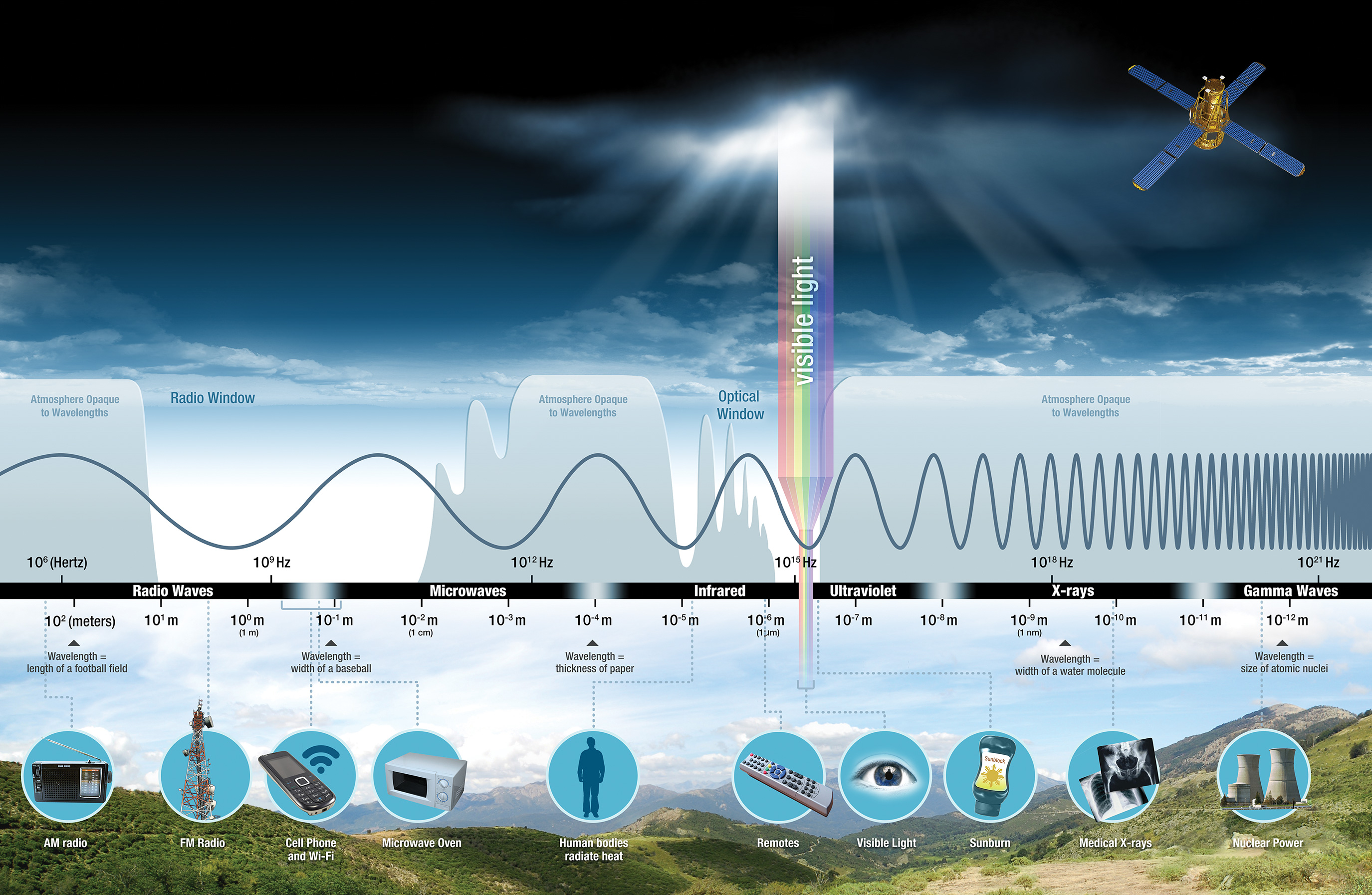
NASA has more than 20 Earth-observing satellites that give researchers a global perspective on the interconnected Earth system. Many of them measure light waves reflected, scattered, absorbed, or emitted by Earth’s surface, water and atmosphere. This light includes visible light, which humans see, as well as invisible ultraviolet and infrared wavelengths, and everything in between. Like musical instruments in an orchestra, the individual satellite instruments need to be “in tune” with each other in order for researchers to get the most out of their data. By using the Moon as a “tuning fork,” scientists can more easily compare data from different satellites to look at global changes over long periods of time.


Image above: This electromagnetic spectrum shows how energy travels in waves; Humans can only see visible light, but the entire spectrum is used by NASA instruments to observe Earth and more. Image Credit: NASA.

That’s where air-LUSI comes in. Developed in partnership with the National Institute of Standards and Technology (NIST), U.S. Geological Survey and McMaster University, air-LUSI is a telescope that measures how much light is reflected off the lunar surface to assess the amount of energy Earth-observing satellites receive from moonlight. It was mounted aboard the ER-2 aircraft managed by and flying out of NASA’s Armstrong Flight Research Center in Palmdale, California. The ER-2 is a high-altitude aircraft that flew at 70,000 feet, above 95% of the atmosphere, which can scatter or absorb the reflected sunlight. This allowed air-LUSI to collect very accurate, NIST traceable measurements that are analogous to those a satellite would make from orbit. In order to improve the accuracy of lunar reflectance models, air-LUSI measurements are accurate with less than 1% uncertainty. During the March flights, air-LUSI measured the Moon for four nights just before a full Moon.

This airborne approach has the advantage of studying moonlight during different phases of the Moon while being able to bring the instrument back between flights for evaluation, maintenance, and, if necessary, repair.

Making Improvements for Better Accuracy

The air-LUSI spectrometer is hermetically sealed within an enclosure that keeps the instrument constantly at sea level temperature and pressure. Light collected by a telescope enters an integrating sphere which directs the light to the spectrometer, which is an instrument that measures variances of light waves. The air-LUSI first flew in similar flights in November 2019. Since then, the air-LUSI team has continued to improve the instrument’s accuracy.  

The team improved the internal monitor so they can better check instrument accuracy over a greater range of wavelengths, from the ultraviolet to the near infrared. They were also able to redesign the integrating sphere to remove small effects of changing temperature.


Image above: Shown is the air-LUSI telescope positioned to measure a simulated Moon in a laboratory for testing and calibration before and after the flight campaign. Image Credit: Kevin Turpie.

“This will help the instrument make measurements with the more than 99% accuracy levels we’re looking for,” said Turpie.

Making these changes was challenging. Delays from the COVID-19 pandemic caused the chief engineer, who was working on the instrument updates and repairs, to develop a new remote work plan. Both he and the principal investigator received special permission to have parts delivered directly to their homes so they could work on the instrument and be prepared for the 2022 flights.

Using the Moon as a Common Standard

The data from 2019 and 2022 together has the potential to assist scientists in making Earth-observing satellite data in the ultraviolet to near-infrared range more consistent. In addition, the common Moon standard would make it easier to compare and fine-tune current and future satellite observations. NASA’s upcoming Plankton, Aerosol, Cloud, ocean Ecosystem (PACE) mission is planning on using the Moon as a common benchmark to make its observations more accurate and inter-consistent with other satellite measurements of Earth. Over the next decade, PACE and the future orbiting sensors of NASA’s Earth System Observatory will help create a more cohesive picture of our planet.

“Having a common calibration source outside of the Earth will help us reach this objective,” said Turpie. “Once air-LUSI measurements are used to improve the accuracy of the total amount of light coming from the Moon, we can take extensively more accurate measurements of Earth using current and future space-borne observatories.”

Related links:

National Institute of Standards and Technology (NIST): https://www.nist.gov/

U.S. Geological Survey: https://www.usgs.gov/

McMaster University: https://www.mcmaster.ca/

Plankton, Aerosol, Cloud, ocean Ecosystem (PACE): https://pace.gsfc.nasa.gov/

NASA’s Earth System Observatory: https://science.nasa.gov/earth-science/earth-system-observatory

Armstrong Flight Research Center: https://www.nasa.gov/centers/armstrong/home/index.html

Images (mentioned), Text, Credits: NASA/Ellen Gray/NASA's Earth Science News Team/By Abby Graf.

Greetings, Orbiter.ch

NASA Tries New Ways, Fluid Materials to Build Giant Space Telescopes


ISS - International Space Station emblem.


April 4, 2022

When it comes to telescopes, bigger is better. Larger telescopes collect more light and allow astronomers to peer farther into space and see distant objects in greater detail.


Image above: An illustration showing the final stage of a possible future giant telescope being created in space using fluids. Image Credits: Studio Ella Maru.

What if there was a way to make a telescope 10 times – or even 100 times – bigger than before? What started as a theoretical question is now a series of experiments to see if fluids can be used to create lenses in microgravity. The next experiment is stowed on the International Space Station National Laboratory waiting for the arrival of Axiom-1 astronauts to try it out, and is part of Ax-1 Mission Specialist Eytan Stibbe’s research portfolio.

It Starts with Fluids

All liquids have an elastic-like force that holds them together at their surface. This force is called surface tension. It's what allows some insects to glide across water without sinking and gives water droplets their shape. On Earth, when droplets of water are small enough (2 mm or smaller), surface tension overcomes gravity and they remain perfectly spherical. If a droplet grows much larger, it gets squished under its own weight.

But in space, blobs of water and other liquids (after wobbling about) eventually assume a perfect spherical shape.


Image above: NASA astronaut Karen Nyberg watches a water bubble float freely between her and the camera, showing her image refracted in the droplet. Image Credit: NASA.

Edward Balaban, principal investigator of the Fluidic Telescope Experiment, or FLUTE, at NASA's Ames Research Center in California's Silicon Valley teamed up with researchers at Ames, the agency's Goddard Space Flight Center in Greenbelt, Maryland, and Technion - Israel Institute of Technology, to explore whether it was possible to make high-precision lenses and mirrors in space using liquids.

"We thought, why not take advantage of the way liquids naturally behave in microgravity and apply it to the construction of large-scale telescopes or space-manufactured optical components that can have all kinds of uses," said Balaban. "In microgravity, liquids take on shapes that are useful for making lenses and mirrors, so if we make them in space, they could be used to build telescopes that are dramatically bigger than was previously thought possible."

Ground Tests: A Drop in the Bucket

Before taking their ideas to the skies, the team wanted to test their ideas on the ground.

"Liquids are useful not only for creating the lenses themselves, but also as a mechanism to eliminate the effect of gravity in an experiment on Earth," said Moran Bercovici, an associate professor of Mechanical Engineering at Technion.

"By injecting a liquid that can be solidified, into circular frames submerged in water, we were able to create lenses literally in a janitor’s bucket," said Dr. Valeri Frumkin, who developed the method in Bercovici's group. "Polymers, which are also used in nail salons to make acrylic nails or in adhesives like superglue, are a natural choice for lens material.  The trick is to make sure that the water has the exact same density as the polymer we're injecting so that the forces of buoyancy precisely oppose gravitational forces to simulate the conditions of weightlessness."

The resulting lenses have an outstanding surface quality comparable or even better than achievable with the best polishing methods, and they took only a tiny fraction of the time to construct.

“This method allows us to completely skip any mechanical processes such as grinding or polishing," said Bercovici. "The natural physics of fluids simply does all the work for us."

Next Up: Testing in Microgravity

In December 2021, the team tried out their ideas on two ZeroG parabolic flights. The flights provided 50 opportunities to achieve 15 to 20-second periods of microgravity – long enough for the team to form liquid lenses and capture data to analyze whether they achieved their goals.


Image above: FLUTE researchers capture data while they push synthetic oil into a circular frame (about the size of a dollar coin), momentarily forming a liquid lens during a 15 to 20-second period of microgravity on a ZeroG parabolic flight. Image Credits: Technion - Israel Institute of Technology.

During the flight researchers used pumps to push synthetic oil into a circular frame (about the size of a dollar coin), letting the liquid fill the gap and momentarily achieve the desired shape. The oils are similar to automotive oil, with different levels of viscosities – or goopiness – to try out which works better.

"Sure enough, in a few seconds we were able to create a free-standing liquid lens – until the plane lifted upwards again and gravity kicked in and the oils oozed out," said

Bercovici. "Our experiment on the space station will add a step to cure the fluids so they keep their shape."

Using a laser to take ultra-fast and ultra-exact measurements, they were able to see the precise moment the liquid took shape.

With the first round of parabolic flights successfully behind them, the team eagerly awaits their experiment aboard the orbiting laboratory. Ax-1 crew member Eytan Stibbe will perform the experiment and former NASA astronaut and Ax-1 commander Michael Lopez-Alegria will serve as his backup. The experiment will take place entirely in microgravity, again using liquid polymers (like the hardened lenses made in the lab at Technion) and will use either UV light or temperature to harden them in-orbit. The lenses will then return to Earth where researchers at Ames will study them.

Moving Water in Space

Video above: Water in space behaves… differently. Video Credits: NASA.

"We expect this approach will create perfectly shaped and smooth surfaces: the best surfaces to turn into mirrors," said Vivek Dwivedi, a FLUTE scientist at Goddard and expert in atomic layer deposition technology that could be used to make ultra-precise telescope mirrors in space.

"If our station experiment is successful, it will be the first time an optical component is made in space," said Balaban. "It feels a bit like making history."

The space station experiment is part of the The Ramon Foundation's Rakia Mission, and is supported by The Israeli Space Agency and the Israeli Ministry of Innovation, Science and Technology. NASA's Space Technology Mission Directorate supports FLUTE through the Center Innovation Fund and the Flight Opportunities Program. FLUTE's test aboard the space station is sponsored by the International Space Station National Laboratory.

Related links:

Center Innovation Fund: https://www.nasa.gov/directorates/spacetech/innovation_fund/index.html

Flight Opportunities Program: https://www.nasa.gov/directorates/spacetech/flightopportunities/index.html

Space Station Research and Technology: https://www.nasa.gov/mission_pages/station/research/overview.html

International Space Station (ISS): https://www.nasa.gov/mission_pages/station/main/index.html

Images (mentioned), Video (mentioned), Text, Credits: NASA/Rachel Hoover.

Best regards, Orbiter.ch

Roscosmos to halt cooperation over International Space Station


ROSCOSMOS logo.


April 4, 2022

Director of space agency Roscosmos says partnership will be restored only when ‘illegal sanctions’ are removed

Russia says it will end cooperation with western countries over the International Space Station until sanctions are lifted.

Russia’s space director said on Saturday that the restoration of normal ties between partners at the ISS and other joint space projects would be possible only once western sanctions against Moscow were lifted.


Image above: The International Space Station is pictured from the SpaceX Crew Dragon Endeavour during a fly around of the orbiting lab that took place following its undocking from the Harmony module’s space-facing port on Nov. 8, 2021. Image Credit: NASA.

Dmitry Rogozin, the head of Roscosmos, said in a social media post that the aim of the sanctions was to “kill Russian economy and plunge our people into despair and hunger, to get our country on its knees”. He added that they “won’t succeed in it, but the intentions are clear”.

“That’s why I believe that the restoration of normal relations between the partners at the International Space Station (ISS) and other projects is possible only with full and unconditional removal of illegal sanctions,” Rogozin said.

Rogozin said Roscosmos proposals on when to end cooperation over the ISS with space agencies of the US, Canada, the EU and Japan would soon be reported to Russian authorities. He has previously said that the sanctions could “destroy” the US-Russian partnership on the ISS.

The west has introduced sweeping sanctions against Russia over what Moscow calls a “special military operation” in Ukraine, launched on 24 February.

Despite the tensions, a US astronaut and two Russian cosmonauts safely landed in Kazakhstan on Wednesday after leaving the space station aboard a Russian Soyuz capsule.

The European Space Agency said last month it was suspending cooperation with Roscosmos over the ExoMars rover mission to search for signs of life on the surface of Mars.

The British satellite venture OneWeb said last month it had contracted with Elon Musk’s SpaceX to send its satellites into orbit after calling off a 4 March launch of 36 satellites from Russia’s Baikonur Cosmodrome in Kazakhstan because of last-minute demands imposed on it by Moscow.

Editor's Note:

We are starting to get used to the gesticulations and meaningless threats of Mr. Rogozin, in fact he cannot do anything, because it is an International Space Station (ISS), therefore several countries which decide its fate, and that even if Russia withdrew from this program, which again will not be the case because as proof Roscosmos has sent three cosmonauts there who will stay there for six months with another cosmonaut already on board. Western sanctions do not affect the civil space domain. So my advice: that Mr. Rogozin recycles himself as a professional poker player because it is only for bluffing that he is good, because at the level of its management of Roscosmos it only precipitates the first space agency in the world towards its end, dint of forgetting the principles of the space truce, ie doing space exploration and science, not politics. Roland Berga.

Related link:

International Space Station (ISS): https://www.nasa.gov/mission_pages/station/main/index.html

Image (mentioned), Text, Credits: The Guardian/Orbiter.ch Aerospace/Roland Berga.

Greetings, Orbiter.ch

Artemis I WDR Update: Go to Proceed for Tanking – Countdown Resumes


NASA - Artemis Exploration Mission 1 patch.


April 4, 2022

The countdown for the wet dress rehearsal has resumed at 10:52 a.m. EDT and clocks have picked back up at T-6 hours, 40 minutes on the clock (L-7 hours, 10 minutes). A new planned T-0 of 6:02 p.m. has been established.


Image above: NASA’s Space Launch System (SLS) rocket with the Orion spacecraft aboard is seen at sunrise atop a mobile launcher at Launch Complex 39B, Monday, April 4, 2022. Image Credits: NASA/Joel Kowsky.

An earlier issue with an outage with the vendor of gaseous nitrogen required for tanking preparations has been resolved. Overnight, teams also resolved the issue with the malfunction of the fans used to provide positive pressure to enclosed areas in the mobile launcher and keep out hazardous gases, and they have a plan for operating the fans to prevent issues from reoccurring. The team was able to successfully bring up and run the primary fan through the night to provide confidence, and has configured the secondary fan to run at 80% capacity to support tanking operations.

At approximately 10 a.m. EDT, the launch director gave the “go” to begin tanking the rocket. Cryogenic loading operations are scheduled to begin with chilling down the liquid oxygen lines for the core stage. Once propellant loading operations begin, liquid oxygen (LOX) and liquid hydrogen (LH2) will flow into the into the rocket’s core stage and interim cryogenic propulsion stage tanks and be topped off and replenished as some of cryogenic propellant boils off. The team will also conduct leak checks to ensure propellant loading is proceeding as expected.

Related articles:

NASA ‘Go’ for Artemis I Wet Dress Rehearsal
https://orbiterchspacenews.blogspot.com/2022/03/nasa-go-for-artemis-i-wet-dress.html

Standing tall: Moon rocket milestone for Artemis
https://orbiterchspacenews.blogspot.com/2022/03/standing-tall-moon-rocket-milestone-for.html

NASA Readies Rocket for Artemis I Wet Dress Rehearsal
https://orbiterchspacenews.blogspot.com/2022/03/nasa-readies-rocket-for-artemis-i-wet.html

Related links:

Space Launch System (SLS): https://www.nasa.gov/exploration/systems/sls/index.html

Orion spacecraft: https://www.nasa.gov/exploration/systems/orion/index.html

Artemis I: https://www.nasa.gov/artemis-1

Image (mentioned), Text, Credit: NASA.

Best regards, Orbiter.ch