lundi 13 mars 2023

Study Finds Ocean Currents May Affect Rotation of Europa’s Icy Crust


NASA - Europa Clipper Mission patch.


Mar 13, 2023

Research reveals a new explanation for how the icy shell of Jupiter’s moon Europa rotates at a different rate than its interior. NASA’s Europa Clipper will take a closer look.

Image above: This view of Jupiter’s icy moon Europa was captured by the JunoCam imager aboard NASA’s Juno spacecraft during the mission’s close flyby on Sept. 29, 2022. The agency’s Europa Clipper spacecraft will explore the moon when it reaches orbit around Jupiter in 2030. Image Credits: NASA/JPL-Caltech/SwRI/MSSS.

NASA scientists have strong evidence that Jupiter’s moon Europa has an internal ocean under its icy outer shell – an enormous body of salty water swirling around the moon’s rocky interior. New computer modeling suggests the water may actually be pushing the ice shell along, possibly speeding up and slowing down the rotation of the moon’s icy shell over time.

Scientists have known that Europa’s shell is probably free-floating, rotating at a different rate than the ocean below and the rocky interior. The new modeling is the first to show that Europa’s ocean currents could be contributing to the rotation of its icy shell.

A key element of the study involved calculating drag – the horizontal force that the moon’s ocean exerts on the ice above it. The research hints at how the power of the ocean flow and its drag against the ice layer could even account for some of the geology seen on Europa’s surface. Cracks and ridges could result from the icy shell slowly stretching and collapsing over time as it is pushed and tugged by the ocean currents.

“Before this, it was known through laboratory experiments and modeling that heating and cooling of Europa’s ocean may drive currents,” said Hamish Hay, a researcher at the University of Oxford and lead author of the study published in JGR: Planets. Hay performed the research while a postdoctoral research associate at NASA’s Jet Propulsion Laboratory in Southern California. “Now our results highlight a coupling between the ocean and the rotation of the icy shell that was never previously considered.”

Europa Clipper spacecraft. Image Credits: NASA/JPL

It might even be possible, using measurements gathered by NASA’s upcoming Europa Clipper mission, to determine with precision how fast the icy shell rotates. When scientists compare images gathered by Europa Clipper with those captured in the past by NASA’s Galileo and Voyager missions, they will be able to examine locations of ice surface features and potentially determine if the position of the moon’s icy shell has changed over time.

For decades, planetary scientists have debated whether Europa’s icy shell might be rotating faster than the deep interior. But rather than tying it to the ocean’s movement, scientists focused on an outside force: Jupiter. They theorized that as the gas giant’s gravity pulls on Europa, it also tugs on the moon’s shell and causes it to spin slightly faster.

“To me, it was completely unexpected that what happens in the ocean’s circulation could be enough to affect the icy shell. That was a huge surprise,” said co-author and Europa Clipper Project Scientist Robert Pappalardo of JPL. “And the idea that the cracks and ridges we see on Europa’s surface could be tied to the circulation of the ocean below – geologists don’t usually think, ‘Maybe it’s the ocean doing that.’”

Europa Clipper, now in its assembly, test, and launch operations phase at JPL, is set to launch in 2024. The spacecraft will begin orbiting Jupiter in 2030, and will use its suite of sophisticated instruments to gather science data as it flies by the moon about 50 times. The mission aims to determine if Europa, with its deep internal ocean, has conditions that could be suitable for life.

Like a Pot of Water

Using techniques developed to study Earth’s ocean, the paper’s authors relied on NASA supercomputers to make large-scale models of Europa’s ocean. They explored the complexities of how the water circulates, and how heating and cooling affects that movement.

Scientists believe that Europa’s internal ocean is heated from below, due to radioactive decay and tidal heating within the moon’s rocky core. Like water heating in a pot on a stove, Europa’s warm water rises to the top of the ocean.

In the simulations, the circulation initially moved vertically, but the rotation of the moon as a whole caused the flowing water to veer in a more horizontal direction – in east-west and west-east currents. The researchers, by including drag in their simulations, were able to determine that if the currents are fast enough, there could be adequate drag on the ice above to speed up or slow down the shell’s rotation speed. The amount of interior heating – and thus, circulation patterns in the ocean – may change over time, potentially speeding up or slowing rotation of the icy shell above.

“The work could be important in understanding how other ocean worlds’ rotation speeds may have changed over time,” Hay said. “And now that we know about the potential coupling of interior oceans with the surfaces of these bodies, we may learn more about their geological histories as well as Europa’s.”

More About the Mission

Europa Clipper’s main science goal is to determine whether there are places below the surface of Jupiter’s icy moon, Europa, that could support life. The mission’s three main science objectives are to understand the nature of the ice shell and the ocean beneath it, along with their composition and geology. The mission’s detailed exploration of Europa will help scientists better understand the astrobiological potential for habitable worlds beyond our planet.

Managed by Caltech in Pasadena, California, JPL leads the development of the Europa Clipper mission in partnership with the Johns Hopkins Applied Physics Laboratory (APL) in Laurel, Maryland, for NASA’s Science Mission Directorate in Washington. APL designed the main spacecraft body in collaboration with JPL and NASA’s Goddard Space Flight Center in Greenbelt, Maryland. The Planetary Missions Program Office at NASA’s Marshall Space Flight Center in Huntsville, Alabama, executes program management of the Europa Clipper mission.

More information about Europa can be found here: https://europa.nasa.gov/

Related links:

JGR: Planets: https://agupubs.onlinelibrary.wiley.com/doi/full/10.1029/2022JE007648

NASA supercomputers: https://www.nas.nasa.gov/aboutnas/about.html

Europa (Moon): https://www.nasa.gov/subject/3148/europa-moon

Jet Propulsion Laboratory (JPL): https://www.nasa.gov/centers/jpl/home/index.html

Images (mentioned), Text, Credits: NASA/Naomi Hartono/Karen Fox/Alana Johnson/JPL/Gretchen McCartney.

Greetings, Orbiter.ch

Room-Temperature Superconductor Discovery Meets With Resistance


Physics logo.


March 13, 2023

A paper in Nature reports the discovery of a superconductor that operates at room temperatures and near-room pressures. The claim has divided the research community.
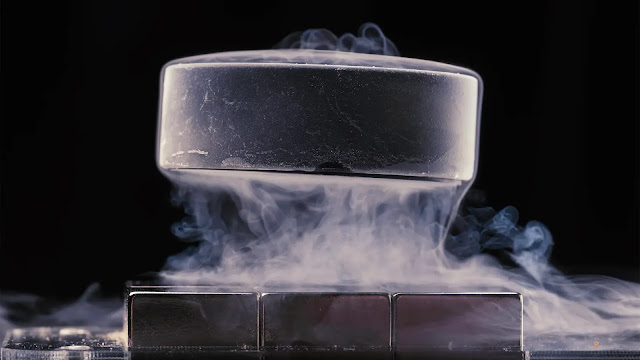
Image above: One hallmark of superconductivity is the Meissner effect, which expels all magnetic fields from a material — a property that allows a superconductor to levitate, as seen here. The researchers claim to observe the Meissner effect in their new material. Image Credits: J. Adam Fenster/University of Rochester.

In a packed talk on Tuesday afternoon at the American Physical Society’s annual March meeting in Las Vegas, Ranga Dias, a physicist at the University of Rochester, announced that he and his team had achieved a century-old dream of the field: a superconductor that works at room temperature and near-room pressure. Interest was so intense in the presentation that security personnel stopped entry to the overflowing room more than fifteen minutes before the talk. They could be overheard shooing curious onlookers away shortly before Dias began speaking.

The results, published today in Nature, appear to show that a conventional conductor — a solid composed of hydrogen, nitrogen and the rare-earth metal lutetium — was transformed into a flawless material capable of conducting electricity with perfect efficiency.

While the announcement has been greeted with enthusiasm by some scientists, others are far more cautious, pointing to the research group’s controversial history of alleged research malfeasance. (Dias strongly denies the accusations.) Reactions by 10 independent experts contacted by Quanta ranged from unbridled excitement to outright dismissal, with many of the experts expressing some version of cautious optimism.

Previously, superconductivity has been observed only at frigid temperatures or crushing pressures — conditions that make those materials impractical for long-desired applications such as lossless power lines, levitating high-speed trains and affordable medical imaging devices. The newly forged compound conducts current with no resistance at 21 degrees Celsius (69.8 degrees Fahrenheit) and at a pressure of around 1 gigapascal. That’s still a lot of pressure — roughly 10 times the pressure at the deepest point in the Marianas Trench — but it’s more than 100 times less intense than the pressure required in previous experiments with similar materials.

“If it turns out to be correct, it’s possibly the biggest breakthrough in the history of superconductivity,” said James Hamlin, a physicist at the University of Florida who was not involved in the work. If it’s true, he said, “it’s an earth-shattering, groundbreaking, very exciting discovery.” But incidents involving the team’s previous work — including but not limited to a near-room-temperature superconductivity claim published in Nature in 2020 and retracted late last year — have cast a shadow across today’s announcement. “It’s hard to not wonder if some of the same problems that have gone unaddressed in previous work also exist in the new work,” Hamlin said.

Hitting All the Benchmarks

For more than a century, scientists have known that cooling most metals to temperatures within a few degrees of absolute zero brings about a dramatic metamorphosis. Around this “critical temperature,” which varies from one material to another, electrons pair up and form a type of quantum fluid. Once this happens, electrons no longer bounce into atoms in the material — interactions that generate resistance — which allows them to flow with no energy loss.

The overarching goal of superconductivity research since then has been to raise the critical temperature.

For decades, physicists have made incremental progress, steadily raising the critical temperature by testing different combinations of elements. One promising class of materials, known as hydrides, emerged in recent years. Hydrides are compounds that combine the featherweight hydrogen with heavier atoms like sulfur or metals. The more hydrogen, the better for superconductivity, physicists believe. Researchers sometimes add in a dusting of other atoms, such as carbon or nitrogen, to further tweak its properties. The first superconducting hydride, reported in 2015, hit its transition at around minus 70 degrees Celsius and 155 gigapascals of pressure (approaching half that of Earth’s core). Within three years, the same group and another both whipped up even more hydrogen-rich “superhydride” materials that could superconduct as high as minus 13 degrees Celsius and at 190 gigapascals.

Image above: The rare-earth metal lutetium was transformed into a room-temperature superconductor in the new research. Image Credit: Lu Yago/Shutterstock.

The new study demolishes all past records. For the past few years, Dias’ team has worked on a superhydride based on lutetium. To produce a sample, the team would bathe a thin film of lutetium in a perfume of 99% hydrogen and 1% nitrogen while baking it for a few days at 200 degrees Celsius. A diamond anvil cell would then compress the sample at 2 gigapascals of pressure. The team would then progressively loosen the anvil while testing the sample for superconducting properties. Dias said that out of hundreds of samples produced, they were able to observe superconductivity in dozens of samples even after the pressure was lowered to about 1 gigapascal.

To demonstrate superconductivity, the team hit three textbook benchmarks. At the critical temperature, they showed a drop in resistance and a peak in a property related to how readily a material warms up. The team also managed to directly measure the expulsion of a magnetic field from the samples — an unambiguous signature for superconductivity called the Meissner effect that has never before been convincingly demonstrated in a superhydride. Curiously, the sample also shifted in color from blue to pink to red in sync with its phase changes.

The paper’s plots are exactly what researchers look for when they test for superconductivity. The strong evidence thrills many scientists who have spent decades searching for materials that can bring the phenomenon closer to everyday conditions.

“I am really excited to see the result. And I don’t in any way doubt that what they’re observing is what it is,” said Siddharth Saxena, a physicist at the University of Cambridge who was not involved in the new work. Eva Zurek, a theoretical chemist at the University at Buffalo who often communicates with the Rochester group but who was also not involved in the research, said that a material that superconducts under these conditions “would impact every aspect of our life in ways we cannot imagine.” Hamlin agrees that the demonstration “is a tour de force of every kind of measurement you would want to see on this material, producing exactly the type of data you would hope to see.”

A Troubled History

Yet Hamlin and other researchers insist that the group’s past requires that today’s historic claims be met with historic levels of scrutiny.

“There is a lot of evidence for superconductivity here if you take it at face value,” said Jorge Hirsch, a physicist at the University of California, San Diego. “But I do not believe any of what these authors say. I am not sold at all.”

Hirsch said his mistrust stems from a long history of allegations of research malfeasance made against previous and current members of the group, many of which he has pressed. Most recently, in 2020 Dias and his co-authors published a study of a carbonaceous sulfur hydride (CSH) that hit its critical transition at around 14 degrees Celsius (57.2 degrees Fahrenheit) and 267 gigapascals. Almost immediately, a handful of experts spotted unusual patterns in the data used to verify the material’s response to magnetic fields. When Dias and his frequent collaborator, Ashkan Salamat, a physicist at the University of Nevada, Las Vegas released their raw data a year later in the form of a 149-page document, they detailed an unusual and complicated method for eliminating background magnetic interference — one they said was necessary for them to detect the tiny magnetic field rejected by the small sample. This method was inconsistent with how they’d described the procedure in the original paper, which led Nature to issue a retraction last September.

Hirsch and other physicists allege that the misconduct goes beyond a misleading mix-up regarding the magnetic background. In September, Hirsch and Dirk van der Marel, a professor emeritus at the University of Geneva, published a claim that what Dias and Salamat had released as raw CSH data was actually derived from the published data. “[We] proved basically mathematically that the raw data are not measured in the laboratory; they are fabricated,” Hirsch said. Hamlin independently released a preprint last October claiming that the electrical resistivity data also appeared to have been processed in an undisclosed manner — a new allegation atop the issue that led to the 2022 retraction.

Image above: Ranga Dias in his laboratory at the University of Rochester. Image Credits: J. Adam Fenster/University of Rochester.

Dias defends his work vigorously. In the months since the retraction, Dias has conducted additional experiments on the CSH material at Argonne and Brookhaven National Laboratories. In these, he invited independent scientists to observe the material’s superconducting transition. He recently submitted a new manuscript to Nature that repeats the claim of high-temperature superconductivity in CSH with rigor he insists will dispel past allegations.

“The witnesses to our work attested to our discovery. We have demonstrated CSH works to achieve superconductivity, as does ‘reddmatter,’” Dias said, referring to the group’s informal, Star Trek–inspired name for the new lutetium-based material. “You can either believe the evidence or not — but you can’t ignore it.”

Nilesh Salke, a physicist at the University of Illinois, Chicago who assisted with the new measurements and was not involved in the 2020 research, said that “the new work confirms the superconductivity in CSH.” He called the discovery of the new lutetium material “remarkable,” adding that it’s “an important milestone in the field of superconductivity.”

Yet the CSH paper isn’t the only related work under fire. One co-author of the CSH paper, Mathew Debessai, was the first author on a 2009 study claiming superconductivity in a third material, europium, which was later retracted for presenting altered data. (Dias was not a co-author of this paper.) Hirsch asserts that in that publication, “the data are copied and pasted into another region.” Others have also argued that some of the data in another of Dias’ recent papers was duplicated from data taken while the team was studying a completely different substance.

"I am really excited to see the result. And I don’t in any way doubt that what they’re observing is what it is."

Dias strongly denies all allegations of wrongdoing and continues to make efforts to rigorously establish his claims of finding superconductivity at everyday temperatures and what counts as almost-everyday pressures in the high-pressure physics community. He stresses that today’s paper describing low-pressure superconductivity in the lutetium material underwent an unusually rigorous peer review process involving multiple rounds of review over the better part of a year. Dias also said that he shared all of his raw data with Nature, and that it will be published alongside the new result. Multiple independent experts voiced confidence in Nature’s ability to make sure that the result was as rigorous as possible.

“I am pretty sure the Nature editor and reviewers must have grilled them before giving a green signal,” Salke said.

“For me, it is difficult to imagine a second retraction,” said Mikhail Eremets, a physicist at the Max Planck Institute for Chemistry in Germany who led the discovery of hydride superconductors. “We should consider it seriously in spite of the prehistory.”

Dias emphasized that he and his colleagues have been completely transparent during an extraordinarily thorough review process. “This time we gave everything,” he said. “All the techniques and everything. Reviewers had access to all the data.”

The remarkable review process, when layered over an uncertain history, has left some researchers in limbo. “I don’t know anymore what I can believe,” van der Marel said. “That’s the whole problem.”

Confirmation and Commerce

Ultimately, acceptance by the wider community of researchers will lie in the hands of other labs. Will they be able to reproduce the material and confirm its superconducting properties? There are reasons to hope that an answer will come relatively quickly.

While there are only a handful of groups in the world who could work with the incredibly high diamond-anvil pressures needed to see superconductivity in CSH, there are dozens of labs that can work in the lower-pressure regime of the lutetium-based material, Hamlin said. Dias said that in the past few months, his lab has been working on a way to remove the diamond anvil cells from the process entirely, which could further speed efforts to confirm the finding.

To allow other labs to faithfully reproduce the results, the group must be willing to share their entire raw data set along with detailed sample-preparation methods, or to send samples of their material to other labs to test, said Hamlin.

However, outside access may fall short of the community’s hopes. Dias and Salamat have founded a startup, Unearthly Materials, which, Dias said, has already raised over $20 million in funding from investors including the CEOs of Spotify and OpenAI.* They’ve also recently applied for a patent on the lutetium hydride material, which would deter them from mailing out samples. “We have clear, detailed instructions on how to make our samples,” Dias said. “We are not going to distribute this material, considering the proprietary nature of our processes and the intellectual property rights that exist.” He suggested that “certain methodologies and processes” are also off the table.

“Without breaking any IP laws, we’re happy to share what we did,” Dias said. “There are some limitations as well, but I think we can work out something.”

Editor’s note:

In a 2021 talk organized by the Sri Lanka Association for the Advancement of Science and later posted to YouTube, Dias said “We recently raised $20 million just to, you know, focus on the science part of this. And these are the investors that we used for this kind of technology.” At that moment (43:25 in the video) a list of names appears on the screen. Under the category labeled “Investors (Series A),” the names include Sam Altman, CEO of OpenAI, and Daniel Ek, co-founder and CEO of Spotify. Following the publication of this article, a representative for Dias told Quanta that those were “aspirational statements,” that the company had not raised the money, and that the names listed were prospective investors.

Related links:

University of Rochester: https://www.rochester.edu/

Nature: https://www.nature.com/articles/s41586-023-05742-0

University of Geneva: https://www.unige.ch/en/

University of Geneva published a claim: https://www.worldscientific.com/doi/abs/10.1142/S0217979223750012

Images (mentioned), Text, Credits: QuantaMagazine/Charlie Wood/Zack Savitsky.

Best regards, Orbiter.ch

Europe’s Mars exploration


ESA - ExoMars Missions logo.


March 13, 2023

The Red Planet has always been on the horizon for space exploration.

Terrae Novae destinations: Mars

Europe’s first Mars mission, Mars Express,  was driven by science – scientists set the requirements to get the best data for planetary research. Europe’s ExoMars programme has always had the ambition to marry exploration with science.

Fifteen years imaging the Red Planet

ESA’s vision is to send Europeans to Mars by 2040. Europe has renewed ambitions to prepare for the first human mission to Mars, using robots as precursors and scouts, in an independent and sustainable manner.  

ESA is a key international partner in Mars robotic exploration. While partnerships remain a fundamental part of the roadmap to autonomy, ESA wants to lead Europe’s journey into the Solar System and to return the benefits of exploration back to society.

Europe goes to Mars

ESA already has expertise in orbiting the Red Planet with Mars Express and the ExoMars Trace Gas Orbiter, or TGO, which is producing the most detailed inventory of atmospheric gases from Mars orbit since 2016. TGO also provides data relay services essential to transmit science and operational data and commands from/to the surface of Mars.

The Rosalind Franklin rover is facing a rebirth with a redefined mission to address the question of whether life existed or is still present on Mars. A new launch date in 2028 serves as a trigger for more autonomy, allowing ESA to invest in European industry to master the technologies needed for the journey.

ExoMars Rosalind Franklin rover

In parallel, ESA has a strategic partnership with NASA to bring samples to Earth for detailed analysis in sophisticated laboratories. The joint Mars Sample Return (MSR) campaign will revolutionise our understanding of the Red Planet by returning scientifically-selected samples for study. This fully robotic technology demonstration will prepare Europe for sending humans to Mars.

Rosalind Franklin Mission

A new Rosalind Franklin Mission includes a European lander to bring the rover to the surface of Mars. The rover will search for evidence of past life on Mars thanks to its drill and scientific instruments.

Rosalind Franklin will be the first rover to drill two metres below the surface, acquiring samples that have been protected from surface radiation and extreme temperatures. The drill will retrieve soils from ancient parts of Mars and analyse them in situ with its onboard laboratory.

Deep drilling for Mars

The mission will also serve to demonstrate key technologies that Europe needs for future planetary exploration missions. This includes the capability to land safely on a planet, to move autonomously on the surface, and to perform drilling and sample processing and analysis automatically. The rover will use novel driving techniques, including wheel-walking to overcome difficult terrains.

The design of a new European lander will reuse significant parts of the European-developed flight equipment from the previous Russian lander, such as parachutes, computer and the landing radar system.

ExoMars rover: front view

While those items remain the same, other parts – the Entry Descent and Landing Module, its aeroshell, the landing platform, and the rover egress system – will be redesigned and built by European industry.

“The newly shaped Rosalind Franklin Mission will recover one of the original objectives of ExoMars – to create an independent European capability to access the surface of Mars with a large and sophisticated robotic payload. There is an exciting opportunity ahead for European industry,” says David Parker, ESA’s Director of Human and Robotic Exploration.

Mars Sample Return

Mars Sample Return is an integral part of ESA’s exploration programme, and will be the first to return samples from another planet.

The campaign is made up of several missions. The first phase is in progress: NASA’s Mars2020 Perseverance rover landed successfully on the Red Planet in 2021 and began gathering samples in an ancient river delta for potential return. The samples will help reveal the early evolution of Mars, including the potential for life.

Bringing Mars rock samples back to Earth

Europe is providing the Sample Transfer Arm and the Earth Return Orbiter.

A European 2.5 metre-long robot will pick up tubes filled with precious soil from Mars and transfer them to a rocket for an historic interplanetary delivery. Able to “see”, “feel” and take autonomous decisions, its high level of dexterity allows the Sample Transfer Arm to extract the tubes from the rover, pick them up from the martian ground, insert them into a container and close the lid before lifting-off from Mars.

Earth Return Orbiter infographic

ESA’s Earth Return Orbiter will rendezvous with the container filled with martian samples and bring the material back to Earth at speeds higher than ever before. It will be the first spacecraft to make a round-trip to another planet, paving the way for a human journey.

Several European scientists are already part of the science team to advise on the sample selection for return and to prepare for the analyses once they are back on Earth.

The campaign is the result of decades of experience, and the latest in a series of increasingly complex missions to advance science and exploration beyond Earth.

Related article:

Earth orbit, Moon, Mars: ESA’s ambitious roadmap
https://orbiterchspacenews.blogspot.com/2022/07/earth-orbit-moon-mars-esas-ambitious.html

Related links:

Mars Express: https://www.esa.int/Science_Exploration/Space_Science/Mars_Express

ExoMars: https://www.esa.int/Science_Exploration/Human_and_Robotic_Exploration/Exploration/ExoMars

ExoMars Trace Gas Orbiter (TGO): https://exploration.esa.int/web/mars/-/46475-trace-gas-orbiter

Mars Sample Return (MSR): https://www.esa.int/Science_Exploration/Human_and_Robotic_Exploration/Exploration/Mars_sample_return

Sample Transfer Arm: https://www.esa.int/Science_Exploration/Human_and_Robotic_Exploration/A_helping_hand_for_Mars

Earth Return Orbiter: https://www.esa.int/ESA_Multimedia/Images/2019/08/Mars_Sample_Return_Earth_Return_Orbiter_elements

European scientists: https://blogs.esa.int/to-mars-and-back/2022/04/07/calling-all-martian-scientists/

Images, Videos, Text, Credits: ESA/Olivier Pâques/S. Corvaja/ATG medialab/Mlabspace.

Greetings, Orbiter.ch

NASA study assess costs and benefits of orbital debris removal


NASA’s Office of Technology logo.


March 13, 2023

A NASA study concluded that some methods of removing orbital debris could pay for themselves within a decade by reducing the costs and risks borne by satellite operators.

Image above: An illustration of objects and space debris in Earth orbit. Image Credits: ESA/ID&Sense/ONiRiXEL, CC BY-SA 3.0 IGO.

The study, released March 10 by NASA’s Office of Technology, Policy and Strategy, examined the costs of several approaches to removing both large and small debris and the benefits they offered to satellite operators by reducing the number of avoidance maneuvers and losses of satellites damaged or destroyed by debris collisions.

NASA billed the report as the most rigorous cost-benefit analysis to date of orbital debris remediation, noting that debris removal analyses had largely focused on emphasizing sustainability and “moral responsibility” for doing so. “Given the substantial upfront expenditures required to develop and deploy remediation capabilities and the potential delay in receiving benefits, these motivations do not appear to be sufficient to incentivize immediate action,” the report stated.

The analysis, which looked at both the cost of establishing various approaches to removing debris as well as the costs incurred by satellite operators from debris, found the most effective approaches involved ground- and space-based lasers to remove large amounts of small debris between 1 and 10 centimeters across. Both laser systems would create benefits that exceed their costs within a decade.

The other effective approaches involved “just-in-time collision avoidance” involving the largest debris objects, using rockets or lasers to nudge such debris to avoid collisions with satellites or other debris. Such approaches could have net benefits almost immediately, or no more than a few decades in a worst-case assessment.

Other approaches included in the study could take much longer to realize a net benefit. Reentry of larger debris objects could break even in as little as 20 to 25 years, but in worst-case scenarios might take close to a century to yield benefits. The study found similar timeframes for “sweeper” spacecraft that would physically remove small debris. It also examined recycling debris by turning it into propellant, but found breakeven times of a few decades, in part because of large upfront research and development costs for the technology.

Space debris 1963-2013. Animation Credit: ESA

The report acknowledged one problem with using lasers to remove debris is the perception that such systems could also be used as weapons. The study concluded that the power of debris-removal lasers would be too low, by a factor of 1,000, to be effective as a weapon against active satellites, “though perceptions may be harder to navigate.”

One interesting finding of the report is the relatively small costs that debris imposes on satellite operators today. The model NASA developed for the report, which was limited to U.S. operators, estimated annual costs on such operators of only $58 million a year, a figure dominated by military as well as civil operational satellites, like Landsat and polar-orbiting weather satellites.

“We found that most satellite operators do not incur much cost from conjunction assessments or collision avoidance maneuvers,” said Bhavya Lal, NASA associate administrator for technology, policy and strategy, in a speech at the American Astronautical Society’s Goddard Memorial Symposium March 10 that coincided with the release of the report. “The key takeaway here is that the risk to satellite operators need not increase at the same rate as orbital debris increases.”

That didn’t mean, though, that remediation approaches like those NASA studies should not be considered, she argued. “Conventional wisdom has been that prevention is more valuable than cure, that debris mitigation is more critical than remediation,” she said, but warned those efforts to mitigate the creation of new debris will likely see diminishing returns in the coming decades.

‘The challenge is to assess the effectiveness of mitigation, tracking, characterization and remediation in a way that enables apples-to-apples comparisons among risk reduction technologies,” she said. “With such information, we can understand the most effective portfolio of risk reduction.”

Lal said that NASA planned to organize a roundtable among various stakeholders to get feedback on the study before starting a second phase that will improve the model and incorporate even smaller debris.

Related articles:

The Progress spacecraft took the ISS away from space debris
https://orbiterchspacenews.blogspot.com/2023/03/the-progress-spacecraft-took-iss-away.html

Russian satellite breaks up in orbit, generating cloud of debris
https://orbiterchspacenews.blogspot.com/2023/02/russian-satellite-breaks-up-in-orbit.html

Two big pieces of space junk nearly collide in orbital 'bad neighborhood'
https://orbiterchspacenews.blogspot.com/2023/01/two-big-pieces-of-space-junk-nearly.html

Russia to launch mission to rescue stranded ISS crew after meteoroid strike
https://orbiterchspacenews.blogspot.com/2023/01/russia-to-launch-mission-to-rescue.html

The current state of space debris
https://orbiterchspacenews.blogspot.com/2020/10/the-current-state-of-space-debris.html

The cost of space debris
https://orbiterchspacenews.blogspot.com/2020/05/the-cost-of-space-debris.html

CleanSat: new satellite technologies for cleaner low orbits
https://orbiterchspacenews.blogspot.com/2015/01/cleansat-new-satellite-technologies-for.html

The number of space debris reached a "critical point"
https://orbiterchspacenews.blogspot.com/2011/09/number-of-space-debris-reached-critical.html

Related links:

Cost and Benefit Analysis of Orbital Debris Remediation: https://www.nasa.gov/sites/default/files/atoms/files/otps_-_cost_and_benefit_analysis_of_orbital_debris_remediation_-_final.pdf

Low-Earth Orbit Economy: https://www.nasa.gov/leo-economy/low-earth-orbit-economy

NASA’s Office of Technology: https://www.nasa.gov/offices/otps/home/index.html

Image (mentioned), Animation (mentioned), Text, Credits: NASA/Loura Hall/SpaceNews/Jeff Foust.

Best regards, Orbiter.ch

CASC - Long March-2C launches Horus-2


CASC - Long March-2C / Horus-2 (荷鲁斯2) patch.


March 13, 2023

Long March-2C carrying Horus-2 liftoff

A Long March-2C launch vehicle launched the Horus-2 (荷鲁斯2) satellite from the Jiuquan Satellite Launch Center, Gansu Province, China, on 13 March 2023, at 04:02 UTC (12:02 local time).

Long March-2C launches Horus-2

According to official sources, the Egyptian remote sensing satellite “entered into the predetermined orbit successfully”.

Egypt official statement

The CEO of the Egyptian Space Agency (EgSA), Sherif Sedky, said Monday that a “Horus-2” satellite will help meet requirements of Egypt’s 2030 vision for sustainable development.

Egypt has successfully launched the “Horus- 2” satellite from the launch base in northwest China, Sedky said in statements to Channel One, adding it carried high-resolution imaging cameras on board.

Horus-2 (荷鲁斯2) satellite

Sedky said that the satellite was launched as part of strategic cooperation between Egypt and China.

“Horus-2” is among a group of remote sensing satellites, and it is being developed through the full participation of a team of Egyptian and Chinese experts, he noted.

Such satellites are designed to recognize the surrounding environment with the aim to maximize the use of natural resources, thus achieving the sustainable development goals of 2030, Sedky made it clear.

Related article from Egypt government:
https://sis.gov.eg/Story/178209/Egypt-launches-Horus-2-satellite-for-remote-sensing?lang=en-us

Egyptian Space Agency (EgSA): https://egsa-space-technology-portal.com/

For more information about China Aerospace Science and Technology Corporation (CASC), visit: http://english.spacechina.com/n16421/index.html

Images, Video, Text, Credits: China Central Television (CCTV)/China Aerospace Science and Technology Corporation (CASC)/EgSA/SciNews/Orbiter.ch Aerospace/Roland Berga.

Greetings, Orbiter.ch

dimanche 12 mars 2023

Ingenuity helicopter captures breathtaking shot of Martian sunset


NASA - Ingenuity Mars Helicopter logo.


March 12, 2023

Ingenuity snapped the shot on Feb. 22, during its 45th Red Planet flight.

Image above:  NASA's Ingenuity helicopter captured this photo of the sun setting on Mars on Feb. 22, 2023, during its 45th Red Planet flight. Image Credits: NASA/JPL-Caltech.

NASA's Ingenuity Mars helicopter recently took to the skies for its 45th flight, traveling nearly one-third of a mile (0.5 kilometers) — and snapping a gorgeous shot of a Red Planet sunset in the process.

Ingenuity is still making short flights around Mars' Jezero Crater, continuing to gather data well beyond its operational life expectancy. Ingenuity arrived on the Red Planet aboard NASA's Perseverance rover, which landed on Jezero's floor in February 2021.

Ingenuity flew for the first time two months later, in April 2021, and was originally tasked with only a few test flights to prove its pioneering technology. However, having exceeded NASA's expectations, Ingenuity's mission expanded to serve as a scout for Perseverance, which is searching for signs of ancient Mars life and collecting samples for future return to Earth. Ingenuity has now flown a total of 46 times, with an accumulated distance of 6.3 miles (10.1 km).

Flights 45 and 46 occurred just three days apart, on Feb. 22 and Feb. 25, with a 47th flight expected any day now. Depending on the relative positions of Earth and Mars, a transmission between the two planets can take anywhere from 5 to 20 minutes to reach its destination. Because of this, Ingenuity is designed to take off, fly and land on its own. Mission controllers program each flight, then must wait for data confirmation that Ingenuity has safely landed. Onboard cameras capture images used to help determine both Ingenuity and Perserverance's next steps.

Ingenuity's high-resolution color camera is angled 22 degrees below the horizon. Images relayed back to NASA from the 4-pound (1.8 kilograms) chopper are therefore primarily focused at the ground, searching for interesting geological features and potential obstacles ahead.

Occasionally, however, a sliver of Martian sky will make an appearance in one of Ingenuity's photographs, serving as a reminder that the rotorcraft is giving us a whole new perspective on the Red Planet. The helicopter captured such an image on its 45th flight, but with an even rarer subject in frame — the sun.

Perseverance Rover and Ingenuity Mars Helicopter. Animation Credits: NASA/JPL-Caltech

The photo shows the sun hanging slightly above the horizon of hilltops in the distance, caught in the process of setting on Ingenuity's 714th Martian day, or sol. The rays shining across the photograph help illuminate the rolling alien landscape of sand and rocks inside Jezero Crater, and it almost feels like a photo you could capture from a desert here on Earth. And therein lies its beauty.

These perceived similarities shape the foundation of why we explore space in the first place. That a sunset photo from a different planet can remind us so much of our own highlights the thin margin between our life-sustaining Earth and other lifeless worlds orbiting our sun and beyond. It symbolizes the very nature of Perserverance's search for ancient Martian life, and begs the question of what sunsets on what other worlds might look like — and if humanity will get to witness those someday, too.

More About Ingenuity

The Ingenuity Mars Helicopter was built by JPL, which also manages the project for NASA Headquarters. It is supported by NASA’s Science Mission Directorate. NASA’s Ames Research Center in California’s Silicon Valley and NASA’s Langley Research Center in Hampton, Virginia, provided significant flight performance analysis and technical assistance during Ingenuity’s development. AeroVironment Inc., Qualcomm, and SolAero also provided design assistance and major vehicle components. Lockheed Space designed and manufactured the Mars Helicopter Delivery System.

At NASA Headquarters, Dave Lavery is the program executive for the Ingenuity Mars Helicopter.

Related article:

Ingenuity helicopter aces 43rd Mars flight, its longest in 10 months
https://orbiterchspacenews.blogspot.com/2023/02/ingenuity-helicopter-aces-43rd-mars.html

Related links:

Ingenuity Mars Helicopter: https://mars.nasa.gov/technology/helicopter/

Image (mentioned), Animation (mentioned), Text, Credits: NASA/JPL-Caltech/Space.com/Josh Dinner.

Best regards, Orbiter.ch

Japanese astronomer catches meteorite smashing into the moon


Astronomy logo.


MArch 12, 2023

The space rock created a brief but brilliant flash that was captured from Earth.

Image above: Japanese astronomer Daichi Fujii captured this shot of a meteorite impacting the moon (bright flash at bottom left) on Feb. 23, 2023. Image Credits: Daichi Fujii (Hiratsuka City Museum).

Meteors travel on average at around 30,000 mph (48,280 kph), or 8.3 miles per second (13.4 km/s). Their high-velocity impacts generate intense heat and create craters, while also giving out a brilliant flash of visible light. Moon impacts can be seen from Earth, as captured above, if they are large enough and occur in an area during lunar nighttime facing Earth.

The newly created crater could be around a dozen meters (39 feet) in diameter and may eventually be imaged by NASA's Lunar Reconnaissance Orbiter or India's Chandrayaan 2 lunar probe, Fujii said.

Astronomer catches meteorite smashing into the moon

While meteors collide with Earth every day, the vast majority of these burn up completely on contact with the atmosphere. The moon, however, has only a very tenuous exosphere, meaning meteors that would not reach Earth's surface commonly impact the moon, creating its crater-covered appearance. These rocks constantly pound the lunar surface, sometimes breaking it right down to fine particles, or lunar soil.

Capturing these events also has science value, helping scientists learn the rate of impacts on the lunar surface, which is all the more relevant with the U.S. and other countries preparing to send astronauts to the moon.

Related link:

Hiratsuka City Museum: https://hirahaku.jp/english/

Image (mentioned), Video, Text, Credits: Daichi Fujii/Twitter/Space.com/Andrew Jones.

Greetings, Orbiter.ch