samedi 30 juillet 2011

August will be hot on the launch pad's!


Hot on the launch pad logo.

July 30, 2011

Several rocket launch will take place in August, including two on the same day (if they are not postponed due to weather).

NASA launches spacecraft JUNO to study the pole of  Jupiter, Arianespace launches two communications satellite. Roscosmos launches satellite telecommunications Express AM4 August 18.

Juno Set to Launch For Jupiter on Aug. 5

The launch period for Juno opens Aug. 5, 2011, and extends through Aug. 26. For an Aug. 5 liftoff, the launch window opens at 11:34 a.m. EDT (8:34 a.m. PDT) and remains open through 12:43 p.m. EDT (9:43 a.m. PDT).

Atlas V-551 rocket launch

Juno will arrive at Jupiter in July 2016 and orbit its poles 33 times to learn more about the gas giant's interior, atmosphere and aurora. Juno will get closer to Jupiter than any other spacecraft and will provide images and the first detailed glimpse of its poles.


Image above: NASA's Juno spacecraft passes in front of Jupiter in this artist's depiction. The Juno mission is the first of NASA's three planetary missions launching this year, making 2011 one of the busiest ever in planetary exploration. Image credit: NASA / JPL-Caltech.

JPL manages the Juno mission for principal investigator Scott Bolton. The Juno mission is part of the New Frontiers Program managed at NASA's Marshall Space Flight Center in Huntsville, Ala. Lockheed Martin Space Systems of Denver built the spacecraft. Launch management for the mission is the responsibility of NASA's Launch Services Program at the agency's Kennedy Space Center in Florida. JPL is a division of the California Institute of Technology in Pasadena.

More information about Juno is available at: http://www.nasa.gov/juno and http://missionjuno.swri.edu

ARIANESPACE FLIGHT VA203 - ASTRA 1N & BSAT-3c/JCSAT-110R

Liftoff is scheduled for Friday 5 August 2011.

Ariane 5 ECA launch

The reconfiguration work and the checkouts on the Ariane 5 ECA launcher are now complete. Arianespace has decided to resume the operations for Flight VA203, Ariane 5 ECA – ASTRA 1N – BSAT-3c/JCSAT-110R.

Liftoff of the Ariane 5 ECA launcher is now scheduled for:

-         Friday 05 August at 06:53 p.m., local time in Kourou, French Guiana,

-         Friday 05 August at 05:53 p.m. in Washington DC,

-         Friday 05 August at 21:53 UTC,

-         Friday 05 August at 11:53 p.m. in Paris,

-         Saturday 06 August at 06:53 a.m. in Tokyo.

Follow the launch live: http://www.videocorner.tv/index.htm

Express AM4 Satellite Launch to Baikonur

The Express AM4 satellite, designed and manufactured by Astrium teaming with Russian Khrunichev for RSCC.

The satellite will undergo preparation for its launch by a Khrunichev Proton Breeze M vehicle on August 18, 2011.

Proton Breeze M launch

Express AM4, to be positioned at 80°E, is the largest Express satellite ever ordered by national Russian operator RSCC. The satellite will provide telecommunication services for Russia and the CIS.

More details (timetable) will follow soon.

Images, Text, Credits: NASA / JPL-Caltech / Arianespace / Roscosmos PAO / Orbiter.ch.

Greetings, Orbiter.ch

jeudi 28 juillet 2011

European ALMA antenna brings total on Chajnantor to 16


ESO - European Southern Observatory logo.

28 July 2011

Getting ready for ALMA’s first scientific observations

European ALMA antenna brings total on Chajnantor to 16

The first European antenna for the Atacama Large Millimeter/submillimeter Array (ALMA) has reached new heights, having been transported to the observatory’s Array Operations Site (AOS) on 27 July 2011. The 12-metre diameter antenna has arrived at the Chajnantor plateau, 5000 metres above sea level. Here, it joins antennas from the other international ALMA partners, bringing the total number at the AOS to 16.


Although 16 sounds like just another number, it is the number of antennas specified for ALMA to begin its first science observations, and is therefore an important milestone for the project. Soon, astronomers will begin conducting new scientific research with ALMA.

The antenna, manufactured by the European AEM Consortium [1] under contract from ESO, was handed over to the observatory in April at the Operations Support Facility (OSF), after six months of testing. The OSF is at an altitude of 2900 metres in the foothills of the Chilean Andes. There, it was equipped with highly sensitive detectors, cooled by liquid helium, and other necessary electronics. Now, one of the giant ALMA transporter vehicles has taken it 28km further, along the dry desert road to the AOS. The AOS is the last port of call in a long journey that began when the component parts of the antenna were manufactured in factories across Europe, under the rigorous oversight of ESO.

First European ALMA antenna on its way to Chajnantor

The ALMA Antenna Project Manager at ESO, Stefano Stanghellini said, “It’s great to see the first European ALMA antenna reach Chajnantor. It is from this arid plateau that these masterpieces of technology will be used to study the cosmos.”

ALMA’s Early Science observations are planned to begin later this year. Although ALMA will still be under construction, the 16-antenna array that will be available already outmatches all other telescopes of this kind. Astronomers from around the world have submitted almost 1000 proposals for Early Science observations. This level of demand is about nine times the number of observations that are expected be carried out during the first phase of Early Science, which demonstrates how excited researchers are to use ALMA, even at this early stage.


The final step from the OSF to the Chajnantor plateau is a relatively short journey, but for ALMA it makes a great difference. The plateau’s elevated location — 2100 metres higher than the OSF — gives it the extremely dry conditions that are vital for observing at millimetre and submillimetre wavelengths, since these faint signals from space are easily absorbed by the Earth’s atmosphere.

While Chajnantor is perfect for ALMA, the extremely high altitude and lack of oxygen make it less pleasant for the site’s human visitors. Although there is a Technical Building on Chajnantor — it is in fact one of the highest buildings in the world — the people working on ALMA do as much as possible from the lower altitude of the OSF, operating the telescope remotely.

European ALMA antenna brings total on Chajnantor to 16

When construction is completed in 2013, ALMA will have a total of 66 state-of-the-art antennas, which will work together as a single powerful telescope observing millimetre- and submillimetre-wavelength light. ALMA will help astronomers study the origins of planets, stars, galaxies and even the Universe itself, by observing cool molecular gas and dust in the Milky Way and beyond, as well as the relic radiation left over from the Big Bang.

ALMA, an international astronomy facility, is a partnership of Europe, North America and East Asia in cooperation with the Republic of Chile. ALMA construction and operations are led on behalf of Europe by ESO, on behalf of North America by the National Radio Astronomy Observatory (NRAO), and on behalf of East Asia by the National Astronomical Observatory of Japan (NAOJ). The Joint ALMA Observatory (JAO) provides the unified leadership and management of the construction, commissioning and operation of ALMA.

Twenty-five European ALMA antennas, including this one, are being provided by ESO through a contract with the European AEM Consortium. ALMA will also have 25 antennas provided by North America, and 16 by East Asia.

Notes:

[1] The AEM Consortium is composed of Thales Alenia Space, European Industrial Engineering, and MT-Mechatronics.

More information:

ESO, the European Southern Observatory, is the foremost intergovernmental astronomy organisation in Europe and the world’s most productive astronomical observatory. It is supported by 15 countries: Austria, Belgium, Brazil, the Czech Republic, Denmark, France, Finland, Germany, Italy, the Netherlands, Portugal, Spain, Sweden, Switzerland and the United Kingdom. ESO carries out an ambitious programme focused on the design, construction and operation of powerful ground-based observing facilities enabling astronomers to make important scientific discoveries. ESO also plays a leading role in promoting and organising cooperation in astronomical research. ESO operates three unique world-class observing sites in Chile: La Silla, Paranal and Chajnantor. At Paranal, ESO operates the Very Large Telescope, the world’s most advanced visible-light astronomical observatory and two survey telescopes. VISTA works in the infrared and is the world’s largest survey telescope and the VLT Survey Telescope is the largest telescope designed to exclusively survey the skies in visible light. ESO is the European partner of a revolutionary astronomical telescope ALMA, the largest astronomical project in existence. ESO is currently planning a 40-metre-class European Extremely Large optical/near-infrared Telescope, the E-ELT, which will become “the world’s biggest eye on the sky”.

Links:

Find out more about the array at the ESO ALMA page: http://www.eso.org/sci/facilities/alma/

Read about the first European ALMA antenna reaching the OSF: http://www.eso.org/public/announcements/ann11022/

Watch the AOS live on the ALMA Observatory website: http://www.almaobservatory.org/en/live-from-the-alma-site/live-from-chajnantor

The transport of an ALMA antenna to Chajnantor is featured in the "Mountain Mission" episode of the documentary series Monster Moves (see for example on Channel 5 in the UK on 16 August 2011): http://www.windfallfilms.com/show/1759/Episode-6-Mountain-Mission.aspx

Images, Text, Credit: ESO / S. Rossi / S. Stanghellini.

Greetings, Orbiter.ch

Lowering of ERS-2 orbit continues


ESA - ERS-2 Mission logo.

28 July 2011

The orbit of ESA’s retired ERS-2 observation satellite is being lowered to reduce the risk of collision with other satellites or space debris. The goal is to leave it well below most operating polar satellites by the end of August.

The first in a series of thruster firings, each lasting about 300 seconds, was commanded by the mission control team at ESA’s European Space Operations Centre in Germany on 6 July to lower the orbit of the Agency’s veteran satellite.

The burns have since lowered the satellite from its initial 785 km-high orbit to about 700 km.

ERS-2 satellite

Engineers are closely monitoring the manoeuvres via ESA’s ground station in Kourou, French Guiana, and the Malindi station in Kenya.

“We achieved our first 700 km target altitude on 27 July,” said Frank Diekmann, the ERS-2 operations manager.

“Between now and the end of August, ERS-2 will be brought down to about 570 km, where the risk of collision with other satellites or space debris is drastically reduced.”

The last phase, called ‘passivation’, will begin late in August or early September. During this phase, a number of long burns will deplete remaining fuel and, finally, the batteries will be disconnected and the transmitters switched off.

Reentry of the satellite into Earth’s atmosphere is projected to occur within 25 years. Continued tracking will allow prediction of the reentry time and path.

ERS-2 radar view of Strait of Messina

ERS-2 was launched in 1995, four years after ERS-1, the first European Remote Sensing satellite.

With 20 years of continuous measurements, the two missions paved the way for the development of many new Earth observation techniques in the areas of atmosphere, land, ocean and ice monitoring.

ERS-2 also carried the first European high-precision instrument to measure stratospheric ozone concentrations. It was crucial for observing the evolution of annual ozone depletion over Antarctica.

ERS-2 travelled 3.8 billion km during its lifetime, providing data for thousands of scientists and projects.

Related missions:

ERS overview: http://www.esa.int/esaEO/SEMGWH2VQUD_index_0_m.html

Space Operations & Situational Awareness: http://www.esa.int/SPECIALS/Operations/index.html

Images, Text, Credit: ESA.

Cheers, Orbiter.ch

mercredi 27 juillet 2011

NASA's Wise Mission Finds First Trojan Asteroid Sharing Earth's Orbit


NASA - WISE Mission patch.

July 28, 2011

Astronomers studying observations taken by NASA's Wide-field Infrared Survey Explorer (WISE) mission have discovered the first known "Trojan" asteroid orbiting the sun along with Earth.

Trojans are asteroids that share an orbit with a planet near stable points in front of or behind the planet. Because they constantly lead or follow in the same orbit as the planet, they never can collide with it. In our solar system, Trojans also share orbits with Neptune, Mars and Jupiter. Two of Saturn's moons share orbits with Trojans.

Scientists had predicted Earth should have Trojans, but they have been difficult to find because they are relatively small and appear near the sun from Earth's point of view.


Image above: This artist's concept illustrates the first known Earth Trojan asteroid, discovered by WISE. The asteroid is gray and its extreme orbit is shown in green. Image credit: Paul Wiegert, University of Western Ontario, Canada.

"These asteroids dwell mostly in the daylight, making them very hard to see," said Martin Connors of Athabasca University in Canada, lead author of a new paper on the discovery in the July 28 issue of the journal Nature. "But we finally found one, because the object has an unusual orbit that takes it farther away from the sun than what is typical for Trojans. WISE was a game-changer, giving us a point of view difficult to have at Earth's surface."

The WISE telescope scanned the entire sky in infrared light from January 2010 to February 2011. Connors and his team began their search for an Earth Trojan using data from NEOWISE, an addition to the WISE mission that focused in part on near-Earth objects, or NEOs, such as asteroids and comets. NEOs are bodies that pass within 28 million miles (45 million kilometers) of Earth's path around the sun. The NEOWISE project observed more than 155,000 asteroids in the main belt between Mars and Jupiter, and more than 500 NEOs, discovering 132 that were previously unknown.

The team's hunt resulted in two Trojan candidates. One called 2010 TK7 was confirmed as an Earth Trojan after follow-up observations with the Canada-France-Hawaii Telescope on Mauna Kea in Hawaii.

The asteroid is roughly 1,000 feet (300 meters) in diameter. It has an unusual orbit that traces a complex motion near a stable point in the plane of Earth's orbit, although the asteroid also moves above and below the plane. The object is about 50 million miles (80 million kilometers) from Earth. The asteroid's orbit is well-defined and for at least the next 100 years, it will not come closer to Earth than 15 million miles (24 million kilometers). An animation showing the orbit:

Trojan Asteroid Shares Orbit With Earth

"It's as though Earth is playing follow the leader," said Amy Mainzer, the principal investigator of NEOWISE at NASA's Jet Propulsion Laboratory (JPL) in Pasadena, Calif. "Earth always is chasing this asteroid around."

A handful of other asteroids also have orbits similar to Earth. Such objects could make excellent candidates for future robotic or human exploration. Asteroid 2010 TK7 is not a good target because it travels too far above and below the plane of Earth's orbit, which would require large amounts of fuel to reach it.

"This observation illustrates why NASA's NEO Observation program funded the mission enhancement to process data collected by WISE," said Lindley Johnson, NEOWISE program executive at NASA Headquarters in Washington. "We believed there was great potential to find objects in near-Earth space that had not been seen before."


Image above: Asteroid 2010 TK7 is circled in green, in this single frame taken by NASA's Wide-field Infrared Survey Explorer, or WISE. Image credit: NASA / JPL-Caltech / UCLA.

NEOWISE data on orbits from the hundreds of thousands of asteroids and comets it observed are available through the NASA-funded International Astronomical Union's Minor Planet Center at the Smithsonian Astrophysical Observatory in Cambridge, Mass.

JPL manages and operates WISE for NASA's Science Mission Directorate in Washington. The principal investigator, Edward Wright, is a professor at the University of California, Los Angeles. The mission was selected under NASA's Explorers Program, which is managed by the agency's Goddard Space Flight Center in Greenbelt, Md. The science instrument was built by the Space Dynamics Laboratory in Logan, Utah.

The spacecraft was built by Ball Aerospace & Technologies Corp., Boulder, Colo. Science operations and data processing take place at the Infrared Processing and Analysis Center at the California Institute of Technology in Pasadena. Caltech manages JPL for NASA.

For more WISE information visit: http://www.nasa.gov/wise

Images (mentioned), Video, Text, Credits: NASA / JPL-Caltech / Whitney Clavin / Trent J. Perrotto.

Best regards, Orbiter.ch

NASA's Chandra Observatory Images Gas Flowing Toward Black Hole


NASA - Chandra X-ray Observatory patch.

July 27, 2011


Image above: Composite image of galaxy NGC 3115. (X-ray: NASA / CXC / Univ. of Alabama / K. Wong et al; Optical: ESO / VLT).

The flow of hot gas toward a black hole has been clearly imaged for the first time in X-rays. The observations from NASA's Chandra X-ray Observatory will help tackle two of the most fundamental problems in modern astrophysics: understanding how black holes grow and how matter behaves in their intense gravity.

The black hole is at the center of a large galaxy known as NGC 3115, which is located about 32 million light years from Earth. A large amount of previous data has shown material falling toward and onto black holes, but none with this clear a signature of hot gas.

By imaging the hot gas at different distances from this supermassive black hole, astronomers have observed a critical threshold where the motion of gas first becomes dominated by the black hole's gravity and falls inward. This distance from the black hole is known as the "Bondi radius."

"It's exciting to find such clear evidence for gas in the grip of a massive black hole," said Ka-Wah Wong of the University of Alabama, who led the study that appears in the July 20th issue of The Astrophysical Journal Letters. "Chandra's resolving power provides a unique opportunity to understand more about how black holes capture material by studying this nearby object."

As gas flows toward a black hole, it becomes squeezed, making it hotter and brighter, a signature now confirmed by the X-ray observations. The researchers found the rise in gas temperature begins about 700 light years from the black hole, giving the location of the Bondi radius. This suggests the black hole in the center of NGC 3115 has a mass about two billion times that of the sun, making it the closest black hole of that size to Earth.

 Artists concept of NASA's Chandra X-ray Observatory. Credit: CXC / NGST.

The Chandra data also show the gas close to the black hole in the center of the galaxy is denser than gas further out, as predicted. Using the observed properties of the gas and theoretical assumptions, the team then estimated that each year gas weighing about 2 percent the mass of the sun is being pulled across the Bondi radius toward the black hole.

Making certain assumptions about how much of the gas's energy changes into radiation, astronomers would expect to find a source that is more than a million times brighter in X-rays than what is seen in NGC 3115.

"A leading mystery in astrophysics is how the area around massive black holes can stay so dim, when there's so much fuel available to light up," said co-author Jimmy Irwin, also of the UA in Tuscaloosa. "This black hole is a poster child for this problem."

There are at least two possible explanations for this discrepancy. The first is that much less material actually falls onto the black hole than flows inside the Bondi radius. Another possibility is that the conversion of energy into radiation is much less efficient than is assumed.

Different models describing the flow of material onto the black hole make different predictions for how quickly the density of the gas is seen to rise as it approaches the black hole. A more precise determination of the rise in density from future observations should help astronomers rule out some of these models.

NASA's Marshall Space Flight Center in Huntsville, Ala., manages the Chandra program for the agency's Science Mission Directorate in Washington. The Smithsonian Astrophysical Observatory controls Chandra's science and flight operations from Cambridge, Mass.

More information, including images and other multimedia, can be found at: http://chandra.nasa.gov and http://chandra.si.edu

Images (mentioned), Text, Credit: NASA.

Greetings, Orbiter.ch

New uses for Space Station


ISS - International Space Station patch.

27 July 2011

For more than a decade, the International Space Station has been a busy orbiting research lab. But it could soon take on a new role as a testbed for ambitious missions deeper into space.

Future ventures could include Mars missions, lunar habitats or travelling to an asteroid – all needing new technologies and techniques that could be tested on the Station.

Following yesterday's meeting of the orbital outpost's Multilateral Coordination Board, member agencies expect to begin identifying specific technology initiatives based on sample exploration missions.

The International Space Station with ATV-2 and Endeavour

The Board meets periodically to coordinate Station activities, with senior representatives from ESA, NASA, the Canadian Space Agency, Russia's Roscosmos and Japan's Ministry of Education, Culture, Sports, Science and Technology.

The meeting also discussed standardising space systems, including the revised International Docking Systems Standard, as well as the Board's effort to gather information on how successfully the Station has been used, the results of which will be published in September.

ESA use of Station

Exploitation of the Station's research facilities is already well under way.

ESA astronaut Paolo Nespoli performed more than 30 experiments during his six-month MagISStra mission, which ended with his return to Earth in May.

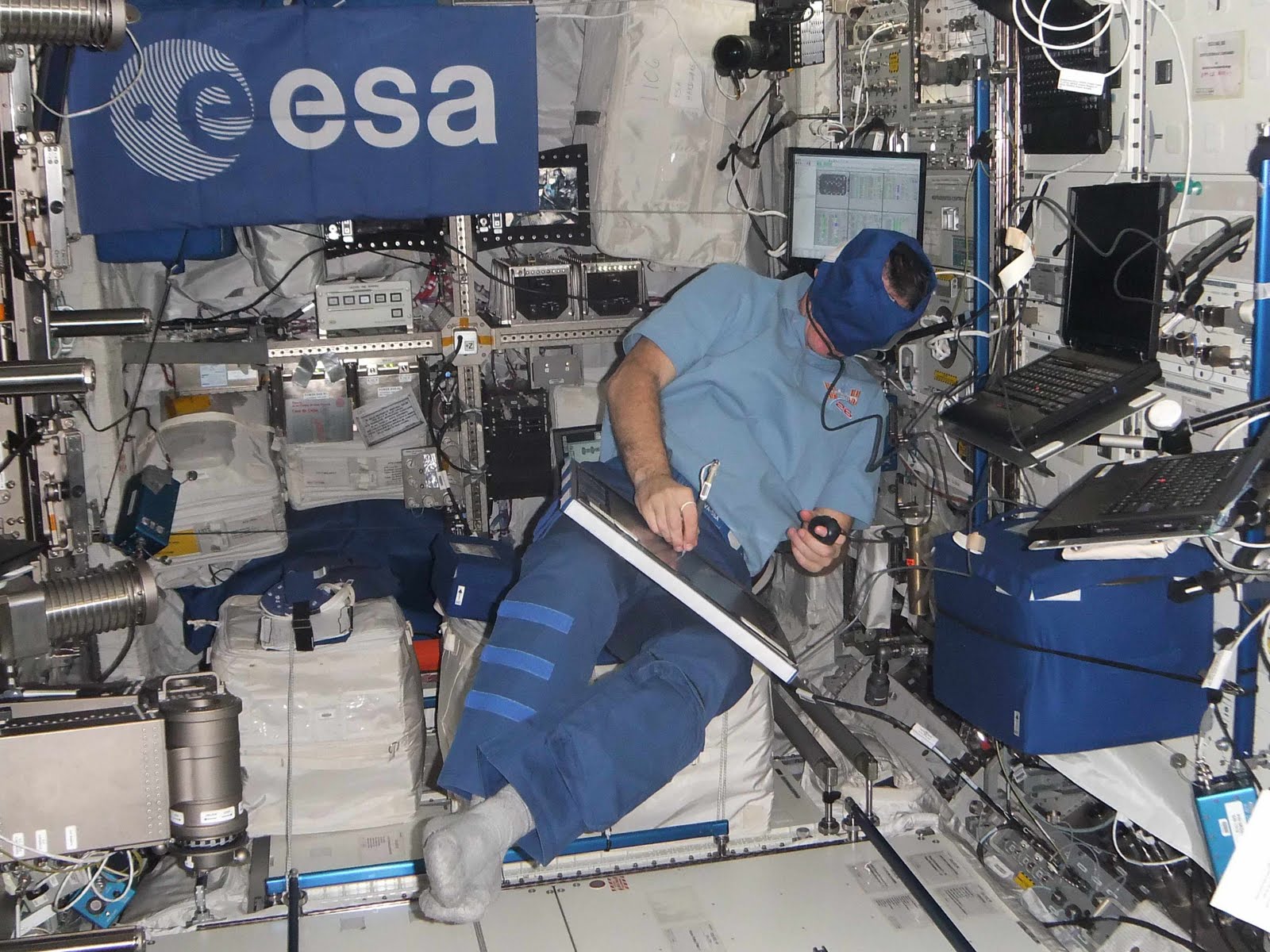
Paolo with 3D Space experiment

Another European 'passenger' – the life-size Matroshka mannequin – ended its latest tour of duty in March, after a year monitoring radiation inside Japan's Kibo module. Paolo removed internal dosimeters from Matroshka for return to Earth.

Other European experiments have been retrieved from outside of the Station. The Expose-R package hosted nine biological samples, including plant seeds and bacterial spores, to study the effects of two years of direct space exposure.

Another space exposure experiment involved fungi known for damaging spacecraft materials. Russia's Mir station was particularly afflicted by fungal growth.

ESA experiments on a variety of crew members are providing new insights into the effects of weightlessness on our balance and how we perceive motion and tilt.

Physical processes are also being probed: the last Shuttle mission recently delivered new samples for a furnace in ESA's Columbus module to investigate rapid solidification of molten metals in weightlessness.

A Station for science

The Alpha Magnetic Spectrometer is a partnership of hundreds of scientists and 16 countries, designed by CERN and tested at ESA's ESTEC technical centre. It has already collected more than two billion observations of galactic cosmic rays since in May 2011.

ISS crew working with Matroshka

NASA has designated the Station's US segment as a national laboratory to encourage its use by national agencies, private firms and universities.

The Canadian Space Agency and NASA will test robotic refuelling systems delivered to the Station by the last Shuttle.

Roscosmos is investigating wheat and vegetable cultivation and human adaptation to long flights.

The Station is being used as a platform for observing Earth, while Japan's X-ray camera is looking in the other direction for cosmic objects such as black holes and neutron stars.

More information:

International Space Station Legal Framework: http://www.esa.int/esaHS/ESAH7O0VMOC_iss_0.html

Columbus Mission: http://www.esa.int/SPECIALS/Columbus/SEMI1163R8F_0.html

AMS-02 homepage: http://www.ams02.org/

Images, Text, Credits: ESA / NASA.

Greetings, Orbiter.ch

VST Looks at the Leo Triplet — and Beyond


ESO - European Southern Observatory logo.

27 July 2011

 VST’s view of the Leo Triplet and beyond

A huge image, from the new VLT Survey Telescope (VST) and its camera OmegaCAM at ESO's Paranal Observatory, shows a triplet of bright galaxies in the constellation of Leo (The Lion). But the faint objects in the background, rather than the foreground galaxies, are what may capture an astronomer’s attention. The VST’s sharp view of these dim objects hints at the power of the telescope and OmegaCAM for mapping the distant Universe.

The VST [1] is the newest addition to ESO’s Paranal Observatory (eso1119). It is a state-of-the-art 2.6-metre telescope, which is equipped with a giant 268-megapixel camera, OmegaCAM [2]. As the name indicates, the VST is dedicated to surveying the skies in visible light, and it is the largest telescope in the world designed exclusively for this purpose. This large view of the Leo Triplet demonstrates the excellent quality of images produced by the VST and its camera.

The triplet of galaxies Messier 65, Messier 66 and NGC 3628 in the constellation of Leo

The Leo Triplet is a magnificent group of interacting galaxies about 35 million light-years from Earth. All three of them are spirals like our own Milky Way galaxy, even though this may not be immediately obvious in this image because their discs are tilted at different angles to our line of sight. NGC 3628, at the left of the frame, is seen edge-on, with thick dust lanes along the plane of the galaxy. The Messier objects M 65 (upper right) and M 66 (lower right), on the other hand, are inclined enough to make their spiral arms visible.

Large telescopes can normally study only one of these galaxies at a time (see for example potw1026a and eso0338c), but the VST field of view — twice as broad as the full Moon — is wide enough to frame all three members of the group in a single picture. The VST also brings to light large numbers of fainter and more distant galaxies, seen as smudges in the background of this image.

Wide-field view of the sky around the Leo Triplet of galaxies

In the foreground of the new image many point-like stars of varied brightness, lying in our own galaxy, can also be seen. One of the science goals of the VST is to search for much fainter objects in the Milky Way, such as brown dwarf stars, planets, neutron stars and black holes. These are thought to permeate the halo of our galaxy but are often too dim to be detected directly even by large telescopes. The VST will look for subtle events, produced by a phenomenon called microlensing [3], to detect these very elusive objects indirectly and study the galactic halo.

Through these studies, the VST is expected to further our understanding of dark matter, which is thought to be the largest constituent of the galactic halo. Clues on the nature of this substance, as well as on the nature of dark energy, are also expected to be found through the VST’s surveys of the distant Universe. The telescope will discover distant galaxy clusters and high-redshift quasars that will help astronomers understand the early Universe and find answers to long-standing questions in cosmology.

Zooming in on the Leo Triplet of galaxies

Very much closer to home, this image also contains the tracks of several asteroids within the Solar System that have moved across the images during the exposures. These show up as short coloured lines [4] and at least ten can be seen in this picture. As Leo is a zodiacal constellation, lying in the plane of the Solar System, the number of asteroids is particularly high.

This image is a composite created by combining exposures taken through three different filters. Light that passed through a near-infrared filter was coloured red, light in the red part of the spectrum is coloured green, and green light is coloured magenta.

Notes:

[1] The VST programme is a joint venture between the INAF–Osservatorio Astronomico di Capodimonte, Naples, Italy and ESO.

[2] OmegaCAM was designed and built by a consortium including institutes in the Netherlands, Germany and Italy with major contributions from ESO.

[3] Microlensing is a gravitational lensing phenomenon by which the presence of a dim but massive object can be inferred from the effect of its gravity on light coming from a more distant star. If, due to a chance alignment, the dim object passes sufficiently close to our line of sight to the more distant star, its gravitational field bends the light coming from the background star. This can lead to a measurable increase in the background star’s brightness. As microlensing events rely on rare chance alignments, they are usually found by large surveys that can observe great numbers of potential background stars.

[4] These are either green or pairs of magenta/red trails. This is because the exposures used to make the green channel of the final colour image were taken on a different night to those used for the red and magenta, which were taken in sequence on the same night.

More information:

ESO, the European Southern Observatory, is the foremost intergovernmental astronomy organisation in Europe and the world’s most productive astronomical observatory. It is supported by 15 countries: Austria, Belgium, Brazil, the Czech Republic, Denmark, France, Finland, Germany, Italy, the Netherlands, Portugal, Spain, Sweden, Switzerland and the United Kingdom. ESO carries out an ambitious programme focused on the design, construction and operation of powerful ground-based observing facilities enabling astronomers to make important scientific discoveries. ESO also plays a leading role in promoting and organising cooperation in astronomical research. ESO operates three unique world-class observing sites in Chile: La Silla, Paranal and Chajnantor. At Paranal, ESO operates the Very Large Telescope, the world’s most advanced visible-light astronomical observatory and two survey telescopes. VISTA works in the infrared and is the world’s largest survey telescope and the VLT Survey Telescope is the largest telescope designed to exclusively survey the skies in visible light. ESO is the European partner of a revolutionary astronomical telescope ALMA, the largest astronomical project in existence. ESO is currently planning a 40-metre-class European Extremely Large optical/near-infrared Telescope, the E-ELT, which will become “the world’s biggest eye on the sky”.

Link:

    Photos of VST: http://www.eso.org/public/images/archive/search/?category=1111&adv=&description=VST

Images, Text, Credits: ESO / INAF-VST / OmegaCAM. Acknowledgement: OmegaCen / Astro-WISE / Kapteyn Institute / IAU and Sky & Telescope / Digitized Sky Survey 2 / Video: ESO / A. Fujii / Digitized Sky Survey 2 / INAF-VST / OmegaCAM. Acknowledgement: OmegaCen / Astro-WISE / Kapteyn Institute. Music: John Dyson (from the album Moonwind).

Cheers, Orbiter.ch