dimanche 14 octobre 2012

Launched from Baikonur rocket Proton-M with the spacecraft Intelsat-23


ILS / ROSCOSMOS - Intelsat 23 launch poster.

14/10/2012

 Liftoff! of the Proton M Breeze M rocket and the IS-23 satellite

October 14 at 12:37 MSK from Baikonur to Start carrier rocket Proton-M with the upper stage (RB) "Breeze-M" and telecommunication spacecraft (SC) Intelsat-23.

We had a successful liftoff about 11 minutes ago of the ILS Proton M Breeze M rocket, which is carrying the IS-23 satellite onboard. The three stages of the Proton vehicle have performed as planned, and it is up to the Breeze M upper stage to complete the mission. The upper stage has begun its first burn.

According to cyclogram flight at 12:46 MSK was divested head unit (upper stage Briz-M and SC Intelsat-23 from the third stage of the launch vehicle.

Intelsat-23

RB Breeze-M spacecraft began breeding Intelsat-23 on the target orbit.

Original press relase by Roscomos: http://www.federalspace.ru/main.php?id=2&nid=19601

More information about Intelsat-23 Mission Control, visit: http://www.ilslaunch.com/mission-control/mission-intelsat-23

Image, Video, Text, Credits: Press Service of the Russian Federal Space Agency (Roscomos PAO) / ILS /  Intelsat.

Best regards, Orbiter.ch

SpaceX Falcon 9 engine glitch places Orbcomm OG2 in wrong orbit


SpaceX logo.

Oct. 14, 2012

Satellite Destroyed During SpaceX Falcon 9 Launch Due to Engine Failure

Experimental communications satellite OG2 that was sent to space on SpaceX Falcon 9 had destroyed during launch, the satellite operator Orbcomm has confirmed.

SpaceX Falcon 9 Blows an Engine, October 7, 2012

New Jersey-based Orbcomm has said that a glitch during liftoff caused the experimental satellite to fall out of orbit and burn to ashes in the atmosphere. The satellite was launched aboard SpaceX Falcon 9 on October 7.

Debris from the rupture of a Falcon 9 engine panel during the Oct. 7

The prototype was planned to reach an altitude of 466 miles above the Earth, but it fell short after one of the Falcon 9 rocket's nine Merlin engines closed earlier than expected. Katherine Nelson, a spokesperson for SpaceX, said that the satellite operator new the risk from the beginning, as the satellite was not part of the core mission.

 SpaceX Falcon 9 rocket

Speaking on the topic, Nelson added, “Orbcomm understood from the beginning that the orbit-raising maneuver was tentative. They accepted that there was a high risk of their satellite remaining at the Dragon insertion orbit.”

Under a $1.6 billion contract with NASA, SpaceX will send a total of 12 flights to the International Space Station (ISS).

Experimental communications satellite OG2 in the test chamber

Orbcomm has claimed an insurance policy worth around $10 million to cover the loss of the OG2.

The satellite operator has plans to launch eight satellites next year and nine satellites in 2014 using Falcon 9 rockets to create a seventeen-member communications satellite network.

For more information about SpaceX, visit: http://www.spacex.com/

Images, Video, Text, Credits: SpaceX / Sierra Nevada Corporation / AFP / Translation: Orbiter.ch.

Greetings, Orbiter.ch

vendredi 12 octobre 2012

Galileo IOV take-off


Arianespace / ESA - Galileo IOV-2 flight VS03 poster.


12 October 2012

 Soyuz VS03 liftoff

The Soyuz ST-B launcher carrying the next two Galileo In-Orbit Validation satellites take off  on 18:15:00 GMT (20:15:00 CEST). Deployment of its twin satellites into orbit is scheduled for three hours 44 minutes after take-off.

Galileo IOV-2 launch [flight VS03]

The quartet of navigation satellites will operate from medium orbit 23 222 km above Earth. This is a significant milestone for Europe’s Galileo programme because four is the minimum number required for navigational fixes, enabling full system testing whenever they are all visible in the sky.

Fairing ejection

This In-Orbit Validation phase will be followed by the deployment of more satellites and ground segment to achieve ‘Full Operational Capability’. After that, users on the ground can exploit the services.

Separation of the two Galileo satellites from Fregat stage

Four Galileo In-Orbit Validation satellites in medium-Earth orbit, the minimum number needed to perform a navigation fix.

 Four Galileo satellites

The first four Galileo satellites were built by a consortium led by EADS Astrium, Germany, with Astrium producing the platforms and Astrium UK responsible for the payloads. They were assembled and tested in Rome by Thales Alenia Space.

For more information about Arianespace, visit: http://www.arianespace.com/index/index.asp

ESA - Navigation - The future - Galileo: http://www.esa.int/esaNA/galileo.html

Images, Text, Credits: ESA / P. Carril / S. Corvaja.

Greetings, Orbiter.ch

X-raying stellar winds in a high-speed collision


ESA - XMM-Newton Space Telescope patch / NASA - SWIFT Mission patch.

12 October 2012

Two massive stars racing in orbit around each other have had their colliding stellar winds X-rayed for the first time, thanks to the combined efforts of ESA’s XMM-Newton and NASA’s Swift space telescopes.

Stellar winds, pushed away from a massive star’s surface by its intense light, can have a profound influence on their environment.

In some locations, they may trigger the collapse of surrounding clouds of gas and dust to form new stars.

Massive star cluster Cyg OB2

In others, they may blast the clouds away before they have the chance to get started.

Now, XMM-Newton and Swift have found a ‘Rosetta stone’ for such winds in a binary system known as Cyg OB2 #9, located in the Cygnus star-forming region, where the winds from two massive stars orbiting around each other collide at high speeds. 

Colliding winds at Cyg OB2 #9

Cyg OB2 #9 remained a puzzle for many years. Its peculiar radio emission could only be explained if the object was not a single star but two, a hypothesis that was confirmed in 2008.

At the time of the discovery, however, there was no direct evidence for the winds from the two stars colliding, even though the X-ray signature of such a phenomenon was expected.

This signature could only be found by tracking the stars as they neared the closest point on their 2.4-year orbit around each other, an opportunity that presented itself between June and July 2011.

As the space telescopes looked on, the fierce stellar winds slammed together at speeds of several million kilometres per hour, generating hot plasma at a million degrees which then shone brightly in X-rays.

Colliding winds at WR 22

The telescopes recorded a four-fold increase in energy compared with the normal X-ray emission seen when the stars were further apart on their elliptical orbit.

“This is the first time that we have found clear evidence for colliding winds in this system,” says Yael Nazé of the Université de Liège, Belgium, and lead author of the paper describing the results reported in Astronomy & Astrophysics.

ESA’s XMM-Newton space telescope


“We only have a few other examples of winds in binary systems crashing together, but this one example can really be considered an archetype for this phenomenon.”

Unlike the handful of other colliding wind systems, the style of the collision in Cyg OB2 #9 remains the same throughout the stars’ orbit, despite the increase in intensity as the two winds meet.

“In other examples the collision is turbulent; the winds of one star might crash onto the other when they are at their closest, causing a sudden drop in X-ray emission,” says Dr Nazé.

NASA’s Swift space telescopes

“But in the Cyg OB2 #9 system there is no such observation, so we can consider it the first ‘simple’ example that has been discovered – that really is the key to developing better models to help understand the characteristics of these powerful stellar winds. ”

“This particular binary system represents an important stepping stone in our understanding of stellar wind collisions and their associated emissions, and could only be achieved by tracking the two stars orbiting around each other with X-ray telescopes,” adds ESA’s XMM-Newton project scientist Norbert Schartel.

Related links:

Extended movie of Cyg OB2 #9: http://svs.gsfc.nasa.gov/vis/a010000/a011100/a011109/

XMM-Newton in-depth: http://sci.esa.int/science-e/www/area/index.cfm?fareaid=23

XMM-Newton overview: http://www.esa.int/esaSC/120385_index_0_m.html

XMM-Newton operations: http://www.esa.int/SPECIALS/Operations/SEMI2HZTIVE_0.html

NASA Swift: http://www.nasa.gov/mission_pages/swift/main/index.html

Images, Videos, Text, Credits: ESA / G. Rauw / NASA.

Best regards, Orbiter.ch

Mars Rock Touched by NASA Curiosity has Surprises


NASA - Mars Science Laboratory (MSL) patch.

Oct. 12, 2012

The first Martian rock NASA's Curiosity rover has reached out to touch presents a more varied composition than expected from previous missions. The rock also resembles some unusual rocks from Earth's interior.

The rover team used two instruments on Curiosity to study the chemical makeup of the football-size rock called "Jake Matijevic" (matt-EE-oh-vick) The results support some surprising recent measurements and provide an example of why identifying rocks' composition is such a major emphasis of the mission. Rock compositions tell stories about unseen environments and planetary processes.

"This rock is a close match in chemical composition to an unusual but well-known type of igneous rock found in many volcanic provinces on Earth," said Edward Stolper of the California Institute of Technology in Pasadena, who is a Curiosity co-investigator. "With only one Martian rock of this type, it is difficult to know whether the same processes were involved, but it is a reasonable place to start thinking about its origin."


This image shows where NASA's Curiosity rover aimed two different instruments to study a rock known as "Jake Matijevic."Image credit: NASA/JPL-Caltech/MSSS.

On Earth, rocks with composition like the Jake rock typically come from processes in the planet's mantle beneath the crust, from crystallization of relatively water-rich magma at elevated pressure.

Jake was the first rock analyzed by the rover's arm-mounted Alpha Particle X-Ray Spectrometer (APXS) instrument and about the thirtieth rock examined by the Chemistry and Camera (ChemCam) instrument. Two penny-size spots on Jake were analyzed Sept. 22 by the rover's improved and faster version of earlier APXS devices on all previous Mars rovers, which have examined hundreds of rocks. That information has provided scientists a library of comparisons for what Curiosity sees.

"Jake is kind of an odd Martian rock," said APXS Principal Investigator Ralf Gellert of the University of Guelph in Ontario, Canada. "It's high in elements consistent with the mineral feldspar, and low in magnesium and iron."

ChemCam found unique compositions at each of 14 target points on the rock, hitting different mineral grains within it.

"ChemCam had been seeing compositions suggestive of feldspar since August, and we're getting closer to confirming that now with APXS data, although there are additional tests to be done," said ChemCam Principal Investigator Roger Wiens (WEENS) of Los Alamos National Laboratory in New Mexico.

Examination of Jake included the first comparison on Mars between APXS results and results from checking the same rock with ChemCam, which shoots laser pulses from the top of the rover's mast.

The wealth of information from the two instruments checking chemical elements in the same rock is just a preview. Curiosity also carries analytical laboratories inside the rover to provide other composition information about powder samples from rocks and soil. The mission is progressing toward getting the first soil sample into those analytical instruments during a "sol," or Martian day.


This image shows the wall of a scuffmark NASA's Curiosity made in a windblown ripple of Martian sand with its wheel. Image credit: NASA/JPL-Caltech/MSSS.

"Yestersol, we used Curiosity's first perfectly scooped sample for cleaning the interior surfaces of our 150-micron sample-processing chambers. It's our version of a Martian carwash," said Chris Roumeliotis (room-eel-ee-OH-tiss), lead turret rover planner at NASA's Jet Propulsion Laboratory in Pasadena, Calif.

Before proceeding, the team carefully studied the material for scooping at a sandy patch called "Rocknest," where Curiosity is spending about three weeks.

"That first sample was perfect, just the right particle-size distribution," said JPL's Luther Beegle, Curiosity sampling-system scientist. "We had a lot of steps to be sure it was safe to go through with the scooping and cleaning."

Following the work at Rocknest, the rover team plans to drive Curiosity about 100 yards eastward and select a rock in that area as the first target for using the drill.

During a two-year prime mission, researchers will use Curiosity's 10 instruments to assess whether the study area ever has offered environmental conditions favorable for microbial life. JPL, a division of Caltech, manages the project and built Curiosity. For more about the Mars Science Laboratory Curiosity rover mission, visit: http://www.nasa.gov/msl and http://mars.jpl.nasa.gov/msl .

You can follow the mission on Facebook and Twitter at: http://www.facebook.com/marscuriosity and http://www.twitter.com/marscuriosity .

Images (mentioned), Text, Credits: NASA / Dwayne Brown / JPL / DC Agle / Guy Webster.

Cheers, Orbiter.ch

Lost asteroid rediscovered with a little help from ESA


Asteroid & Comet Watch logo / ESA - European Space Agency patch.

12 October 2012

A potentially hazardous asteroid once found but then lost has been rediscovered and its orbit confirmed by a determined amateur astronomer working with ESA’s space hazards programme. The half-kilometre object will not threaten Earth anytime soon.

Amateur astronomer Erwin Schwab, from Germany, conducted his asteroid hunt in September during a regular observation slot at ESA’s Optical Ground Station in Tenerife, Spain, sponsored by the Agency’s Space Situational Awareness programme.

Asteroid 2008SE85

He was determined to rediscover the object, known by its catalogue name as 2008SE85.

Potentially Hazardous Asteroid 2008SE85 was discovered in September 2008 by the Catalina Sky Survey, and observed by a few observatories to October 2008. 

Asteroid considered lost

Since then, however, nobody had observed the object and predictions for its current position had become so inaccurate that the object was considered to be ‘lost’.

Erwin planned his observing sequence to look for the object within the area of uncertainty of its predicted position. After only a few hours, he found it about 2° – four times the apparent size of the Moon – away from its predicted position.

Orbit of 2008SE85

“I found the object on the evening of Saturday, 15 September, while checking the images on my computer,” says Erwin.

“I then saw it again at 01:30 on Sunday morning – and that was my birthday! It was one of the nicest birthday presents.”

These new observations of the roughly 500 m-diameter asteroid will allow a much more accurate determination of its orbit and help confirm that it will not be a threat to Earth anytime soon.

Potentially Hazardous Asteroids approach Earth closer than about 7 million km; about 1300 are known.

When a new asteroid is discovered, follow-up observations must be done within a few hours and then days to ensure it is not subsequently lost.

USA-based Minor Planet Center acknowledges the find

Asteroid position measurements are collected from observers worldwide by the US-based Minor Planet Center, which acknowledged the rediscovery of 2008SE85 by releasing a Minor Planet Electronic Circular announcing the new observations.

1m telescope at ESA's Optical Ground Station

“These observations were part of the strong collaboration that we have with a number of experienced backyard observers,” says Detlef Koschny, Head of the Near-Earth Object segment of ESA’s Space Situational Awareness programme.

"It’s not the first time our collaboration with amateurs has scored such a success. Members of the Teide Observatory Tenerife Asteroid Survey started by Matthias Busch from Heppenheim, Germany, discovered two new near-Earth objects during the last year while working with our observing programme."

More information:

Near-Earth Objects - NEO: http://www.esa.int/SPECIALS/SSA/SEMDQGCKP6G_0.html

Space Situational Awareness: http://www.esa.int/SPECIALS/SSA/index.html

Minor Planet Electronic Circular announcing the new observations: http://www.minorplanetcenter.net/mpec/K12/K12S01.html

Images, Text, Credits: ESA / E. Schwab / Deimos.

Greetings, Orbiter.ch

jeudi 11 octobre 2012

Sun - Very Active Region Coming Our Way


NASA - Solar Dynamics Observatory (SDO) patch.

Oct. 11, 2012


A new, very active region is approaching over the left side of the sun. It has already popped off 12 flares (C and M class) in 2 days (Oct. 8-10). The region may be a harbinger of geo-effective activity to come. Credit: NASA/SDO.

Getting NASA's SDO into Focus


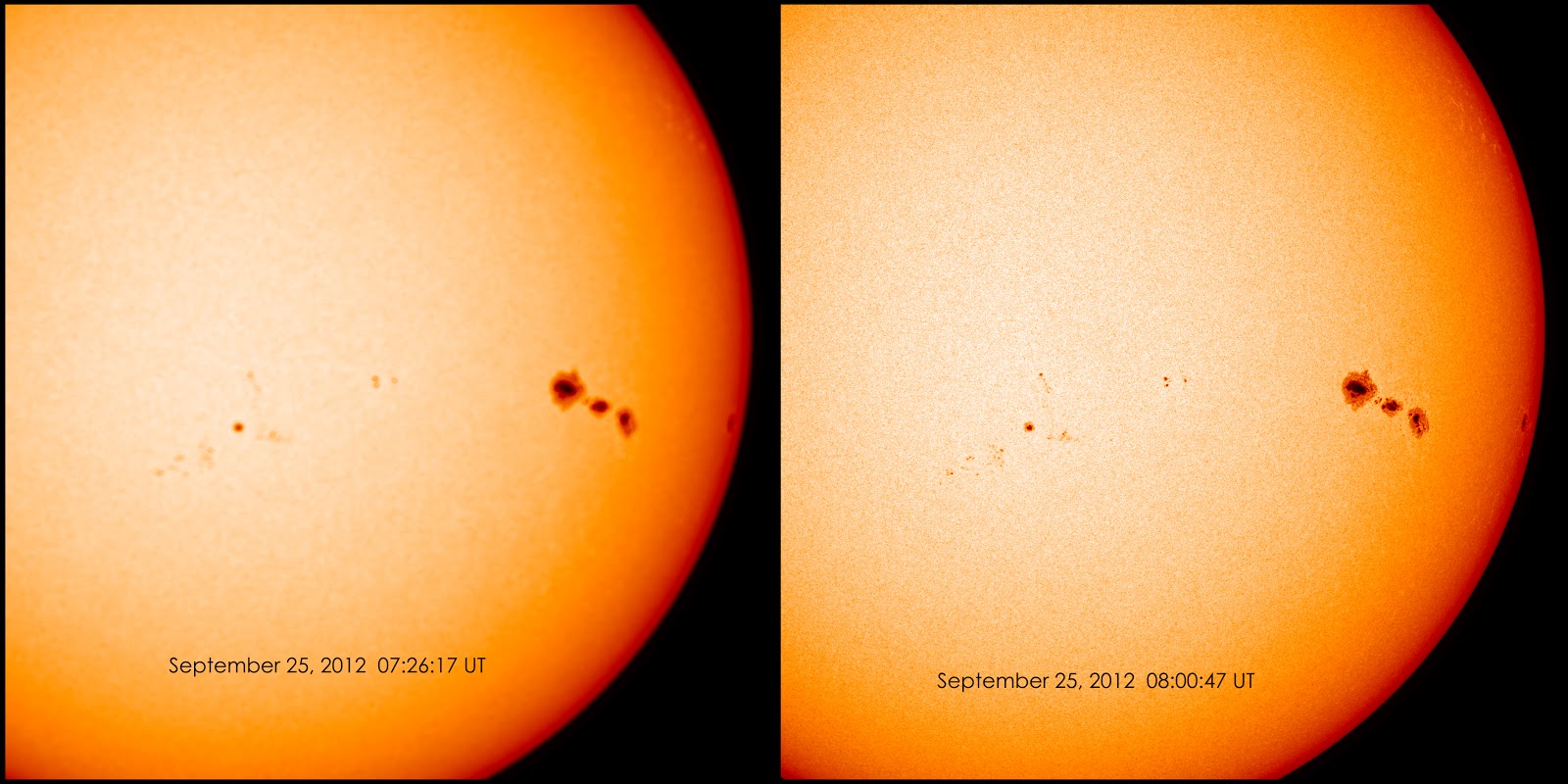
Image above: During an eclipse, lack of heat from the sun causes the window in front of SDO’s Helioseismic and Magnetic Imager (HMI) to change shape. This causes a blurry image for about 45 minutes after Earth finishes its transit across the sun, as shown on the left. The right half shows HMI data at its usual high resolution, data which helps scientists observe sunspots and their magnetic characteristics. Credit: NASA/SDO/HMI.

On Sept. 6 to Sept. 29, 2012, NASA’s Solar Dynamic Observatory (SDO) moved into its semi-annual eclipse season, a time when Earth blocks the telescope’s view of the sun for a period of time each day. Scientists choose orbits for solar telescopes to minimize eclipses as much as possible, but they are a fact of life -– one that comes with a period of fuzzy imagery directly after the eclipse.

The Helioseismic and Magnetic Imager (HMI) on SDO observes the sun through a glass window. The window can change shape in response to temperature changes, and does so dramatically and quickly when it doesn’t directly feel the sun’s heat.

“You’ve got a piece of glass looking at the sun, and then suddenly it isn’t,” says Dean Pesnell, the project scientist for SDO at NASA’s Goddard Space Flight Center in Greenbelt, Md. “The glass gets colder and flexes. It becomes like a lens. It’s as if we put a set of eye glasses in front of the instrument, causing the observations to blur.”


Image above: The Helioseismic and Magnetic Imager (HMI) aboard the Solar Dynamics Observatory (SDO) maps the magnetic field on the sun's surface. Credit: NASA/SDO and the HMI science team.

To counteract this effect, HMI was built with heaters to warm the window during an eclipse. By adjusting the timing and temperature of the heater, the HMI team has learned the best procedures for improving resolution quickly. Without adjusting the HMI front window heaters, it takes about two hours to return to optimal observing.

Solar Dynamics Observatory (SDO). Image Credit: NASA/SDO/HMI

Over the two years since SDO launched in 2010, the team has brought the time it takes to get a clear image down from 60 minutes to around 45 to 50 minutes after an eclipse. “We allocated an hour for these more blurry images,” says Pesnell. “And we’ve learned to do a lot better than that. With 45 eclipses a year, the team gets a lot of practice.”

SDO will enter its next eclipse season on March 3, 2013.

Red Hot Solar Ballet


NASA's Solar Dynamics Observatory captured this minor eruption on the sun over a 2.5 hour time period on Oct 4, 2012. The movie was made using an image every 15 seconds, played back at 15 frames per second. Credit: NASA/SDO/S. Hill.

Red Hot Solar Ballet. Image Credit: NASA/SDO/S. Hill

This minor eruption from Oct 4, 2012 rises and falls with the grace and polished movement of a ballet dancer. The close-up video at just about full resolution captures the event in extreme ultraviolet light at a wavelength of 304 Angstroms. Scientists use this wavelength to observe material in a low layer of the sun's atmosphere called the chromosphere. Most of the solar material in this eruption did not have enough momentum to break away into space and is pulled down again into the Sun.

Related Links:

SDO NASA website: http://sdo.gsfc.nasa.gov/ and http://www.nasa.gov/mission_pages/sdo/main/index.html

Link to Hi-res media: http://svs/vis/a010000/a011100/a011111/

NASA's Goddard Space Flight Center: http://www.nasa.gov/centers/goddard/home/index.html

Images (mentioned), Videos (mentioned), Text, Credits: NASA's Goddard Space Flight Center / Karen C. Fox.

Best regards, Orbiter.ch