vendredi 20 décembre 2013

Beatles Legend John Lennon Among Those Honored with Mercury Craters


NASA - Messenger Mission to Mercury patch.

Dec. 20, 2013

It’s unlikely that Mercury’s surface is populated with tangerine trees and marmalade skies, but the famous British musician who coined that phrase now has a physical presence on the planet closest to the Sun. The International Astronomical Union (IAU) has named an impact crater on the planet after John Lennon, the British pop music sensation who helped make The Beatles the most popular group of their generation.

Lennon is one of ten newly named craters on the planet, joining 114 other craters named since NASA’s MESSENGER spacecraft's first Mercury flyby in January 2008.


Image above: Mercury's Lennon crater, named for Beatle John Lennon, as seen from NASA's MESSENGER spacecraft. Image Credit: NASA/Johns Hopkins Applied Physics Lab/Carnegie Institution.

“The MESSENGER team is delighted that the IAU has named an additional 10 impact craters on Mercury,” said MESSENGER Principal Investigator Sean Solomon of Columbia University, who suggested Lennon. “We are particularly pleased that eight of the 10 individuals honored made all or many of their artistic contributions in the Twentieth Century, the same century in which the MESSENGER mission was conceived, proposed, and approved for flight. Imagine.”

The IAU has been the arbiter of planetary and satellite nomenclature since its inception in 1919.  In keeping with the established naming theme for craters on Mercury, all of the newly designated features are named after “deceased artists, musicians, painters, and authors who have made outstanding or fundamental contributions to their field and have been recognized as art historically significant figures for more than 50 years.”

Messenger spacecraft. Image Credit: NASA

While the notoriety and fame of the namesakes is fun, David Blewett, a MESSENGER participating scientist, says there is a practical reason for naming craters. “After a while, identifying craters by their latitude and longitude becomes laborious,” Blewett says. “Assigning names to the craters makes it easier for scientists to communicate about them, share notes and observations.”

In addition to Lennon, the newly named craters are:

- Barney, for Natalie Clifford Barney (1876-1972), an American-French playwright, poet, and novelist.

- Berlioz, for Hector Berlioz (1803-1869), a French Romantic composer best known for his compositions Symphonie fantastique and Grande messe des morts.

- Calder, for Alexander Calder (1898-1976), an American sculptor best known as the originator of the mobile, a type of kinetic sculpture made with delicately balanced or suspended components that move in response to motor power or air currents.

- Capote, for Truman Capote (1924-1984), an American author whose short stories, novels, plays, and nonfiction include the novella Breakfast at Tiffany's and the true-crime novel In Cold Blood.

- Caruso, for Enrico Caruso (1873-1921), an Italian tenor who sang to great acclaim at the major opera houses of Europe and the Americas and appeared in a wide variety of roles from the Italian and French repertoires that ranged from the lyric to the dramatic.

- Ensor, for James Sidney Ensor (1860-1949), a Belgian painter and printmaker, considered an important influence on expressionism and surrealism.

- Giambologna, for Jean Boulogne Giambologna (1529-1608), a Dutch sculptor known for his marble and bronze statuary in a late Renaissance or Mannerist style.

- Remarque, for Erich Maria Remarque (1898-1970), a German author best known for his novel All Quiet on the Western Front, which depicted the horrors of war from the viewpoint of young German soldiers.

- Vieira da Silva, for Maria Elena Vieira da Silva (1908-1992), a Portuguese-born French painter of intricate, semiabstract compositions.

More information about the names of features on Mercury and the other objects in the Solar System can be found at the U.S. Geological Survey's planetary nomenclature web site: http://planetarynames.wr.usgs.gov/index.html.

For more information about Messenger Mission, visit: http://www.nasa.gov/mission_pages/messenger/main/

Images (mentioned), Text, Credit: NASA.

Greetings, Orbiter.ch

Look out below – Design for Demise study aims to cut satellite reentry risk


ESA - Clean Space logo.

20 December 2013

Even in space, what goes up does sometimes come down – potentially endangering people on the ground. So ESA’s Clean Space initiative is commissioning a study on ‘Design for Demise’ techniques, aimed at reducing the risk of satellite fragments surviving atmospheric reentry.

Below about 600 km the vestigial atmosphere drags the sky clear of derelict satellites over a period of months or years. Friction between a fast-moving orbiting item and the air starts to slow it and pull it lower, at the same time generating heat.

GOCE reenters atmosphere

By the time an object reaches an altitude below 80 km, aerodynamic stresses should cause the item to break into smaller pieces, which in turn melt then vapourise, in the same way meteors burn up to become shooting stars.

But a surprising quantity of material actually survives its scorching plunge through the atmosphere. Dozens of items have been recovered over the years: while low-melt-rate materials such as aluminium do not generally make it, components made of titanium, steel and glass are more resilient.

The majority of such fragments fall unwitnessed into the oceans. Of the remaining land, only about a quarter is inhabited, so the odds of a human being struck per single fragment should be extremely low – the chance of any injury is truly minuscule compared to, say, a car accident. That has not stopped it happening, at least once: in 1997 lightweight mesh from a Delta II stage harmlessly hit the shoulder of Lottie Williams in Turley, Oklahoma, USA.

The hardiest spacecraft components are more prone to making it back. Fuel tanks, for instance, have variously landed in Thailand, Argentina, Saudi Arabia and the US state of Texas – the woman who found a 260 kg launcher tank on her farm just 50 metres from her home described it as looking like an ‘upside down rhinoceros’.

Debris fallen in Saudi Arabia

Since April 2008 all ESA satellites and launcher upper stages intended to be disposed of by atmospheric reentry at the end of their working lives must demonstrate that the risk from fragments surviving reentry to cause casualties on the ground is less than one in 10 000.

Ideally a mission would retain enough propellant to direct itself downwards in a controlled manner, increasing the likelihood of either total incineration or else steering down to an uninhabited area, but this is not always possible within the limited design margin of many spacecraft.

As an alternative, the multidisciplinary ‘Design for Demise’, D4D, approach is the intentional design of spacecraft systems and/or hardware to reduce the casualty risk on the ground, especially in the case of uncontrolled reentry.

So ESA’s Clean Space initiative has issued an invitation to tender for a new study to better quantify the satellite re-entry risk using various re-entry analysis tools, and consider how D4D can best reduce it.

Design for Demise technology roadmap (Click on the image for enlarge)

The study includes identifying which parts of a satellite pose the greatest risk and identify ways D4D can be applied to reduce it, from system to subsystem down to equipment level. These D4D techniques will also be applied to a pair of actual ESA missions, to assess their feasibility in practice.

Guidelines will be drawn up for applying D4D in future, and the technology developments needed for its use in future mission platforms will be outlined in a roadmap.

For more information check the invitation to tender package, accessible via ESA’s Electronic Mailing Invitation to Tender System (EMITS).

About Clean Space: 

What is Clean Space?: http://www.esa.int/Our_Activities/Space_Engineering/Clean_Space/What_is_Clean_Space

Why is it needed?: http://www.esa.int/Our_Activities/Space_Engineering/Clean_Space/Why_is_it_needed

What are its objectives?: http://www.esa.int/Our_Activities/Space_Engineering/Clean_Space/What_are_its_objectives

Q & A on Clean Space: http://www.esa.int/Our_Activities/Space_Engineering/Clean_Space/Q_A_on_Clean_Space

Images, Text, Credits: ESA / Bill Chater / NASA Orbital Debris Program Office.

Best regards, Orbiter.ch

jeudi 19 décembre 2013

Astronauts Finalizing Spacewalk Preparations


ISS - Expedition 38 Mission patch / EVA - Extra Vehicular Activities patch.

Dec. 19, 2013

NASA astronauts Rick Mastracchio and Mike Hopkins and Japanese astronaut Koichi Wakata gathered together Thursday to review spacewalk procedures. Mastracchio and Hopkins will exit the station to replace a faulty pump module over a series of spacewalks. Wakata will operate the station’s robotic arm to maneuver the spacewalkers at the worksite.

The first spacewalk is scheduled for Saturday at 7:10 a.m. EDT when the spacewalkers will set up the worksite on the S1 truss. Monday’s spacewalk will include the removal of the old pump module and the installation of a spare pump module. If necessary a third spacewalk would occur on Christmas day to finalize the installation of the new pump module.

Station Spacewalks to Replace Pump Module

Video above: Lead U.S. Spacewalk Officer Allison Bolinger discusses the details of the three spacewalks the Expedition 38 crew will conduct to replace a faulty pump module on the International Space Station. Image Credit: NASA TV.

NASA Television will begin coverage of the spacewalks an hour before their 7:10 a.m. scheduled start times. The spacewalks are scheduled to last about six hours and 30 minutes. Shortly after the spacewalks conclude, mission controllers will participate in a briefing at Johnson Space Center to discuss the day’s activities.

A briefing was held Wednesday with International Space Station program manager Mike Suffredini, Flight Director Dina Contella and Lead Spacewalk Officer Allison Bolinger. The mission managers discussed how a faulty pump module forced the launch delay of the Cygnus resupply craft and led to the planning for the contingency spacewalks.

View spacewalk briefing graphics: http://www.flickr.com/photos/nasa2explore/sets/72157638802205565/

Read more about the news conference: http://www.nasa.gov/press/2013/december/nasa-postpones-orbital-launch-sets-spacewalks-to-repair-faulty-station-pump/

Read more about the Orbital 1 mission: http://www.nasa.gov/mission_pages/station/structure/launch/orbital.html

The astronauts are also preparing for the possibility of ammonia leaks during their spacewalk. The pump modules are filled with ammonia for cooling and leaks have occurred while disconnecting cables during previous repair spacewalks. If ammonia flakes get on a crew member’s suit, the spacewalkers would go through a series of decontamination steps before re-entering the space station.


Image above: Rick Mastracchio (foreground) checks U.S. spacesuits inside the Quest airlock. Image Credit: NASA TV.

In the Russian side of the space station, Commander Oleg Kotov and Sergey Ryazanskiy are preparing for a Dec. 27 pre-planned spacewalk. The cosmonauts with assistance from Flight Engineer Mikhail Tyurin resized their Orlan spacesuits, checked batteries and reviewed their translation paths to the external worksites.

The duo will install a foot restraint; install medium and high resolution cameras; jettison gear from a pair of external experiments; and install a new experiment as well as a payload boom on the Zvezda service module.

Kotov and Ryazanskiy also participated in a study that monitored their cardiovascular system. Tyurin later worked on the Russian radiation detection experiment Matryeshka that observes radiation absorption in a mannequin.

Read more about Matryeshka: http://www.nasa.gov/mission_pages/station/research/experiments/643.html

For more information about the Space Station (ISS), visit: http://www.nasa.gov/mission_pages/station/main/index.html

Images, Video, Text, Credits: NASA / NASA TV.

Greetings, Orbiter.ch

NASA's Asteroid Hunter Spacecraft Returns First Images after Reactivation


NASA - NEO WISE Mission logo.

Dec. 19, 2013

Probe Will Assist Agency in Search for Candidates to Explore


Image above: This image of a patch of sky in the constellation Pisces is among the first taken by the infrared cameras of NASA's NEOWISE spacecraft. Image Credit: NASA/JPL-Caltech.

NASA's Near-Earth Object Wide-field Infrared Survey Explorer (NEOWISE), a spacecraft that made the most comprehensive survey to date of asteroids and comets, has returned its first set of test images in preparation for a renewed mission.

NEOWISE discovered more than 34,000 asteroids and characterized 158,000 throughout the solar system during its prime mission in 2010 and early 2011. It was reactivated in September following 31 months in hibernation to assist NASA's efforts to identify the population of potentially hazardous near-Earth objects (NEOs). NEOWISE also can assist in characterizing previously detected asteroids that could be considered potential targets for future exploration missions.

"NEOWISE not only gives us a better understanding of the asteroids and comets we study directly, but it will help us refine our concepts and mission operation plans for future, space-based near-Earth object cataloging missions," said Amy Mainzer, principal investigator for NEOWISE at NASA's Jet Propulsion Laboratory (JPL) in Pasadena, Calif. "The spacecraft is in excellent health, and the new images look just as good as they were before hibernation. Over the next weeks and months we will be gearing up our ground-based data processing and expect to get back into the asteroid hunting business, and acquire our first previously undiscovered space rock, in the next few months."

Some of the deep space images taken by the spacecraft include a previously detected asteroid named (872) Holda. With a diameter of 26 miles (42 kilometers), this asteroid orbits the sun between Mars and Jupiter in a region astronomers call the asteroid belt. The images tell researchers the quality of the spacecraft's observations is the same as during its primary mission.

The spacecraft uses a 16-inch (40-centimeter) telescope and infrared cameras to seek out and discover unknown NEOs and characterize their size, albedo or reflectivity, and thermal properties. Asteroids reflect, but do not emit visible light, so data collected with optical telescopes using visible light can be deceiving.

Infrared sensors, similar to the cameras on NEOWISE, are a powerful tool for discovering, cataloging and understanding the asteroid population. Some of the objects about which NEOWISE will be collecting data could become candidates for the agency's announced asteroid initiative.

NASA's initiative will be the first mission to identify, capture and relocate an asteroid. It represents an unprecedented technological feat that will lead to new scientific discoveries and technological capabilities that will help protect our home planet. The asteroid initiative brings together the best of NASA's science, technology and human exploration efforts to achieve President Obama's goal of sending humans to an asteroid by 2025.

WISE Reactivated to Hunt for Asteroids. Image Credit: NASA/JPL-Caltech

"It is important that we accumulate as much of this type of data as possible while the spacecraft remains a viable asset," said Lindley Johnson, NASA's NEOWISE program executive in Washington. "NEOWISE is an important element to enhance our ability to support the initiative."

NEOWISE began as WISE. The prime mission, which was launched in December 2009, was to scan the entire celestial sky in infrared light. WISE captured more than 2.7 million images in multiple infrared wavelengths and cataloged more than 747 million objects in space, ranging from galaxies faraway to asteroids and comets much closer to Earth. NASA turned off most of WISE's electronics when it completed its primary mission in February 2011.

Upon reactivation, the spacecraft was renamed NEOWISE with the goal of discovering and characterizing asteroids and comets whose orbits approach within 28 million miles (45 million kilometers) from Earth's path around the sun.

JPL manages the project for NASA's Science Mission Directorate in Washington. The Space Dynamics Laboratory in Logan, Utah, built the science instrument. Ball Aerospace & Technologies Corp. of Boulder, Colo., built the spacecraft. Science operations and data processing take place at the Infrared Processing and Analysis Center at the California Institute of Technology in Pasadena. Caltech manages JPL for NASA.

Some of the first images taken during the spacecraft's checkout period are available at: http://go.nasa.gov/1dnQPyc

More information about NEOWISE is available online at: http://www.nasa.gov/wise

For more information on the asteroid initiative, visit: http://www.nasa.gov/asteroidinitiative

Images (mentioned), Text, Credits: NASA / Dwayne Brown / JPL / DC Agle.

Cheers, Orbiter.ch

Liftoff for ESA’s billion-star surveyor


ARIANESPACE - GAIA launch poster / ESA - GAIA Mission patch.

19 December 2013

 Gaia liftoff

ESA’s Gaia mission blasted off this morning on a Soyuz rocket from Europe’s Spaceport in Kourou, French Guiana, on its exciting mission to study a billion suns.

Gaia is destined to create the most accurate map yet of the Milky Way. By making accurate measurements of the positions and motions of 1% of the total population of roughly 100 billion stars, it will answer questions about the origin and evolution of our home Galaxy.

Gaia launch

The Soyuz launcher, operated by Arianespace, lifted off at 09:12 GMT (10:12 CET). About ten minutes later, after separation of the first three stages, the Fregat upper stage ignited, delivering Gaia into a temporary parking orbit at an altitude of 175 km.

A second firing of the Fregat 11 minutes later took Gaia into its transfer orbit, followed by separation from the upper stage 42 minutes after liftoff. Ground telemetry and attitude control were established by controllers at ESA’s operations centre in Darmstadt, Germany, and the spacecraft began activating its systems.

The sunshield, which keeps Gaia at its working temperature and carries solar cells to power the satellite, was deployed in a 10-minute automatic sequence, completed around 88 minutes after launch.

Gaia is now en route towards an orbit around a gravitationally-stable virtual point in space called L2, some 1.5 million kilometres beyond Earth as seen from the Sun.

Tomorrow, engineers will command Gaia to perform the first of two critical thruster firings to ensure it is on the right trajectory towards its L2 home orbit. About 20 days after launch, the second critical burn will take place, inserting it into its operational orbit around L2.

Gaia: launch to orbit

A four-month commissioning phase will start on the way to L2, during which all of the systems and instruments will be turned on, checked and calibrated. Then Gaia will be ready to begin its five-year science mission.

Gaia’s sunshield will block heat and light from the Sun and Earth, providing the stable environment needed by its sophisticated instruments to make an extraordinarily sensitive and precise census of the Milky Way’s stars.

“Gaia promises to build on the legacy of ESA’s first star-mapping mission, Hipparcos, launched in 1989, to reveal the history of the galaxy in which we live,” says Jean-Jacques Dordain, ESA’s Director General.

“It is down to the expertise of Europe’s space industry and scientific community that this next-generation mission is now well and truly on its way to making ground-breaking discoveries about our Milky Way.”

Repeatedly scanning the sky, Gaia will observe each of the billion stars an average of 70 times each over the five years. It will measure the position and key physical properties of each star, including its brightness, temperature and chemical composition.

Gaia mapping the stars of the Milky Way

By taking advantage of the slight change in perspective that occurs as Gaia orbits the Sun during a year, it will measure the stars’ distances and, by watching them patiently over the whole mission, their motions across the sky.

The position, motion and properties of each star provide clues about its history, and Gaia’s huge census will allow scientists to piece together a ‘family tree’ for our home Galaxy.

The motions of the stars can be put into ‘rewind’ to learn more about where they came from and how the Milky Way was assembled over billions of years from the merging of smaller galaxies, and into ‘fast forward’ to learn more about its ultimate fate.

“Gaia represents a dream of astronomers throughout history, right back to the pioneering observations of the ancient Greek astronomer Hipparchus, who catalogued the relative positions of around a thousand stars with only naked-eye observations and simple geometry,” says Alvaro Giménez, ESA’s Director of Science and Robotic Exploration.

Deployment of Gaia's DSA

“Over 2000 years later, Gaia will not only produce an unrivalled stellar census, but along the way has the potential to uncover new asteroids, planets and dying stars.”

By comparing its repeated scans of the sky, Gaia will also discover tens of thousands of supernovas, the death cries of stars as they reach the end of their lives and explode. And slight periodic wobbles in the positions of some stars should reveal the presence of planets in orbit around them, as they tug the stars from side to side.

Gaia will also uncover new asteroids in our Solar System and refine the orbits of those already known, and will make precise tests of Einstein’s famous theory of General Relativity.

After five years, the data archive will exceed 1 Petabyte or 1 million Gigabytes, equivalent to about 200 000 DVD’s worth of data. The task of processing and analysing this mountain of data will fall to the Gaia Data Processing and Analysis Consortium, comprising more than 400 individuals across at scientific institutes across Europe.

“Where Hipparcos catalogued 120 000 stars, Gaia will survey almost 10 000 times as many and at roughly 40 times higher precision,” says Timo Prusti, ESA’s Gaia project scientist.

“Along with tens of thousands of other celestial and planetary objects, this vast treasure trove will give us a new view of our cosmic neighbourhood and its history, allowing us to explore the fundamental properties of our Solar System and the Milky Way, and our place in the wider Universe.”

“After years of hard work and determination of everyone involved in the mission, we are delighted to see our Gaia discovery machine on the road to L2, where we will continue the noble European tradition of star charting to decipher the history of the Milky Way,” adds Giuseppe Sarri, ESA’s Gaia project manager.

The spacecraft was designed and built by Astrium, with a core team composed out of Astrium France, Germany and the United Kingdom.

Related links:

Gaia overview: http://www.esa.int/Our_Activities/Space_Science/Gaia/Gaia_overview

Gaia factsheet: http://www.esa.int/Our_Activities/Space_Science/Gaia/Gaia_factsheet

Frequently asked questions: http://www.esa.int/Our_Activities/Space_Science/Gaia/Frequently_Asked_Questions_about_Gaia

Gaia brochure: http://www.esa.int/About_Us/ESA_Publications/ESA_BR-296_Gaia_ESA_s_galactic_census

Hipparcos mission: http://sci.esa.int/science-e/www/area/index.cfm?fareaid=20

Images, Videos, Text, Credits: ESA / S. Corvaja / M. Pedoussaut / C. Carreau / ATG medialab; background: ESO / S. Brunier.

Greetings, Orbiter.ch

mercredi 18 décembre 2013

Expedition 38 Gets Ready for U.S. and Russian Spacewalks


ISS - Expedition 38 Mission patch.


Dec. 18, 2013

Flight Engineers Rick Mastracchio and Mike Hopkins continue preparing for a series of spacewalks to remove a failed pump module and install a spare pump module. NASA managers have planned for the first spacewalk to begin Saturday, the second on Monday and if necessary a third spacewalk on Christmas day.

Station Program Manager Mike Suffredini, Flight Director Dina Contella and lead spacewalk manager Allison Bolinger provided more details during a spacewalk briefing at Johnson Space Center.


Image above: Rick Mastracchio (left) and Mike Hopkins check a U.S. spacesuit inside the Quest airlock. Image Credit: NASA TV.

View spacewalk briefing graphics: http://www.flickr.com/photos/nasa2explore/sets/72157638802205565/

Read more about the news conference: http://www.nasa.gov/press/2013/december/nasa-postpones-orbital-launch-sets-spacewalks-to-repair-faulty-station-pump/

Mastracchio has six spacewalks to his credit with 38 hours and 30 minutes of experience working outside a spacecraft. This will be Hopkins first spacewalk.

The last time a spacewalk took place on Christmas day was in 1974 during the Skylab 4 mission. NASA astronauts Gerald Carr and William Pogue stepped outside the Skylab space station to retrieve film from a telescope and photograph Comet Kohoutek.


Image above: This computer graphic depicts a spacewalker attached to the Canadarm2 removing the starboard pump module. Image Credit: NASA TV.

Orbital Sciences is preparing to roll back their Antares rocket carrying the Cygnus commercial resupply craft back from the launch pad to its integration hangar. The Antares rolled out to the launch pad on Tuesday to protect for a planned Dec. 19 launch to deliver gear to the International Space Station. That launch has now slipped to no earlier than January so NASA can focus on replacing the pump module.

Read more about the Orbital 1 mission: http://www.nasa.gov/mission_pages/station/structure/launch/orbital.html

Commander Oleg Kotov and Flight Engineer Sergey Ryazanskiy are also preparing for a spacewalk. This is a pre-planned spacewalk scheduled for Dec. 27 outside the station’s Russian segment. The duo will install a foot restraint; install medium and high resolution cameras; jettison gear from a pair of external experiments; and install a new experiment as well as a payload boom on the Zvezda service module.

For more information about the International Space Station (ISS), visit: http://www.nasa.gov/mission_pages/station/main/

Images (mentioned), Text, Credits:  NASA.

Greetings, Orbiter.ch

NASA's Deep Space Network: The Original 'Wireless Network' Turns 50


NASA patch.

Dec. 18, 2013

Dawn in the Apollo Valley

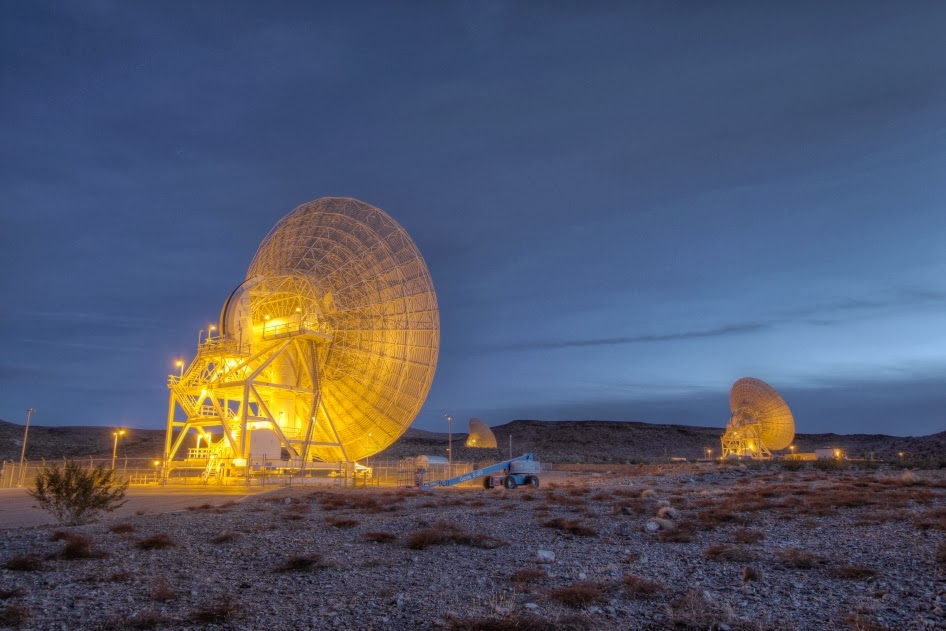
Image above: Beam Wave Guide antennas at Goldstone, known as the "Beam Waveguide Cluster." Each antenna is 111.5-feet (34-m) in diameter. Image Credit: NASA/JPL-Caltech.

NASA's Deep Space Network, the world's largest and most powerful communications system for "talking to" spacecraft, will reach a milestone on Dec. 24: the 50th anniversary of its official creation.

Over the past 50 years, antennas of the Deep Space Network (DSN) have communicated with just about every mission that has gone to the moon or beyond. The historic communiqués include "That's one small step for man. One giant leap for mankind"; numerous encounters with the outer planets of our solar system; images taken by rovers exploring Mars; and the data confirming that NASA's Voyager spacecraft had finally entered interstellar space.

The Deep Space Network has been so critical to so many missions over the decades, the network's team members like to use the phrase "Don't leave Earth without us."

From the very beginning of NASA's space program, it was clear that a simple, direct way to communicate with missions in deep space would be needed. For example, what is the purpose of sending a spacecraft to Mars if we can't receive data, images and other vital information from that spacecraft?

What is now known as the Deep Space Network first existed as just a few small antennas called the Deep Space Instrumentation Facility. The facility was originally operated by the U.S. Army in the 1950s and then later moved over to the jurisdiction of the newly created National Aeronautics and Space Administration (NASA).

On December 24, 1963, the Deep Space Instrumentation Facility officially morphed into the Deep Space Network and quickly became the de facto network for any planned missions into deep space. Three antenna complexes were established around the globe, spread out at roughly 120 degrees of longitude so that even as Earth rotated, spacecraft would always be above the horizon of at least one complex. While some of the communication facilities have moved over the decades, today the three complexes, which operate 24/7/365, are located in Canberra, Australia; Madrid, Spain; and Goldstone, Calif.

 Goldstone 70-Meter

Image above: Late night in the desert: Goldstone's 230-foot (70-meter) antenna tracks spacecraft day and night. This photograph was taken on Jan. 11, 2012. Image Credit: NASA/JPL-Caltech.

Space agencies in Europe, Japan and Russia have all relied on the Deep Space Network when planning and communicating with their own missions over the decades. The Deep Space Network has been used recently by India's first interplanetary probe, the Mars Orbiter Mission (MOM).

"Today, the DSN supports a fleet of more than 30 U.S. and international robotic space missions," said DSN Project Manager Al Bhanji of NASA's Jet Propulsion Laboratory, Pasadena, Calif., which manages the Deep Space Network.  "Without the DSN, we would never have been able to undertake voyages to Mercury and Venus, visit asteroids and comets, we'd never have seen the stunning images of robots on Mars, or close-up views of the majestic rings of Saturn."

In addition to allowing missions to upload and download data to and from dozens of spacecraft, the network helps navigators pinpoint spots for landings and conduct burns that place spacecraft into orbit around other planets, or fine-tune their trajectory. Currently, the list of spacecraft supported by the DSN includes NASA's Curiosity rover on Mars, the Spitzer Space Telescope, the Saturn explorer Cassini and the two Voyager spacecraft, which are more than 9.6 billion miles (15.5 billion kilometers) away from Earth.

 Goldstone 34-meter Beam Waveguide

Image above: Goldstone's 111.5-foot (34-meter) Beam Waveguide tracks a spacecraft as it comes into view. This photograph was taken on Jan. 11, 2012. Image Credit: NASA/JPL-Caltech.

The Deep Space Network is also instrumental in carrying out its own science investigations. For instance, the 230-foot (70-meter) antenna at Goldstone is capable of using its radar to "ping" the near-Earth asteroids to determine a highly accurate position and velocity, and scientists are then able to calculate trajectories the asteroids will take over the next 100 years or more. This is crucial for tracking asteroids that could potentially cause damage were they to impact Earth. If the asteroid is close enough, they can also use the radar to “image” the objects to determine its size, shape and rotation.

Additionally, by combining signals from the DSN antennas with other radio telescopes in an appropriate manner, one can create a "synthetic telescope" that's able to peer into the cores of active galaxies halfway across the observable universe. Likewise, the DSN can be used to probe interiors of planets in our own galaxy, study the solar wind and study gravitational physics.

The future of the Deep Space Network looks bright, with optical communications on the horizon to augment the traditional RF-technology (radio waves moving at the speed of light). Optical communications, when operational, will provide a dramatic increase in data return from science missions; the potential bandwidth carried by an optical communications laser beam is far greater than with traditional radio frequencies. In fact, the DSN team envisions the day, not so far off, when, in addition to returning photos of robotic wheel tracks in the dusty surface of Mars, they will be streaming video to a wide-eyed public as the first humans leave their own footprints on its surface.

"In 2063, when we celebrate the Deep Space Network's 100th anniversary, we can imagine that we might be recalling the amazing days when our antennas streamed high-res video as the first humans stepped onto the surface of Mars," said Al Bhanji. "Or that day when we discovered a new living 'Earth' orbiting a distant star."

Of course, no one knows if or when that day might come. But the DSN will likely play a paramount role in breaking the "Earth-shattering" news.

JPL, a division of the California Institute of Technology in Pasadena, manages the Deep Space Network for NASA. More information about the Deep Space Network is online at: http://www.jpl.nasa.gov/dsn50/

More information about NASA's Space Communications and Navigation program is at: http://www.spacecomm.nasa.gov

Images (mentioned), Text, Credits: NASA / Joshua Buck / JPL / David Israel.

Best regards, Orbiter.ch