jeudi 14 octobre 2021

CASC - Long March-2D launches Xihe and 10 small satellites


CASC - China Aerospace Science and Technology Corporation logo.


Oct. 14, 2021

Long March-2D launches Xihe and 10 small satellites

A Long March-2D launch vehicle launched the Chinese Hα Solar Explorer (CHASE) and 10 small satellites from the Taiyuan Satellite Launch Center, Shanxi Province, northern China, on 14 October 2021, at 10:51 UTC (18:51 local time).

Long March-2D launches Xihe and 10 small satellites

CHASE, also known as Xihe (羲和) after the goddess of the Sun who created the calendar in ancient Chinese mythology, is China’s first space-based solar observatory. For the first time on a Long March-2D launch vehicle, grid fins were used to control the descent of the first stage, with the goal of reducing the landing area.

Chinese Hα Solar Explorer (CHASE)

For more information about China Aerospace Science and Technology Corporation (CASC): http://english.spacechina.com/n16421/index.html

Images, Video, Text, Credits: China Media Group(CMG)/China Central Television (CCTV)/China Aerospace Science and Technology Corporation (CASC)/Solar Exploration Science and Technology Test Satellite (太阳探测科学技术试验卫星)/SciNews/Orbiter.ch Aerospace/Roland Berga.

Greetings, Orbiter.ch

Rocket Lab - We're back (to-back) on the pad


Rocket Lab logo.


Oct. 14, 2021

What's better than one Electron launch? How about TWO?


Our launch team is busy preparing Electron and Launch Complex 1 for TWO back-to-back launches in November for our customers BlackSky and Spaceflight.

Across two launch windows opening days apart, we're sending four Gen-2 satellites for BlackSky to low Earth orbit as they quickly expand their constellation of Earth-imaging sats to meet growing demand for real-time insights across the globe. With a third dedicated mission for BlackSky on the manifest to follow - alongside the Gen-2 satellite we successfully deployed for them on our 'They Go Up So Fast' mission in March - these missions represent the largest number of satellites BlackSky have committed to a single launch provider yet. We're thrilled to be their ride to space and can't wait to head to the skies again with these two missions next month.

🚀 Love At First Insight launch window: opens November 11
🚀🚀 A Data With Destiny launch window: opens November 27


Image above: BlackSky's Gen-2 satellites ready and waiting in our payload cleanroom and integration area at Launch Complex 1 in New Zealand.

Mission Overview

Scheduled to lift-off from Launch Complex 1 on New Zealand’s Mahia Peninsula, the ‘Love At First Insight’ mission will be Rocket Lab’s 22nd Electron launch overall and fifth mission of 2021.

The ‘Love At First Insight’ mission is the latest in a multi-launch agreement signed earlier this year for BlackSky between Rocket Lab and Spaceflight Inc., which is providing integration and mission management services for BlackSky. This mission will deploy the eighth and ninth satellites of BlackSky’s planned constellation as part of that rapid-launch agreement, with another four Gen-2 smallsats across the two additional Electron dedicated missions to follow.

Welcome to the family


We are so excited to introduce you to the newest member of the Rocket Lab family: Advanced Solutions, Inc (ASI), based in Colorado.

ASI are pioneers in critical flight software that powers spacecraft when they're in space, supporting satellites with Guidance, Navigation, and Control (GNC), mission simulations, and test software. Their off-the-shelf flight software MAX has been operating across more than 45 satellites for a cumulative 135 years in space, helping satellites to get to far-away planets and broaden what we're capable of in space.

Bringing ASI onto the team will help us expand what we do in Space Systems with our Photon satellites, and continue growing our list of satellite hardware components on offer. We couldn't think of a better team to help us continue streamlining access to space for satellite customers, no matter what the mission. Welcome to the family, ASI!

Let's go solar sailing


We're honored to have been tapped by NASA to launch their Advanced Composite Solar Sail System (ACS3) technology demonstration on an Electron mission next year!


Much like wind in a sail moves boats on the water, a solar sail can harness sunlight to propel a spacecraft - opening up the possibility to remove the need for rocket fuel to move around in space. NASA wants to build on this capability to potentially power deep space missions at much lower cost, and by testing composite material in the solar sail boom that will deploy from the ACS3 CubeSat, the results from the technology demonstration will guide the design of future larger-scale composite solar sail systems that could be used for space weather early warning satellites, near-Earth asteroid reconnaissance missions, or communications relays for crewed exploration missions.


ACS3 requires a higher altitude than the other rideshare payloads launching on the same mission, so after deploying the first payloads, the Kick Stage will perform another burn with its 3D printed Curie engine to raise the orbit and deploy ACS3. Electron and the Kick Stage's proven ability to deliver satellites to their precise locations in space even when sharing the ride to orbit with others was one of the reasons NASA chosen Electron for ACS3's launch to space.


Launching a composite satellite on the world's first full carbon composite rocket seems like a fitting partnership to us, and we're thrilled to be supporting this mission to push the boundaries of composites in space once again.

Related links:

BlackSky: https://www.blacksky.com/

Spaceflight: https://spaceflight.com/

Rocket Lab: https://www.rocketlabusa.com/

Images, Animation, Text, Credits: Rocket Lab/NASA.

Best regards, Orbiter.ch

With Flight ST36, Arianespace sets a new mark; more than half of the OneWeb constellation now successfully deployed


ARIANESPACE / Starsem - OneWeb Flight ST36 Mission logo.


Oct. 14, 2021

- Arianespace has successfully performed Soyuz Flight ST36. This latest launch for OneWeb’s placed 36 more satellites into orbit.

- ST36 represents an important step in OneWeb and Arianespace’s partnership: the operator now has more than half, 358 satellites, of its constellation on orbit.

- ST36 is the 10th launch of Arianespace in 2021.

Soyuz Flight ST36 liftoff

Performed on Thursday, October 14 at precisely 6:40 pm. local time at Russia’s Vostochny Cosmodrome (9:40 a.m. UTC), Soyuz Flight ST36 lifted-off with 36 OneWeb satellites onboard, bringing the size of the fleet in orbit to 358, after this successful deployment. Flight ST36 was the 61st Soyuz mission carried out by Arianespace and its Starsem affiliate. The mission lasted three hours and 51 minutes. The 36 satellites were deployed during nine separation sequences, at an altitude of 450 km.

“Congratulations to all the teams who made this eleventh launch dedicated to OneWeb’s satellites a success,” said Stéphane Israël, CEO of Arianespace. “ST36 marks a new milestone in our common history. Precisely one hour and eighteen minutes after liftoff, during the first separation sequence, we officially crossed the halfway mark for OneWeb’s constellation deployment! By the end of 2022, we will proudly operate eight more Soyuz launches in order to complete full the deployment of the constellation.”

OneWeb 11 launch (on-board camera view)

OneWeb’s mission is to create a global connectivity platform through a next-generation satellite constellation in Low Earth Orbit. The OneWeb constellation will deliver high-speed, low-latency connectivity to a wide range of customer sectors, including aviation, maritime, enterprise and government. Central to its purpose, OneWeb seeks to bring connectivity to the hardest to reach places, where fiber cannot reach, and thereby bridge the digital divide.
 
The satellite prime contractor is OneWeb Satellites, a joint venture of OneWeb and Airbus Defence and Space. The satellites were produced in Florida, USA in its leading-edge satellite manufacturing facilities that can build up to two satellites per day on a series production line dedicated to spacecraft assembly, integration, and testing.

OneWeb satellite

The launch of the satellites was operated by Arianespace and its Euro-Russian affiliate Starsem under contract with Glavkosmos, a subsidiary of Roscosmos, the Russian space agency. Arianespace is responsible for the overall mission and flight-worthiness, with the support of Starsem for launch campaign activities including management of its own launch facilities at the Baikonur Cosmodrome. RKTs-Progress (the Samara Space Center) is responsible for the design, development, manufacture and integration of the Soyuz launch vehicle as well as for the 3-stage Soyuz flight. NPO Lavotchkin is responsible for the launch preparation operations and flight of the Fregat orbital vehicle.


About Arianespace

Arianespace uses space to make life better on Earth by providing launch services for all types of satellites into all orbits. It has orbited more than 1,000 satellites since 1980, using its family of three launchers, Ariane, Soyuz and Vega, from launch sites in French Guiana (South America) and from the Russian cosmodromes in Baikonur and Vostochny. Arianespace is headquartered in Evry, near Paris, and has a technical facility at the Guiana Space Center in French Guiana, plus local offices in Washington, D.C., Tokyo and Singapore. Arianespace is a subsidiary of ArianeGroup, which holds 74% of its share capital, with the balance held by 15 other shareholders from the European launcher industry.  https://www.arianespace.com/

About Starsem

Starsem is dedicated to providing international commercial marketing and operation of the Soyuz launch vehicle from the Baikonur cosmodrome. Shareholders in Starsem are Arianespace, ArianeGroup, the State Space Corporation ROSCOSMOS and the Samara Space Center "RKTs-Progress." https://www.starsem.com

Images, Video, Text, Credits: Arianespace/ROSCOSMOS/Starsem/SciNews.

Greetings, Orbiter.ch

Working towards a Digital Twin of Earth


ESA - European Space Agency patch.


Oct. 14, 2021

How can a digital replica of Earth help us understand our planet’s past, present and future? As part of the fourth edition of Φ-week taking place this week, a group of European scientists have put forward their ideas on the practical implementation of Digital Twins and the potential application areas for a Digital Twin Earth in the real world.

Luca Brocca presenting the Hydrology Digital Twin at Φ-week

In the coming decades, population growth and human activities are expected to amplify the current pressures on critical resources such as fresh water and food, intensify the stress on land and marine ecosystems, as well as increase environmental pollution and its impacts on health and biodiversity.

These threats, comprising rising sea levels, increasing ocean acidification and more intense extreme events like floods and heatwaves, will need to be closely monitored, especially for our most vulnerable populations.

Responding to these challenges, ESA came together at the 2020 edition of Φ-week to discuss how Earth observation can contribute to the creation of a digital twin of Earth – a dynamic, digital replica of our planet which accurately mimics Earth’s behaviour.

ESA Φ-week 2021

Constantly fed with Earth observation data, combined with in situ measurements and artificial intelligence, Digital Twin Earth will help visualise and forecast natural and human activity on the planet. The model will be able to monitor the health of the planet, perform simulations of Earth’s interconnected system with human behaviour, and help support European environmental policies.

In September 2020, ESA launched several Digital Twin Earth Precursor Activities to explore some of the main scientific and technical challenges in building a digital twin of Earth. These activities included: Forest, Hydrology, Antarctica, Food Systems, Ocean and Climate Hot Spots.

Each activity addressed a different scientific, technical and operational challenge regarding Digital Twin Earth including the role of artificial intelligence and consistent data, stakeholder engagement scientific credibility and role of sectorial models and Information and Communication Technology (ITC) infrastructure.

At this year’s Φ-week, experts from the community came forward with the results of the activities over the last year.

Digital Twin Antarctica

Antarctica is a major reservoir of freshwater in the word, with a huge potential to contribute to sea level rise in the future. Current ice sheet models present major differences and deviations among models, as well as strong variability in unstable areas.

Therefore, a digital twin of Antarctica is necessary. Noel Gourmelen, from the University of Edinburgh commented, “By harnessing satellite observations, numerical simulations, and Artificial Intelligence, we have built a twin of the Antarctic ice sheet system, its hydrology, surrounding ocean, atmosphere, and biosphere. We have used the Antarctic twin to track the whereabouts of melt water on and under the ice sheet, and to explore how fringing ice shelves melt under various hydrology scenarios.”

Digital Twin Antarctica

The Food Systems digital twin simulates agricultural activities and interactions within ecosystems on a daily basis. Different models can be run separately for each simulation unit, depending on crop, water and irrigation management system.  

Chandra Taposea, from CGI IT UK Lt, said, “Digital Twin Earths and the scope we are trying to achieve is vital in helping us reach the next step in sense-making and decision-making, and be able to help both individual users and large-scale policy makers. Our Food Systems Digital Twin has managed to integrate models from different domains, looking at how extreme precipitation would affect global crop models, but not without its trials and tribulations.”

Digital Twin Hydrology

Luca Brocca, from the National Research Council, Italy, explains what the Hydrology Digital Twin entails, “In the ESA Digital Twin Earth Hydrology project, we have developed a 4D reconstruction of dynamic hydrology at unprecedented resolution through the integration of Earth observation and an advanced modelling system. The DTE Hydrology Prototype has been used for water resources management and for identifying locations and times of risk for landslides and flooding in the Po River Basin, in northern Italy.”

Digital Twin Hydrology

Digital Twin Climate Impacts

The Climate Impacts Digital Twin will enable decision makers, without expert technical knowledge, to generate and visualise, in real-time, decision-relevant information related to regionalised impacts of climate change.

Robert Parker, from the University of Leicester, said, “Our Climate Impact Explorer Digital Twin, initially focused on African drought, utilises an innovative combination of Earth observation, environmental modelling and Machine Learning to bring enhanced decision support capabilities directly to our stakeholders.

“By emulating these complex models and deploying them as fast and simple cloud-based tools, our prototype helps democratise access to these expert systems, giving stakeholders the capability to explore potential climate-driven drought responses.”

Digital Twin Forest

Matti Motus, Principal Scientist at VTT, explains how the Forest Digital Twin works: “This digital twin will be a specialised Digital Twin of Earth, providing a reconstruction of the forest system at levels of detail not possible with generic land surface models. Satellite-based Earth observation, especially the high-quality Copernicus Sentinel data, allows us to get unique and uniform information for all forests of the globe.

Matti Motus presenting Forest Digital Twin

“Translating this into understanding on forest structure and to drive models of forest functioning requires local measurements, which are far more scattered and heterogeneous. In the precursor project, we have learned how to overcome these obstacles and provide growth and carbon balance predictions for different forests in Europe. We know now that we have the basic tools and the computing power to build a fully functioning digital twin of forests. It has been a very exciting, yet demanding journey, especially considering that it was fully implemented during the Covid-related restrictions.”

Digital Twin Ocean

This Digital Twin Ocean will focus on exploring the potential of artificial intelligence to learn directly from its data, from the past and the behaviour of the Earth system to predict the future to forecast oceanic events.

Betrand Chapron, from IFREMER, said, “The Digital Twin Ocean project addresses two very distinct phenomena in two very contrasting ocean basins: machine heatwaves in the Mediterranean Sea, and sea ice dynamics to help assess the Arctic amplification. Put simply, two strategies were followed.

“The first was the data-driven approach, where data augmented by regularly sampled numerical operational model assimilating data, are used to drive capabilities to visualise and analyse the recurrences of the ocean-atmosphere dynamical systems, and the model-driven approach, where very high numerical simulations, augmented by irregularly sampled data, are used to assess the large scales and long-term consequences of small scales.”

Related links:

2020 edition of Φ-week: https://www.esa.int/Applications/Observing_the_Earth/Digital_Twin_Earth_quantum_computing_and_AI_take_centre_stage_at_ESA_s_Ph-week

Digital Twin Earth Precursor Activities: https://www.esa.int/ESA_Multimedia/Videos/2020/09/Ph-week_-_Digital_Twin_Earth_Experiences_in_the_World#.YWPxu9Aiz_o.link

Observing the Earth: https://www.esa.int/Applications/Observing_the_Earth

Images, Videos, Text, Credit: European Space Agency (ESA).

Greetings, Orbiter.ch

mercredi 13 octobre 2021

Virtual Reality, Spacesuits, Departure Preps Keeping Crew Busy


ISS - Expedition 65 Mission patch.


October 13, 2021

Exercising wearing virtual reality goggles, replacing spacesuit components, and getting ready for this weekend’s crew departure were the main objectives for the Expedition 65 crew today. The residents aboard the International Space Station also juggled ongoing research and maintenance tasks amidst Russian filmmaking activities.

Daily exercise in microgravity is vital to maintain bone and muscle health in the weightless environment of the orbiting lab. Scientists are studying whether virtual reality may add an extra dimension of pleasure and satisfaction for a crew member during an exercise session in space. Commander Thomas Pesquet of ESA (European Space Agency) put on a virtual reality headset and strapped himself on to an exercise bike Wednesday morning for the Immersive Exercise study. The virtual reality sequence, including audio, is synchronized with the pedaling speed to increase the immersive sensation.


Image above: NASA astronaut Megan McArthur poses with an AstroBee robotic free-flying assistant inside the space station’s Kibo laboratory module. Image Credit: NASA.

Pesquet then spent the afternoon with NASA Flight Engineer Shane Kimbrough working on a U.S. spacesuit. The duo swapped components to resize the spacesuit and checked out the suit’s communications gear.

Kimbrough earlier swapped out fuel bottles inside the Combustion Integrated Rack before cleaning up the seven-windowed cupola. NASA Flight Engineer Megan McArthur spent her day deploying camcorders inside the Harmony module where the SpaceX Crew Dragon and Cargo Dragon vehicles are docked.

International Space Station (ISS). Animation Credit: ESA

In the Unity module, NASA Flight Engineer Mark Vande Hei set up networking hardware and software then moved on to cargo work inside Northrop Grumman’s Cygnus space freighter. Flight Engineer Akihiko Hoshide of the Japan Aerospace Exploration Agency (JAXA) cleaned smoke alarms in the Kibo laboratory module then worked on botany and life science activities.

Cosmonaut Oleg Novitskiy is preparing for his return to Earth this weekend inside the Soyuz MS-18 crew ship. Joining him for this morning’s Soyuz descent training session were Russian spaceflight participants Yulia Peresild and Klim Shipenko. Novitskiy will lead the duo aboard the Soyuz to a parachuted landing in Kazakhstan on Sunday at 12:36 a.m. EDT (10:36 a.m. Kazakh time).


Image above: Roscosmos cosmonaut Oleg Novitsky and space flight participants Klim Shipenko and Yulia Peresild, continued to prepare for their return to Earth, which is scheduled for October 17, 2021. Image Credit: ROSCOSMOS.

Veteran cosmonaut Anton Shkaplerov spent Wednesday morning studying future spacecraft piloting and robotic techniques. First time space-flyer Pyotr Dubrov of Roscosmos photographed Shkaplerov during the session. The duo, including Novitskiy, then spent the afternoon on filmmaking activities with their two Russian space station guests.

Related links:

Expedition 65: https://www.nasa.gov/mission_pages/station/expeditions/expedition65/index.html

Exercise bike: https://www.nasa.gov/mission_pages/station/research/experiments/explorer/Facility.html?#id=821

Immersive Exercise: https://www.nasa.gov/mission_pages/station/research/experiments/explorer/Investigation.html?#id=8370

Combustion Integrated Rack: https://www.nasa.gov/mission_pages/station/research/experiments/explorer/Facility.html?#id=317

Cupola: https://www.nasa.gov/mission_pages/station/structure/elements/cupola.html

Harmony module: https://www.nasa.gov/mission_pages/station/structure/elements/harmony

Unity module: https://www.nasa.gov/mission_pages/station/structure/elements/unity

Kibo laboratory module: https://www.nasa.gov/mission_pages/station/structure/elements/japan-kibo-laboratory

Piloting and robotic techniques: https://www.energia.ru/en/iss/researches/human/24.html

Space Station Research and Technology: https://www.nasa.gov/mission_pages/station/research/overview.html

International Space Station (ISS): https://www.nasa.gov/mission_pages/station/main/index.html

Aniamtion (mentioned), Images (mentioned), Text, Credits: NASA/Mark Garcia.

Greetings, Orbiter.ch

Blue Origin successfully and safely completes second human flight to space and back


Blue Origin - New Shepard NS-18 Mission patch.


Oct. 13, 2021

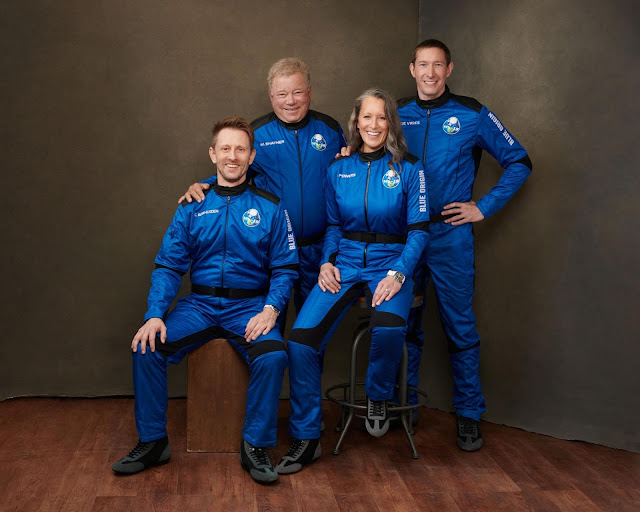
Blue Origin successfully completed its second human spaceflight on board New Shepard on Wednesday, October 13, 2021. The flight included four space tourists, Dr. Chris Boshuizen, Glen de Vries, Audrey Powers, and William Shatner, as well as thousands of postcards from Blue Origin’s foundation, Club for the Future.


Image above: The crew of New Shepard Mission NS-18. Pictured from left to right: Dr. Chris Boshuizen, William Shatner, Audrey Powers, and Glen de Vries. Image Credit: Blue Origin.

Now official space tourists, the crew was welcomed back from space with a celebration in the West Texas desert with family, friends, and the Blue Origin team.

Blue Origin NS-18: New Shepard’s Second Human Flight

“At Blue Origin, we are motivated by the dreamers that inspire us and the builders who turn those dreams into reality. Today’s crew represented both dreamers and builders. We had the honor of flying our very own Audrey Powers, Vice President of New Shepard Operations, who fulfilled a lifelong dream to go to space and has been an integral part of building New Shepard. Our two customers, Chris Boshuizen and Glen de Vries, have built their own successful ventures and have now realized their own dreams of space travel. And, as everyone knows, William Shatner has played an important role in describing and imagining the wonders of universe and inspired many of us to pursue a career in the space industry,” said Bob Smith, CEO Blue Origin. “This flight was another step forward in flying astronauts safely and often. It’s an incredible team and we are just getting started.”    

Blue Origin is planning one more crewed flight this year, with several more crewed flights planned for 2022. If you are interested in flying on New Shepard, please visit our website (https://www.blueorigin.com/).  If you are interested in purchasing a commemorative patch or other merchandise, head to the Blue Origin Shop (https://shop.blueorigin.com/).

Editor note:

They are not astronauts! Only space tourists.

Image (mentioned), Video, Text, Credits: Blue Origin/Gradatim Ferociter/SciNews.

Greetings, Orbiter.ch

Cool tech to almost double deep space data


ESA - European Space Agency patch.


Oct. 13, 2021

An upgrade to ESA’s three 35-metre deep-space antennas will boost science data return by 40% by cooling the ‘antenna feed’ to just 10 degrees above the lowest temperature possible in the Universe.

Super-cool addition to deep space family

Why is this important?

ESA’s ground stations help us tackle some of the greatest scientific questions. They are used to send instructions to spacecraft across the Solar System and receive the data they collect via a ‘downlink’.

The demand on the stations' downlink capacity is higher than ever before. In the next few years, the Agency is preparing to launch new spacecraft deeper into our Solar System and support missions from an increasing number of partner space agencies.

New cryogenically cooled "antenna feed" for Estrack

What are the upgrades?

To increase downlink capacity, you must either build new antennas, or improve the performance of existing ones. ESA is doing both.

While a new and sorely needed deep space antenna is being built in Australia, it’s important - and economical - to squeeze as much performance out of pre-existing dishes as we can. A series of upgrades across ESA’s network of ground stations is doing just that:

- The antenna feed – the tech that connects the physical antenna to the electronic transmitter and receiver – at ESA’s three 35-metre deep-space antennas is being cooled to just 10 degrees above absolute zero (about -263°C).

- Current upgrades will increase the amount of data that can be downlinked from spacecraft by up to 40%, allowing more high-definition images of the Sun to be received from Solar Orbiter during one communication window, for example.

- Future upgrades across higher frequency bands will mean an increase of 80 % more data can be downloaded – that’s almost double the deep space data reaching Darmstadt!

- This clever tech will also increase the sensitivity of ESA deep space antennas, extending their range to support future ESA missions that venture as far as Uranus and Neptune.

“With these upgrades, ESA is pushing the limits of what’s technically possible and enabling scientists to explore new worlds and gather unprecedented amounts of data,” says Stéphane Halté, ESA ground station engineer in charge of the project together with Filippo Concaro.

“The upgrades have come at just the right time,” says Andrea Accomazzo, Head of Solar System and Exploration Missions at ESA’s space operations centre in Darmstadt. “They give us the performance we need to ease the high demand on our tracking network and continue to provide the highest standard of data return for an increasing number of scientists.”

New cryogenically cooled hardware for Estrack

The details:

- The integration of the first new cryo-cooled antenna feed was completed in May 2021 at ESA’s Cebreros station in Spain.

- The upgrade at Cebreros improves the rate at which data can be processed in X-band frequencies by up to 40%.

- ESA’s Malargüe station will receive the same X band feed upgrade in 2022 along with a new ‘Ka band’ cryo-cooled feed, where the expected data rate increase will be as high as 80%. This will greatly benefit existing missions such as Bepicolombo and upcoming missions like Juice. The antenna in New Norcia will receive the upgrade at a later date.

- Cooling the feed electronics minimises the effects of ‘thermal noise’, allowing weaker signals to be received. Below 10 K, impurities in the metals used in the electronics begin to limit the benefits of further cooling.

- The cryo-cooled feeds are manufactured by French company Callisto Space, which received funding from ESA during the technology’s 5-year development. Canadian company Calian conducts the integration of the new technology into the antennas.

- The technology was tested at NASA's High Power Transmitter Test facility in 2019 at Goldstone, California, at a power output of 30 kilowatts – roughly equivalent to the power output by 30 000 mobile phones in use at the same time.

- Specific ultra-low noise semiconductor technology has been developed with university partners (Chalmers university and ETH Zurich) to reach the ultimate noise performance. The same technology is used today for the development of quantum computers. This is an example where ESA technology development can support the overall scientific community and support the competitiveness of European companies.

Less cool updates from the Estrack network

Not quite so cool, but equally necessary, ESA’s smaller dishes in French Guiana and Sweden are getting various performance improving upgrades, readying the entire Estrack network for ESA’s future plans in space.

Kourou tracking station

At Europe’s Spaceport in Kourou, French Guiana, ESA’s 15-metre antenna is being upgraded with new ‘TTCP modems’, allowing maximum data rates in preparation for future Moon, Earth and ‘No-name’ space weather missions.

Kiruna station

In Kiruna, Sweden, ESA’s two antennas will see an evolution in the fundamental ‘Monitoring & Control’ system as well as a new antenna feed and refurbishment for the 13-m ‘Kiruna 2’ dish and various enhancements to Kiruna-1.

Related links:

ESA Ground Stations: https://www.esa.int/Enabling_Support/Operations/ESA_Ground_Stations

ESA's New Norcia station: https://www.esa.int/Enabling_Support/Operations/ESA_Ground_Stations/New_Norcia_-_DSA_1

ESA’s Cebreros station: https://www.esa.int/Enabling_Support/Operations/ESA_Ground_Stations/Cebreros_-_DSA_2

ESA’s Malargüe station: https://www.esa.int/Enabling_Support/Operations/ESA_Ground_Stations/Malarguee_-_DSA_3

ESA’s Kiruna station: https://www.esa.int/Enabling_Support/Operations/ESA_Ground_Stations/Kiruna_station

ESA’s French Guiana station: https://www.esa.int/Enabling_Support/Operations/ESA_Ground_Stations/Kourou_station

Images, Text, Credits: ESA/J. Mai/S. Halté/A. Chance.

Greetings, Orbiter.ch