dimanche 4 avril 2021

Perseverance Rover on Mars: Ingenuity helicopter is on Martian soil


NASA - Mars Helicopter Ingenuity logo.


April 4, 2021

Ingenuity, who arrived on Mars with Perseverance, is now separated from the rover and will soon be on his own in exploring the red planet


Image above: NASA's Ingenuity Mars Helicopter stands on the Red Planet's surface as NASA's Perseverance rover (partially visible) rolls away. Image Credits: NASA/JPL-Caltech.

NASA's Ingenuity mini-helicopter, which arrived on Mars in February attached to the Perseverance rover, has just detached from it and is therefore now on the surface of the Red Planet, NASA said. This ultralight helicopter, which looks like a large drone, had arrived folded up and strapped under the Perseverance rover, which landed on Mars on February 18, and remained there until the rover reached where it should have take place the flight.

 NASA JPL on Twitter

“Its 293 million mile (471 million km) journey ended with this small 4 inch (10 cm) jump from the rover's belly to the surface of Mars. Next test: survive the night, ”the NASA lab in charge tweeted. A photo accompanying the tweet showed Perseverance rolling away from the helicopter. He absolutely needs to clear his sight in less than 25 hours, because the helicopter will need the sun to power its solar panels, and thus be able to survive by warming up during the freezing Martian nights.

Still a few days before the first flight

Ingenuity has so far fed off the rover's energy, but now it will have to fend for itself. "There is a small radiator which makes it possible to maintain a temperature of around 7 ° Celsius inside the helicopter, while the temperatures at night on Mars can drop to -90 °", explained Friday Bob Balaram, chief engineer of the Mars Helicopter project.

NASA’s Mars Helicopter Ingenuity (Trailer)

"This helps protect the key equipment of the device," he added. For the next two days, the ground crew will verify that the solar panels are working as expected, before starting to test the motors and sensors before the first flight, which is not expected to take place until April 11.

Related links:

Perseverance Mars Rover: http://www.nasa.gov/perseverance

Ingenuity Mars Helicopter: https://mars.nasa.gov/technology/helicopter

Images (mentioned), Video (NASA), Text, Credits: NASA/JPL/AFP/Orbiter.ch Aerospace/Roland Berga.

Best regards, Orbiter.ch

samedi 3 avril 2021

Correction of the ISS orbit


ROSCOSMOS - Russian Vehicles patch.


April 3, 2021

In accordance with the flight program of the International Space Station, on April 2, 2021, specialists from the Mission Control Center of TsNIIMash (part of the Roscosmos State Corporation) corrected the altitude of its orbit. For this, the engines of the Progress MS-14 transport cargo vehicle docked to the Zvezda service module of the ISS Russian segment were automatically switched on at 15:14 Moscow time. The impulse value was 0.21 m/s.

ISS reboost

The engines of the "space truck" worked for 132.8 seconds in order to increase the average altitude of the station's orbit by 0.36 km and amounted to 419.85 km. At present, specialists from the ballistic and navigation support service of the TsNIIMash MCC are analyzing the received telemetry information and refining the parameters of the ISS orbit.

ISS reboost by Progress cargo spacecraft. Image Credit: NASA

According to the ballistic and navigation support service of the TsNIIMash MCC, the parameters of the ISS orbit were:

- Orbital period: 92.91 min;
- Orbital inclination: 51.66 degrees;
- Minimum height above the Earth's surface: 418.17 km;
- Maximum height above the surface of the Earth: 439.77 km.


This maneuver was performed to form ballistic conditions before the landing of the Soyuz MS-17 spacecraft and before the launch of the Soyuz MS-18 spacecraft, which is scheduled for April 9, 2021. Roscosmos cosmonauts Oleg Novitsky, Pyotr Dubrov, as well as NASA astronaut Mark Vande Hai will go on it. Currently, the crew of the 64th long-term expedition, consisting of Roscosmos cosmonauts Sergei Ryzhikov and Sergei Kud-Sverchkov, as well as NASA astronauts Kathleen Rubins, Michael Hopkins, Victor Glover, Shannon Walker, and JAXA astronaut Soichi Noguchi, are working on board the International Space Station.

Related article:

Today ISS orbital altitude will be increased by 360 meters
https://orbiterchspacenews.blogspot.com/2021/04/today-iss-orbital-altitude-will-be.html

Updated: April 2, at 17:30 Moscow time. ROSCOSMOS Press Release: https://www.roscosmos.ru/30581/

Image (mentioned), Video (ESA), Text, Credits: ROSCOSMOS/Orbiter.ch Aerospace/Roland Berga.

Best regards, Orbiter.ch

vendredi 2 avril 2021

CASC - Long March-4C launches Gaofen-12-02


CASC -  China Aerospace Science and Technology Corporation logo.


April 2, 2021

Long March-4C launches Gaofen-12-02

A Long March-4C launch vehicle launched the Gaofen-12 Earth observation satellite from the Jiuquan Satellite Launch Center, Gansu Province, northwest China, on 30 March 2021, at 22:45 UTC (31 March, 06:45 local time).

Long March-4C launches Gaofen-12-02

Gaofen-12-02 (高分十二号02) is a microwave remote sensing satellite capable of providing photographs with a resolution of better than a meter.

Gaofen satellite

According to official sources, "Gaofen-12-02 will be mainly used in land surveys, urban planning, determining and registering land rights, road network design, crop yield estimates, and disaster prevention and relief."

Related articles:

CASC - Long March-3B launches Gaofen-13
https://orbiterchspacenews.blogspot.com/2020/10/casc-long-march-3b-launches-gaofen-13.html

CASC - Long March-11 launches Jilin-1 Gaofen-03-1
https://orbiterchspacenews.blogspot.com/2020/09/casc-long-march-11-launches-jilin-1.html

CASC - Long March-4B launches Gaofen-11 02
https://orbiterchspacenews.blogspot.com/2020/09/casc-long-march-4b-launches-gaofen-11-02.html

Long March-2D launches Gaofen-9 05, Tiantuo-5 and a multifunctional test satellite
https://orbiterchspacenews.blogspot.com/2020/08/long-march-2d-launches-gaofen-9-05.html

CASC - Long March-2D launches Gaofen-9 04
https://orbiterchspacenews.blogspot.com/2020/08/casc-long-march-2d-launches-gaofen-9-04.html

CASC - Long March-2D launches Gaofen-9 03 and HEAD-5 satellites
https://orbiterchspacenews.blogspot.com/2020/06/casc-long-march-2d-launches-gaofen-9-03.html

CASC - Long March-2D launches Gaofen-9 02 and HEAD-4 satellites
https://orbiterchspacenews.blogspot.com/2020/05/casc-long-march-2d-launches-gaofen-9-02.html

For more information about China Aerospace Science and Technology Corporation (CASC): http://english.spacechina.com/n16421/index.html

Images, Video, Text, Credits: CASC/China Central Television (CCTV)/SciNews/Günter Space Page/Orbiter.ch Aerospace/Roland Berga.

Greetings, Orbiter.ch

Space Station Science Highlights: Week of March 29, 2021


ISS - Expedition 64 Mission patch.


Apr 2, 2021

Scientific activities conducted aboard the International Space Station the week of March 29 included testing the use of capillary fluidics to water plants, demonstrating a small optical communications system, and measuring tiny particles with a miniature scanning electron microscope.


Image above: This image taken from the space station shows the Moon rising over Earth. Image Credit: NASA.

The seven crew members currently inhabiting the station include four from NASA’s Commercial Crew Program, providing increased crew time for science activities on the orbiting lab. The space station has been continuously inhabited by humans for 20 years and has supported many scientific breakthroughs during that time. The station provides a platform for long-duration research in microgravity and for learning to live and work in space, experience that supports Artemis, NASA’s program to go forward to the Moon and on to Mars.

Here are details on some of the microgravity investigations currently taking place:

Better cosmic watering cans


Animation above: NASA astronaut Kate Rubins conducts operations for the Plant Water Management investigation, which tests using concepts of capillary fluidics to deliver adequate water and nutrients to plants. Animation Credit: NASA.

A number of investigations aboard the space station have looked at how plants grow in microgravity, with the aim of developing ways to produce fresh food on future long-duration missions. Microgravity makes it challenging to provide adequate fluid and nutrition for plant growth. The Plant Water Management series of investigations tests using concepts of capillary fluidics – such as surface tension, wetting, and geometry – to deliver adequate water and nutrients to plants. During the week, the crew transferred fluid to test kits and performed system priming and various tests.  

Small system, big data

SOLISS, an investigation from the Japanese Aerospace Exploration Agency (JAXA), demonstrates the capabilities of an optical communications system that allows transmission of large amounts of data from the space station and satellites to the ground. One advantage of SOLISS technology is lower cost, since it eliminates the need to retrieve physical data stored on the space station, and it supports scientific activities by making possible real-time downlink of large amounts of data. On Earth, the technology could help people stay connected and enable sending and receiving of data in remote locations. This week, crew members installed the SOLISS hardware.

Hunting down tiny particles


Image above: Sample preparation kit for Mochii, shown during set up of the miniature scanning electron microscope on the space station. This tool enables real-time, on-site imaging and measurement of the composition of tiny particles on the space station. Image Credit: NASA.

Mochii is a miniature scanning electron microscope with spectroscopy that conducts real-time, on-site imaging and measures the composition of tiny particles on the space station. These particles can cause vehicle and equipment malfunctions and threaten crew health. Currently, samples must be returned to Earth for analysis, leaving the crew and vehicle at risk. On-board analysis of particles is a critical need for future deep space exploration when samples cannot be sent back to Earth. Mochii also provides a powerful platform for commercial microgravity research on the space station and a springboard for applications beyond low-Earth orbit, including planetary science on manned and robotic missions. Crew members inspected Mochii during the week in preparation for scientific operations.

Other investigations on which the crew performed work:

- GRIP studies how spaceflight affects a person’s ability to regulate the force of their grip and the trajectory of upper limbs when manipulating objects. It is an ESA (European Space Agency) investigation.
https://www.nasa.gov/mission_pages/station/research/experiments/explorer/Investigation.html?#id=1188

- The ESA GRASP investigation examines how the central nervous system integrates information from the senses to coordinate hand movement and visual input, in part to determine whether gravity is a frame of reference for control of this movement.
https://www.nasa.gov/mission_pages/station/research/experiments/explorer/Investigation.html?#id=2038

- Transparent Alloys, a set of five ESA experiments, seeks to improve the understanding of melting-solidification processes in plastics. Solidification of organic transparent substances serves as a model for solidification of metallic alloys, so these studies add to basic knowledge for solidification dynamics and microstructure formation.
https://www.nasa.gov/mission_pages/station/research/experiments/explorer/Investigation.html?#id=8504

- SERFE demonstrates a technology using evaporation of water to remove heat from spacesuits and maintain appropriate temperatures for crew members and equipment during space walks.
https://www.nasa.gov/mission_pages/station/research/experiments/explorer/Investigation.html?#id=7514

- The ISS Experience uses footage captured by crew members to create an immersive virtual reality series documenting life and research aboard the space station. The first episode premiered in fall 2020 on multiple platforms, and episode 2, “Advance,” releases on March 29.
https://www.nasa.gov/mission_pages/station/research/experiments/explorer/Investigation.html?#id=7877

- RTPCG-2 demonstrates new methods for producing high-quality protein crystals in microgravity for analysis on Earth to identify possible targets for drugs to treat disease.
https://www.nasa.gov/mission_pages/station/research/experiments/explorer/Investigation.html?#id=8073

- Standard Measures collects a set of core measurements from astronauts before, during, and after long-duration missions to create a data repository to monitor and interpret how humans adapt to living in space.
https://www.nasa.gov/mission_pages/station/research/experiments/explorer/Investigation.html?#id=7711

- Antimicrobial Coatings tests a coating to control microbial growth on several different materials that represent high-touch surfaces. Some microbes change characteristics in microgravity, potentially creating new risks to crew health and spacecraft.
https://www.nasa.gov/mission_pages/station/research/experiments/explorer/Investigation.html?#id=8352

- Ribosome Profiling, an investigation from JAXA, uses a state-of-the-art technique to provide insight into how gravity affects gene expression, with a special focus on translation regulation. The work could help researchers understand why aging-related changes often occur in space and may lead to better treatments for those changes.
https://www.nasa.gov/mission_pages/station/research/experiments/explorer/Investigation.html?#id=7985

- Food Acceptability looks at how the appeal of food changes during long-duration missions. Whether crew members like and actually eat foods directly affects caloric intake and associated nutritional benefits.
https://www.nasa.gov/mission_pages/station/research/experiments/explorer/Investigation.html?#id=7562 

Space to Ground: Scanning the Horizon: 04/02/2021

Related links:

Expedition 64: https://www.nasa.gov/mission_pages/station/expeditions/expedition64/index.html

Plant Water Management: https://www.nasa.gov/mission_pages/station/research/experiments/explorer/Investigation.html?#id=7884

SOLISS: https://www.nasa.gov/mission_pages/station/research/experiments/explorer/Investigation.html?#id=7750

Mochii: https://www.nasa.gov/mission_pages/station/research/experiments/explorer/Facility.html?#id=7657

ISS National Lab: https://www.issnationallab.org/

Spot the Station: https://spotthestation.nasa.gov/

Space Station Research and Technology: https://www.nasa.gov/mission_pages/station/research/overview.html

International Space Station (ISS): https://www.nasa.gov/mission_pages/station/main/index.html

Images (mentioned), Animation (mentioned), Video (NASA), Text, Credits: NASA/Michael Johnson/John Love, ISS Research Planning Integration Scientist Expedition 64.

Greetings, Orbiter.ch

Exodus of civilization into space - Astrophysical End of the World. Part 2


End of the World logo.


April 2, 2021

Preamble

Here the second article of a series of articles by Ph.D. Morozov Sergey Lvovich, expert in chronology and calendar systems, as well as space biology and medicine, Parliamentarian of Asgardia (AMP) the first space Nation.

Ph.D. Morozov Sergey Lvovich

Astrophysical End of the World

The end of the world is a common phraseological unit that means a real or imagined threat of the cessation of the existence of all people, civilizations, all mankind, the Earth or even the entire Universe. In a narrower sense - the destruction of all living things.

The previous article looked at the biblical End of the World. Calculated in 1373 in the Vatican by the theologian Isaac Argir, the Last Judgment did not take place in 1492.

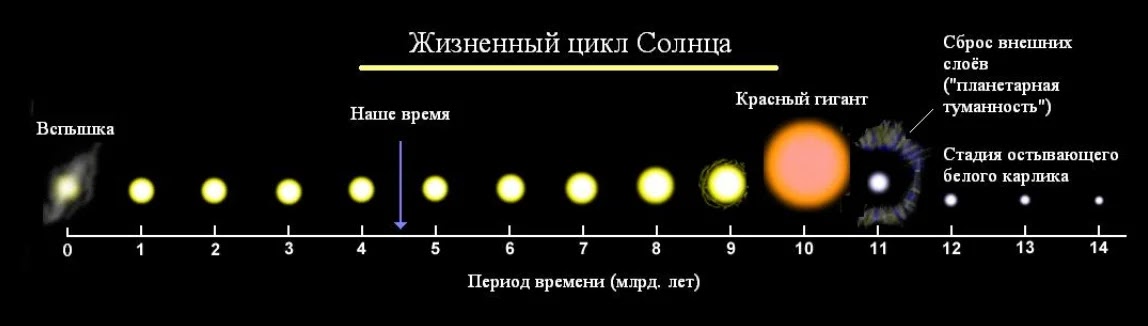
In fact, the period of the physical existence of the Earth as a planet is absolutely limited by the laws of the astrophysics of the Sun. Over time, civilization will have to leave the Earth in full force without return. There will be nowhere to return, as the Earth will be absorbed by the enlarged corona of the Sun when it passes from the main sequence to the stage of the "red giant". This will happen in about 5.5 billion years.

Life Cycle of the Sun (the blue arrow indicate the actual cycle of our sun)

Main sequence - Hertzsprung - Russell diagram for the most famous stars

Everything will happen gradually - first, the Ice Ages, Periods and Epochs will end. Then the temperature on the Earth will progressively rise due to the approach of the fiery corona of the red Sun, and gradually the temperature on the Earth will become so high that the Earth will be completely uninhabitable. All plants and forests will die.

The planet will resemble Mars, and so it will be until the sun's corona finally engulfs 4 terrestrial planets at once: Mercury, Venus, Earth and Mars.

End of World (Armageddon)

Coming soon to read the continuation of the cycle "The Exodus of Civilization into Space" - Geochronological Ice Ages, periods, eras.

Related article:

The ideology of space expansion - Space calendar. Part 1
https://orbiterchspacenews.blogspot.com/2021/03/the-ideology-of-space-expansion-space.html

Related links:

About Ph.D. Morozov Sergey Lvovich: https://zen.yandex.ru/media/id/5fbb90753e3ad265054f930a/ob-avtore-kanala-5fbd2bf80b4af80149fb12c2

Original article in Russian on Zen.Yandex:
https://zen.yandex.ru/media/id/5fbb90753e3ad265054f930a/ishod-civilizacii-v-kosmos-chast-2--astrofizicheskii-konec-sveta-5fc5f5a1e8c5ae189c02edd6

Asgardia website: https://asgardia.space/

Author: Ph.D. Morozov Sergey Lvovich / Zen.Yandex. Editor / Translation: Roland Berga.

Best regards, Orbiter.ch

Hubble Revisits the Veil Nebula


NASA - Hubble Space Telescope patch.


Apr 2, 2021


This image taken by the NASA/ESA Hubble Space Telescope revisits the Veil Nebula, which was featured in a previous Hubble image release. In this image, new processing techniques have been applied, bringing out fine details of the nebula’s delicate threads and filaments of ionized gas.

To create this colorful image, observations were taken by Hubble's Wide Field Camera 3 instrument using five different filters. The new post-processing methods have further enhanced details of emissions from doubly ionized oxygen (seen here in blues), ionized hydrogen, and ionized nitrogen (seen here in reds).

The Veil Nebula lies around 2,100 light-years from Earth in the constellation of Cygnus (the Swan), making it a relatively close neighbor in astronomical terms. Only a small portion of the nebula was captured in this image.

The Veil Nebula is the visible portion of the nearby Cygnus Loop, a supernova remnant formed roughly 10,000 years ago by the death of a massive star. That star – which was 20 times the mass of the Sun – lived fast and died young, ending its life in a cataclysmic release of energy. Despite this stellar violence, the shockwaves and debris from the supernova sculpted the Veil Nebula’s delicate tracery of ionized gas – creating a scene of surprising astronomical beauty.

Hubble Space Telescope (HST)

The Veil Nebula is also featured in Hubble’s Caldwell Catalog, a collection of astronomical objects that have been imaged by Hubble and are visible to amateur astronomers in the night sky.

For more information about Hubble, visit:

http://hubblesite.org/

http://www.nasa.gov/hubble

http://www.spacetelescope.org/

Hubble’s Caldwell Catalog: https://www.nasa.gov/feature/goddard/caldwell-34

Text Credits: European Space Agency (ESA)/NASA/Lynn Jenner/Image, Animation Credits: ESA/Hubble & NASA, Z. Levay.

Greetings, Orbiter.ch
jeudi 1 avril 2021

Spectr-RG will reveal the secrets of distant quasars in a young universe


ROSCOSMOS / DLR - Spectrum-RG (Spectr-RG) Mission patch.


April 1, 2021

The Russian Science Foundation has summed up the results of three competitions to support fundamental and exploratory research. In the competition of individual scientific groups, the winner was the project “Search and study of distant quasars in an X-ray survey of the entire sky using the eROSITA telescope of the Russian orbital observatory“ Spektr-RG ”under the leadership of Corresponding Member of the Russian Academy of Sciences Marat Ravilievich Gilfanov.


“The first few billion years of the life of the Universe were filled with events - galaxies were actively forming, in the cores of which supermassive black holes grew rapidly. The growth of supermassive black holes occurred mainly due to the accretion (falling onto a black hole) of interstellar gas and was accompanied by the release of a huge amount of energy in the form of electromagnetic radiation, says Marat Gilfanov. “Thanks to their colossal luminosity, such objects - quasars, located at huge, cosmological, distances from us, we can observe even today”.

The goal of the project, supported by the Russian Science Foundation, is to study the growth of supermassive black holes in galactic nuclei in the young Universe. The objects of study are distant quasars located at redshifts from z = 3 to at least z = 6. This redshift interval corresponds to the second billion years in the life of the universe. Quasars will be selected from the number of X-ray sources discovered by the eROSITA telescope on board the Russian orbital observatory Spektr-RG during the all-sky survey.

The Spektr-RG orbital X-ray observatory was launched from the Baikonur cosmodrome on July 13, 2019 and began scanning the entire sky in December 2019. To date, the third out of eight planned sky surveys is under way. Following the results of the first year of the survey, the eROSITA telescope achieved a record sensitivity, an order of magnitude higher than the sensitivity of the previous most complete survey of the entire sky by the ROSAT observatory (Germany).

Thanks to this, already now, with the help of the eROSITA telescope, about two million X-ray sources have been discovered - ~ 20 times more than was registered by the ROSAT observatory. About three quarters of these sources are active galactic nuclei and quasars. The search and selection of distant quasars for research within the framework of the project will be carried out using the SRGz machine learning system, developed by the project participants in the High Energy Astrophysics Department of the IKI RAS. As a result, a sample of several thousand high luminosity quasars at z> 3 will be obtained, which is tens of times larger in number than all existing samples of distant quasars selected by their X-ray emission.

“Based on this most complete sample to date, we will investigate the physical and statistical properties of actively growing supermassive black holes in the young Universe, including their luminosity function, spectral distribution of emitted energy, variability of X-ray radiation. These results will significantly 'advance' our understanding of the general picture of the growth of supermassive black holes in the young Universe and the physics of matter accretion on them. "

Spektr-RG (Spectrum-RG) orbital X-ray observatory

Within the framework of the 2021 competition for grants in the priority area of activity of the Russian Science Foundation "Conducting fundamental scientific research and exploratory research by individual scientific groups", 526 projects were supported. They are planned for implementation in 2021–2023 with a possible extension of the implementation period by one or two years. The size of one grant is up to 6 million rubles annually.

In 2020, the implementation of three-year projects of individual research groups, supported by the Russian Science Foundation in 2018, was also completed. The terms of the competition provided for the extension of the implementation of projects for a period of one to two years. As part of the 2021 competition for the extension, 218 projects were supported. Among them are two projects led by the staff of the IKI RAS:

- Magnetic-plasma radiation processes on neutron stars and in the vicinity of black holes (supervisor - Dr. G.S. Bisnovaty-Kogan).

- A promising device "Space gamma spectrometer with labeled charged particles" (KGS-MZCh) for studying the Moon, Mars and other celestial bodies of the solar system by methods of nuclear physics (supervisor - Dr. IG Mitrofanov).

IKI RAN: http://press.cosmos.ru/srgerosita-raskroet-tayny-dalekih-kvazarov-v-molodoy-vselennoy

ROSCOSMOS Press Release: https://www.roscosmos.ru/30563/

Spektr-RG orbital X-ray observatory: https://www.roscosmos.ru/srg/

Images, Text, Credits: ROSCOSMOS/Orbiter.ch Aerospace/Roland Berga.

Greetings, Orbiter.ch