mardi 4 janvier 2022

Orion’s fireplace: ESO releases new image of the Flame Nebula


ESO - European Southern Observatory logo.


Jan 4, 2022

The Flame Nebula region as seen with APEX and VISTA

Orion offers you a spectacular firework display to celebrate the holiday season and the new year in this new image from the European Southern Observatory (ESO). But no need to worry, this iconic constellation is neither exploding nor burning. The “fire” you see in this holiday postcard is Orion’s Flame Nebula and its surroundings captured in radio waves — an image that undoubtedly does justice to the nebula’s name! It was taken with the ESO-operated Atacama Pathfinder Experiment (APEX), located on the cold Chajnantor Plateau in Chile’s Atacama Desert.

The newly processed image of the Flame Nebula, in which smaller nebulae like the Horsehead Nebula also make an appearance, is based on observations conducted by former ESO astronomer Thomas Stanke and his team a few years ago. Excited to try out the then recently installed SuperCam instrument at APEX, they pointed it towards the constellation Orion. “As astronomers like to say, whenever there is a new telescope or instrument around, observe Orion: there will always be something new and interesting to discover!” says Stanke. A few years and many observations later, Stanke and his team have now had their results accepted for publication in the journal Astronomy & Astrophysics.

The Flame Nebula region as seen with APEX

One of the most famous regions in the sky, Orion is home to the giant molecular clouds closest to the Sun — vast cosmic objects made up mainly of hydrogen, where new stars and planets form. These clouds are located between 1300 and 1600 light-years away and feature the most active stellar nursery in the Solar System’s neighbourhood, as well as the Flame Nebula depicted in this image. This “emission” nebula harbours a cluster of young stars at its centre that emit high-energy radiation, making the surrounding gases shine.

With such an exciting target, the team were unlikely to be disappointed. In addition to the Flame Nebula and its surroundings, Stanke and his collaborators were able to admire a wide range of other spectacular objects. Some examples include the reflection nebulae Messier 78 and NGC 2071 — clouds of interstellar gas and dust believed to reflect the light of nearby stars. The team even discovered one new nebula, a small object, remarkable in its almost perfectly circular appearance, which they named the Cow Nebula.

The Flame Nebula region as seen with APEX and the DSS2

The observations were conducted as part of the APEX Large CO Heterodyne Orion Legacy Survey (ALCOHOLS), which looked at the radio waves emitted by carbon monoxide (CO) in the Orion clouds. Using this molecule to probe wide areas of the sky is the primary goal of SuperCam, as it allows astronomers to map large gas clouds that give birth to new stars. Unlike what the “fire” of this image might suggest, these clouds are actually cold, with temperatures typically just a few tens of degrees above absolute zero.  

Given the many secrets it can tell, this region of the sky has been scanned many times in the past at different wavelengths, each wavelength range unveiling different, unique features of Orion’s molecular clouds. One example are the infrared observations performed with ESO’s Visible and Infrared Survey Telescope for Astronomy (VISTA) at the Paranal Observatory in Chile that make up the peaceful background of this image of the Flame Nebula and its surroundings. Unlike visible light, infrared waves pass through the thick clouds of interstellar dust, allowing astronomers to spot stars and other objects which would otherwise remain hidden.

Multiple views of the Flame Nebula region as seen with the DSS2, VISTA and APEX

So, this holiday season, bring in the new year with this spectacular multiwavelength firework show put on by the Orion’s Flame Nebula, presented by ESO!

More information:

The observations mentioned in this press release are presented in a paper accepted for publication in Astronomy & Astrophysics.

The team is composed of Th. Stanke (European Southern Observatory, Garching bei München, Germany [ESO]), H. G. Arce (Department of Astronomy, Yale University, New Haven, CT, USA), J. Bally (CASA, University of Colorado, Boulder, CO, USA), P. Bergman (Department of Space, Earth and Environment, Chalmers University of Technology, Onsala Space Observatory, Onsala, Sweden), J. Carpenter (Joint ALMA Observatory, Santiago, Chile [ALMA]), C. J. Davis (National Science Foundation, Alexandria, VA, USA), W. Dent (ALMA), J. Di Francesco (NRC Herzberg Astronomy and Astrophysics, Victoria, BC, Canada [HAA] and Department of Physics and Astronomy, University of Victoria, BC, Canada [UVic]), J. Eislöffel (Thüringer Landessternwarte, Tautenburg, Germany), D. Froebrich (School of Physical Sciences, University of Kent, Canterbury, UK), A. Ginsburg (Department of Astronomy, University of Florida, Gainesville, FL, USA), M. Heyer (Department of Astronomy, University of Massachusetts, Amherst, MA, USA), D. Johnstone (HAA and UVic), D. Mardones (Departamento de Astronomía, Universidad de Chile, Santiago, Chile), M. J. McCaughrean (European Space Agency, ESTEC, Noordwijk, The Netherlands), S. T. Megeath (Department of Physics and Astronomy, University of Toledo, OH, USA), F. Nakamura (National Astronomical Observatory, Tokyo, Japan), M. D. Smith (Centre for Astrophysics and Planetary Science, School of Physical Sciences, University of Kent, Canterbury, UK), A. Stutz (Departmento de Astronomía, Facultad de Ciencias Físicas y Matemáticas, Universidad de Concepción, Chile), K. Tatematsu (Nobeyama Radio Observatory, National Astronomical Observatory of Japan, National Institutes of Natural Sciences, Nagano, Japan), C. Walker (Steward Observatory, University of Arizona, Tucson, AZ, US [SO]), J. P. Williams (Institute for Astronomy, University of Hawai‘i at Manoa, HI, USA), H. Zinnecker (Universidad Autonoma de Chile, Santiago, Chile), B. J. Swift (SO), C. Kulesa (SO), B. Peters (SO), B. Duffy (SO), J. Kloosterman (University of Southern Indiana, Evansville, IN, USA), U. A. Yıldız (Jet Propulsion Laboratory, California Institute of Technology, Pasadena, CA, USA [JPL]), J. L. Pineda (JPL), C. De Breuck (ESO), and Th. Klein (European Southern Observatory, Santiago, Chile).

APEX is a collaboration between the Max Planck Institute for Radio Astronomy (MPIfR), the Onsala Space Observatory (OSO) and ESO. Operation of APEX at Chajnantor is entrusted to ESO.

SuperCAM is a project by the Steward Observatory Radio Astronomy Laboratory at the University of Arizona, US.

The European Southern Observatory (ESO) enables scientists worldwide to discover the secrets of the Universe for the benefit of all. We design, build and operate world-class observatories on the ground — which astronomers use to tackle exciting questions and spread the fascination of astronomy — and promote international collaboration in astronomy. Established as an intergovernmental organisation in 1962, today ESO is supported by 16 Member States (Austria, Belgium, the Czech Republic, Denmark, France, Finland, Germany, Ireland, Italy, the Netherlands, Poland, Portugal, Spain, Sweden, Switzerland and the United Kingdom), along with the host state of Chile and with Australia as a Strategic Partner. ESO’s headquarters and its visitor centre and planetarium, the ESO Supernova, are located close to Munich in Germany, while the Chilean Atacama Desert, a marvellous place with unique conditions to observe the sky, hosts our telescopes. ESO operates three observing sites: La Silla, Paranal and Chajnantor. At Paranal, ESO operates the Very Large Telescope and its Very Large Telescope Interferometer, as well as two survey telescopes, VISTA working in the infrared and the visible-light VLT Survey Telescope. Also at Paranal ESO will host and operate the Cherenkov Telescope Array South, the world’s largest and most sensitive gamma-ray observatory. Together with international partners, ESO operates APEX and ALMA on Chajnantor, two facilities that observe the skies in the millimetre and submillimetre range. At Cerro Armazones, near Paranal, we are building “the world’s biggest eye on the sky” — ESO’s Extremely Large Telescope. From our offices in Santiago, Chile we support our operations in the country and engage with Chilean partners and society.

Links:

Research paper: https://arxiv.org/abs/2201.00463

Photos of APEX: https://www.eso.org/public/images/archive/category/apex/

For journalists: subscribe to receive our releases under embargo in your language: https://www.eso.org/public/outreach/pressmedia/#epodpress_form

For scientists: got a story? Pitch your research: http://eso.org/sci/publications/announcements/sciann17369.html

Images Credits: ESO/Th. Stanke & ESO/J. Emerson/VISTA. Acknowledgment: Cambridge Astronomical Survey Unit/ESO/Digitized Sky Survey 2. Acknowledgement: Davide De Martin/Video Credits: ESO; Th. Stanke; J. Emerson/VISTA. Acknowledgement: Cambridge Astronomical Survey Unit; Digitized Sky Survey 2. Acknowledgment: Davide De Martin/Text Credits: ESO/Bárbara Ferreira/Thomas Stanke.

Best regards, Orbiter.ch

lundi 3 janvier 2022

Crew Kicks off 2022 with Biology, Botany and Spacewalk Preps


ISS - Expedition 66 Mission patch.


Jan 3, 2022

The five astronauts and two cosmonauts of Expedition 66 started the first work week of 2022 researching microgravity science, reviewing Crew Dragon emergency procedures and ramping up for a spacewalk.

Biology and botany are critical research subjects on the orbiting lab as NASA and its international partners plan human missions to the Moon, Mars and beyond. Robotics is also important as scientists and engineers explore a variety of ways to assist space crews.


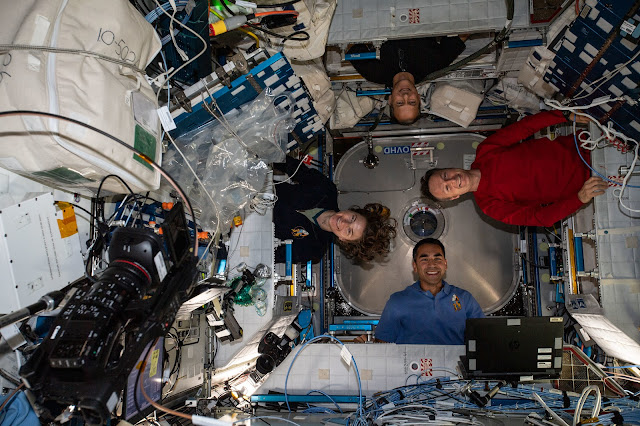
Image above: Clockwise from bottom, astronauts Raja Chari, Kayla Barron, Thomas Marshburn and Matthias Maurer are pictured during a playful portrait aboard the station. Image Credit: NASA.

NASA Flight Engineer Raja Chari swabbed bacteria samples today and began sequencing their DNA with the BioMole Facility to understand the microbial environment on the station. Thomas Marshburn of NASA photographed operations for the Plant Habitat-05 experiment that is studying cotton genetics. Finally, NASA astronaut Kayla Barron set up an AstroBee robotic free flyer with an experimental audio sensor that may possibly identify early indications of space hardware failure.

The three NASA astronauts also joined ESA (European Space Agency) Matthias Maurer and reviewed their procedures for a variety of emergency scenarios aboard the SpaceX Crew Dragon vehicle. The quartet trained on a computer for unlikely events such as a fire, a depressurization, and an emergency undocking in the Crew Dragon spacecraft.

International Space Station (ISS). Animation Credit: NASA

The station’s other NASA astronaut, Mark Vande Hei, had Monday morning off before going into the afternoon working on experimental gear that may maintain safe temperatures in U.S. spacesuits. Vande Hei, along with cosmonaut Pyotr Dubrov, are due to depart the station in the spring after nearly a year in space.

The next spacewalk at the International Space Station is targeted for Jan. 19 to outfit the Nauka multipurpose laboratory module. Cosmonauts Dubrov and Anton Shkaplerov started Monday morning inspecting the spacewalking tools they will use to configure and finish connecting Nauka to the station’s Russian segment.

Related links:

Expedition 66: https://www.nasa.gov/mission_pages/station/expeditions/expedition66/index.html

Plant Habitat-05: https://www.nasa.gov/mission_pages/station/research/experiments/explorer/Investigation.html?#id=8341

Audio sensor: https://www.nasa.gov/mission_pages/station/research/experiments/explorer/Investigation.html?#id=7860

Nauka multipurpose laboratory module: https://www.roscosmos.ru/tag/nauka/

Space Station Research and Technology: https://www.nasa.gov/mission_pages/station/research/overview.html

International Space Station (ISS): https://www.nasa.gov/mission_pages/station/main/index.html

Image (mentioned), Animation (mentioned), Text, Credits: NASA/Mark Garcia.

Best regards, Orbiter.ch

samedi 1 janvier 2022

NASA Zeroing in on Path Forward for Lucy Solar Array


NASA - LUCY Mission patch.


Jan 1, 2022

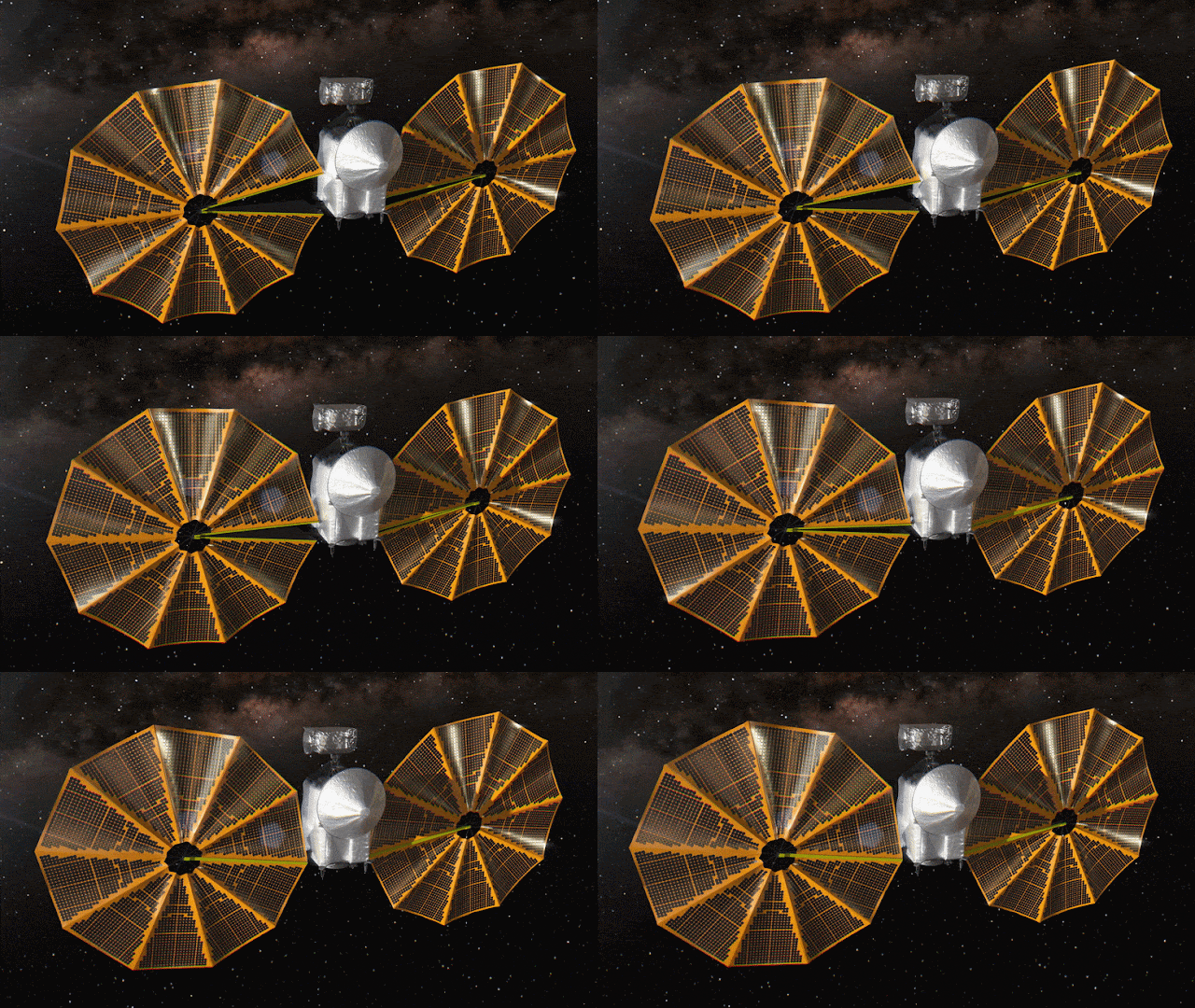
(Update Dec 8, 2021) NASA plans to conduct additional ground tests on an engineering model of the Lucy solar array motor and lanyard prior to potentially attempting full deployment of one of the probe’s solar arrays.

A project team completed an assessment Dec. 1 of the ongoing solar array issue, which did not appear to fully deploy as planned after launch in late October. Initial ground tests determined additional motor operations are required to increase the probability of the latching Lucy’s array in place as intended, and the team has recommended additional testing.

Lucy solar array deployment

Spacecraft operations included discharging and charging the battery while pointed at Earth, moving the spacecraft to point to the Sun, operating the solar array motor with the launch day parameters, moving back to pointing at Earth, and then another battery discharge and recharge. The solar arrays charge the batteries, then the batteries are deliberately discharged, and the solar array circuits are used to recharge the batteries; performing these charging and discharging processes gives the team more information about the solar array circuits.

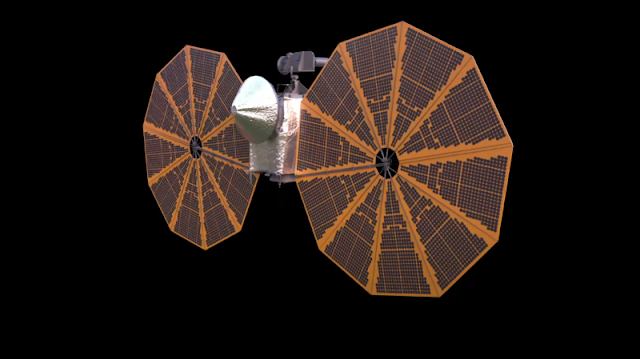
The team gathered information on two of the 10 gores – the individual solar array panel segments that make up the full array — that previously had no data. NASA now has data on all 10 gores confirming they are open, producing power as expected, and not stuck

NASA's Lucy spacecraft Solar Array deployed

These activities are helping the agency create a robust plan for attempting to fully deploy the array. Additional ground tests using the engineering model setup will validate a two-motor attempt for full deployment. NASA currently is creating a schedule and the resources needed to support that effort, as well as continuing to study the possibility of leaving the array as is.

Related articles:

NASA Team Remains Focused on Lucy’s Solar Arrays
https://orbiterchspacenews.blogspot.com/2021/10/nasa-team-remains-focused-on-lucys.html

NASA, ULA Launch Lucy Mission to ‘Fossils’ of Planet Formation
https://orbiterchspacenews.blogspot.com/2021/10/nasa-ula-launch-lucy-mission-to-fossils.html

For more information about NASA's Lucy mission, visit:

https://www.nasa.gov/mission_pages/lucy/overview/index

Animation, Image, Text, Credits: NASA/Karen Fox/JPL-Caltech.

Best regards, Orbiter.ch

Biden-Harris Administration Extends Space Station Operations Through 2030


ISS - International Space Station patch.


Jan 1, 2022

NASA Administrator Bill Nelson announced today the Biden-Harris Administration’s commitment to extend International Space Station (ISS) operations through 2030, and to work with our international partners in Europe (ESA, European Space Agency), Japan (JAXA, Japan Aerospace Exploration Agency), Canada (CSA, Canadian Space Agency), and Russia (State Space Corporation Roscosmos) to enable continuation of the groundbreaking research being conducted in this unique orbiting laboratory through the rest of this decade.


Image above: The space station is viewed from the SpaceX Cargo Dragon during its automated approach before docking. Image Credit: NASA TV.

“The International Space Station is a beacon of peaceful international scientific collaboration and for more than 20 years has returned enormous scientific, educational, and technological developments to benefit humanity. I’m pleased that the Biden-Harris Administration has committed to continuing station operations through 2030,” Nelson said. “The United States’ continued participation on the ISS will enhance innovation and competitiveness, as well as advance the research and technology necessary to send the first woman and first person of color to the Moon under NASA’s Artemis program and pave the way for sending the first humans to Mars. As more and more nations are active in space, it’s more important than ever that the United States continues to lead the world in growing international alliances and modeling rules and norms for the peaceful and responsible use of space.”

Over the past two decades, the United States has maintained a continuous human presence in orbit around the Earth to test technologies, conduct scientific research, and develop skills needed to explore farther than ever before. The unique microgravity laboratory has hosted more than 3,000 research investigations from over 4,200 researchers across the world and is returning enormous scientific, educational, and technological developments to benefit people on Earth. Nearly 110 countries and areas have participated in activities aboard the station, including more than 1,500,000 students per year in STEM activities.


Image above: This composite image made from seven frames shows the International Space Station, with a crew of seven onboard, in silhouette as it transits the Sun at roughly five miles per second, Friday, June 25, 2021, from near Nellysford, Va. Onboard are Expedition 65 NASA astronauts Megan McArthur, Mark Vande Hei, Shane Kimbrough, ESA (European Space Agency) astronaut Thomas Pesquet, Japan Aerospace Exploration Agency (JAXA) astronaut Akihiko Hoshide, and Roscosmos cosmonauts Pyotr Dubrov and Oleg Novitskiy. At the time of the transit, Kimbrough and Pesquet were working outside on the station’s port 6 truss to install the second Roll-Out Solar Array (iROSA) on the 4B power channel. Image Credits: NASA/Joel Kowsky.

Instruments aboard the ISS, used in concert with free-flying instruments in other orbits, help us measure the stresses of drought and the health of forests to enable improved understanding of the interaction of carbon and climate at different time scales. Operating these and other climate-related instruments through the end of the decade will greatly increase our understanding of the climate cycle.

International Space Station (ISS). Animation Credit: ESA

Extending operations through 2030 will continue another productive decade of research advancement and enable a seamless transition of capabilities in low-Earth orbit to one or more commercially owned and operated destinations in the late 2020s. The decision to extend operations and NASA’s recent awards to develop commercial space stations together ensure uninterrupted, continuous human presence and capabilities; both are critical facets of NASA’s International Space Station transition plan.

Station Time in Orbit

Download the Space Station: 2022 Calendar: https://www.nasa.gov/sites/default/files/atoms/files/2022_iss_calendar.pdf

Related link:

International Space Station (ISS):  https://www.nasa.gov/mission_pages/station/main/index.html

Images (mentioned), Animation (mentioned), Text, Credits: NASA/Brian Dunbar.

Greetings, Orbiter.ch

The first ISS orbit correction in 2022 is scheduled for January 12


ROSCOSMOS - Russian Vehicles patch.


Jan 1, 2022

The planned correction of the orbital altitude of the International Space Station is scheduled for January 12, 2022 and is carried out in order to form ballistic (and orbit) conditions before the launch of the Soyuz MS-21 manned spacecraft into orbit and the Soyuz MS-19 landing.

International Space Station (ISS)

According to preliminary data from the ballistic and navigation support service of the TsNIIMash Flight Control Center (part of the Roscosmos State Corporation), at 21:09 Moscow time, a command will be issued to turn on the engines of the Progress MS-18 cargo vehicle, which will operate for 292.5 seconds ... The impulse will be 0.54 m / s. After carrying out the corrective maneuver, the station's orbit altitude will increase by 850 meters, and the average orbital altitude will increase to 417.73 km.

The parameters of the ISS orbit after the corrective maneuver should be:

- Orbital period: 92.87 min;

- Orbital inclination: 51.66 degrees;

- Minimum orbit altitude: 414.69 km;

- Maximum orbital altitude: 436.87 km.


Currently, a crew of Roscosmos cosmonauts, ISS commander Anton Shkaplerov and Peter Dubrov, as well as NASA astronauts Mark Vande Hei, Raja Chari, Thomas Marshburn, Keila Barron and ESA astronaut Matthias Maurer are working on board the International Space Station.

Related links:

ROSCOSMOS Press Release: https://www.roscosmos.ru/33744/

TsNIIMash: https://www.roscosmos.ru/tag/cniimash/

MCC: https://www.roscosmos.ru/tag/cup/

International Space Station (ISS): https://www.roscosmos.ru/tag/mks/

Image, Text, Credits: ROSCOSMOS/MCC/Orbiter.ch Aerospace/Roland Berga.

Best regards, Orbiter.ch

10 people met the New Year in space


ISS - International Space Station emblem.


CMS - China Manned Space logo.


Jan 1, 2022

The celebration of the New Year 2022 in near-earth orbit was first met by ten earthlings at once: seven on the International Space Station and three on the Chinese space station "Tiangong". It was the most crowded New Year's "feast" in orbit in the history of world manned space exploration.

In the early years of the space program, holidays in space were relatively rare and therefore even more memorable. The first cosmonauts to celebrate the New Year in space were Yuri Romanenko and Georgy Grechko in 1977-1978.

ISS - Expedition 66 Crew

As space travel became more prolonged, holidays in space became more common. With the appearance of the Soviet Mir station in 1986, the New Year began to be celebrated regularly: 12 Mir crews spent this holiday in orbit.

The arrival on board the International Space Station of the first long-term expedition (Sergei Krikalev, Yuri Gidzenko and William Shepard) on November 2, 2000, marked the beginning of the permanent human presence in space. They were the first to celebrate the New Year at the new station. For 21 years, 83 people met the New Year on the ISS, some of the cosmonauts and astronauts repeatedly, and the cosmonaut of Roscosmos Anton Shkaplerov celebrated four New Years in orbit (in 2011-2012, in 2014-2015, in 2017-2018. and 2021-2022).

CSS - Shenzhou-13 Crew

“The most interesting fact from my biography is that I will celebrate the New Year in orbit for the 64th time! This will happen because we orbit the Earth 16 times per day, - says Roscosmos cosmonaut Anton Shkaplerov. “Thus, we cross the conditional line over the Earth 16 times, where at the moment it is midnight, and people raise their glasses of champagne and wish each other a Happy New Year!”

The Year of the Tiger in orbit was met by Roscosmos cosmonauts Anton Shkaplerov and Petr Dubrov, NASA astronauts Mark Vande Hei, Thomas Marshburne, Raja Chari, Keila Barron and ESA astronaut Mathias Maurer, while on the International Space Station, as well as Zhang Zhigang, Wang Yapuin and Ye Guangf aboard the Tiangong station.

Related links:

ROSCOSMOS Press Release: https://www.roscosmos.ru/33743/

Expedition 66: https://www.roscosmos.ru/tag/mks-66/

International Space Station (ISS): https://www.roscosmos.ru/tag/mks/

Images, Text, Credits: ROSCOSMOS/CNSA/Orbiter.ch Aerospace/Roland Berga.

Greetings, Orbiter.ch

New images from Tianwen-1 and Zhurong


CNSA - Tianwen-1 (天問-1) Mission to Mars logo.


Jan 1, 2022

New image from Tianwen-1

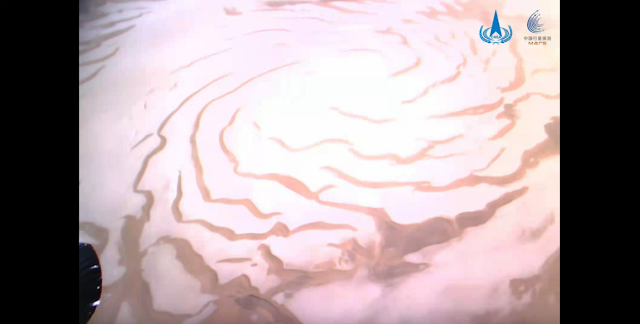
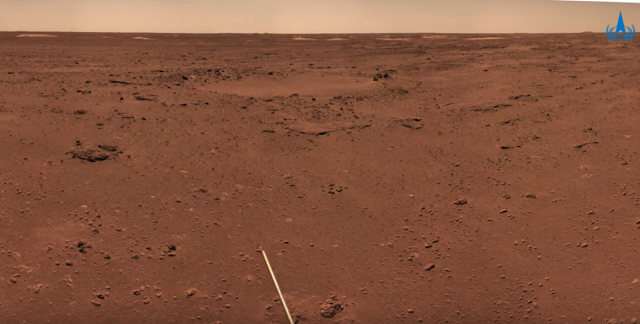
On 1 January 2022, the China National Space Administration (CNSA) released new images from the Tianwen-1 orbiter and the Zhurong rover. The Tianwen-1 orbiter was captured in orbit around Mars by a camera released from the orbiter.

New images from Tianwen-1 and Zhurong

The panorama is composed from three images recently obtained by the Zhurong rover using the Navigation and Terrain Camera (NaTeCam). Tianwen-1 (天问一号) is China’s first Mars exploration mission with an orbiter, a lander and a rover named Zhurong (祝融).

New image from Zhurong

Related articles:

China’s Mars rover has amassed reams of novel geological data
https://orbiterchspacenews.blogspot.com/2021/11/chinas-mars-rover-has-amassed-reams-of.html

Tianwen-1 orbiter enters into its science orbit
https://orbiterchspacenews.blogspot.com/2021/11/tianwen-1-orbiter-enters-into-its.html

Zhurong's first weather report from Mars & Tianwen-1 orbiter delays move into science orbit
https://orbiterchspacenews.blogspot.com/2021/08/zhurongs-first-weather-report-from-mars.html

Zhurong completes its designed mission
https://orbiterchspacenews.blogspot.com/2021/08/zhurong-completes-its-designed-mission.html

Tianwen-1 and Zhurong – a new phase of Mars exploration
https://orbiterchspacenews.blogspot.com/2021/08/tianwen-1-and-zhurong-new-phase-of-mars.html

Tianwen-1 Mission to Mars - Close-Up of Zhurong’s Parachute
https://orbiterchspacenews.blogspot.com/2021/07/tianwen-1-mission-to-mars-close-up-of.html

Tianwen-1 Mission to Mars - New images from Zhurong
https://orbiterchspacenews.blogspot.com/2021/07/tianwen-1-mission-to-mars-new-images.html

Zhurong landing on Mars & Sounds of Zhurong’s descend onto Mars
https://orbiterchspacenews.blogspot.com/2021/06/zhurong-landing-on-mars-sounds-of.html

Zhurong rover and Tianwen-1 lander on Mars
https://orbiterchspacenews.blogspot.com/2021/06/zhurong-rover-and-tianwen-1-lander-on.html

Tianwen-1 Lander and Zhurong Rover seen by NASA’s Mars Reconnaissance Orbiter
https://orbiterchspacenews.blogspot.com/2021/06/tianwen-1-lander-and-zhurong-rover-seen.html

Zhurong is roving on Mars!
https://orbiterchspacenews.blogspot.com/2021/05/zhurong-is-roving-on-mars.html

Why the China Mars rover’s landing site has geologists excited & Zhurong’s first images from Mars
https://orbiterchspacenews.blogspot.com/2021/05/why-china-mars-rovers-landing-site-has.html

Tianwen-1 orbiter relays Zhurong rover’s data and images
https://orbiterchspacenews.blogspot.com/2021/05/tianwen-1-orbiter-relays-zhurong-rovers.html

Zhurong landed on Mars! The Tianwen-1 rover is on Utopia Planitia (Videos)
https://orbiterchspacenews.blogspot.com/2021/05/zhurong-landed-on-mars-tianwen-1-rover.html

China succeeds in landing its rover on Mars
https://orbiterchspacenews.blogspot.com/2021/05/china-succeeds-in-landing-its-rover-on.html

Related link:

For more information about China National Space Administration (CNSA), visit: http://www.cnsa.gov.cn/
 
Images, Video, Text, Credits: China National Space Administration (CNSA)/China Media Group(CMG)/China Central Television (CCTV)/SciNews/Orbiter.ch Aerospace/Roland Berga.

Best regards & Happy New Year 2022, Orbiter.ch