jeudi 11 juin 2020

Bizarre nearby star offers clues to origins of mysterious fast radio bursts


NASA - Swift Mission patch.

June 11, 2020

The first fast radio burst detected in our Galaxy comes from a magnetized star, and could help to explain these cosmic enigmas.

An artist's impression of a magnetar.Credit: ESO/L. Calçada.

For a fraction of a second in late April, a hyper-magnetized star in the Milky Way suddenly blasted out radio energy. Now scientists say that this sudden, strange blip could help to explain one of astronomy’s biggest puzzles: what powers the hundreds of other mysterious fast radio bursts (FRBs) that have been spotted much farther away in the Universe.

The star, known as SGR 1935+2154, is a magnetar — a dense, spinning ember left behind after a supernova and wrapped in intense magnetic fields. Many astronomers think that fast radio bursts — brief but powerful cosmic flashes that flare for just milliseconds — come from magnetars, but haven’t been able to show the link.

“I wouldn’t say it’s the nail in the coffin that we’ve figured out that fast radio bursts come from magnetars,” says Emily Petroff, an astronomer at the University of Amsterdam in the Netherlands. “But it’s by far the most promising piece of evidence that we’ve found.”

Preliminary papers describing the burst, which is the first to be detected in the Milky Way, have flooded the arXiv preprint server in recent days.

Until now, the closest known fast radio burst happened around 150 million parsecs (490 million light years) from Earth. This magnetar is in our Galaxy just 10,000 parsecs away, making it close enough for astronomers to have a great view as it sizzles with activity. “Here is something that gets close to the insane intensity of cosmic FRBs, but that is happening not so far away,” says Sarah Burke Spolaor, an astronomer at West Virginia University in Morgantown. “It’s a fantastic opportunity to learn about at least one of the sources that could be causing FRBs.”

Cake-tin telescope

The show began on 27 April, when satellites including NASA’s Neil Gehrels Swift Observatory spotted γ-rays streaming from SGR 1935+2154. The star is one of about 30 known magnetars in the Milky Way; these occasionally go through spurts of activity during which they emit radiation at different wavelengths. The next day, the Canadian Hydrogen Intensity Mapping Experiment (CHIME) radio telescope in Penticton, Canada, detected a huge radio flash occurring to the side of its field of view — from the place in the sky where the magnetar lay1.

Swift Observatory spacecraft. Image Credit: NASA

The CHIME team had been hoping to pick up radio emission from SGR 1935+2154. But they were expecting faint radio pulses. Instead, “we got something much more exciting”, says Paul Scholz, an astronomer at the University of Toronto who led the analysis.

A second research team got even luckier by catching the intense burst full-on. The STARE2 radio telescope is made of low-tech antennas — each consists of a metal pipe with two cake tins attached — at two locations in California and one in Utah. STARE2 has been observing the sky since last year, hoping to catch something resembling a fast radio burst in the Milky Way. On 28 April, it did exactly that, detecting the same radio pulse that CHIME saw2. “I was so excited that it took me a little bit of time to open up the data and inspect it, to make sure it was real,” says Chris Bochenek, a graduate student at the California Institute of Technology (Caltech) in Pasadena who works on STARE2. “Chris messaged us on Slack, and fairly unrepeatable things were said,” says Vikram Ravi, an astronomer at Caltech and Bochenek’s co-adviser.

Canadian Hydrogen Intensity Mapping Experiment (CHIME)

Energy outburst

The radio flash is by far the brightest ever seen from a magnetar in the Milky Way, and could offer clues to what causes fast radio bursts seen elsewhere in the Universe.

Because magnetars are spinning quickly and have powerful magnetic fields, they have huge reservoirs of energy that can produce outbursts. One idea about the source of these outbursts is that something happening inside the magnetar — such as a ‘starquake’, analogous to an earthquake — could crack its surface and release energy. Another possibility is that the highly magnetized environment around the magnetar somehow produces the burst.

Astronomers might be able to narrow down these possibilities by studying both the radio burst from SGR 1935+2154 and bursts in other wavelengths of light that happened simultaneously, says Laura Spitler, an astronomer at the Max Planck Institute for Radioastronomy in Bonn, Germany. Several satellites detected X-ray bursts from the magnetar at around the same time as the radio emission. It is the first time astronomers have detected these signals in other wavelengths; seeing them was possible only because the magnetar is so close to Earth.

But some mysteries remain. For one thing, the 28 April burst was about 1,000 times less energetic than fast radio bursts seen in distant galaxies. And some distant bursts repeat at intervals that can’t easily be explained as coming from a magnetar. Perhaps some, but not all, fast radio bursts come from magnetars, says Petroff.

Astronomers still want to collect as many examples of fast radio bursts as they can, both near and far away. “Each serves as a kind of backlight shining through all the material between us and the source,” says Jason Hessels, an astronomer at the University of Amsterdam. Scientists have recently started to use that information to map the distribution of matter in the Universe6.

“There’s an exciting future to the field,” says Hessels, “even if this is more or less the answer to where the bursts are coming from.”

doi: 10.1038/d41586-020-01666-1

References:

1. The CHIME/FRB Collaboration. Preprint at arXiv https://arxiv.org/abs/2005.10324 (2020).

2. Bochenek, C. D. et al. Preprint at arXiv https://arxiv.org/abs/2005.10828 (2020).

3. Borghese, A. et al. Preprint at arXiv https://arxiv.org/abs/2006.00215 (2020).

4. Tavani, M. et al. Preprint at arXiv https://arxiv.org/abs/2005.12164 (2020).

5. Li, C. K. et al. Preprint at arXiv https://arxiv.org/abs/2005.11071 (2020).

6. Macquart, J.-P. et al. Nature 581, 391–395 (2020).

Related links:

Max Planck Institute for Radioastronomy: https://www.mpifr-bonn.mpg.de/2169/en

STARE2 radio telescope: https://arxiv.org/abs/2001.05077

Canadian Hydrogen Intensity Mapping Experiment (CHIME): https://chime-experiment.ca/

NASA's Swift Observatory: https://www.nasa.gov/mission_pages/swift/main

Images (mentioned), Text, Credits: NATURE/Alexandra Witze.

Greetings, Orbiter.ch

CASC - HaiYang-1D launched by Long March-2C


CASC - China Aerospace Science and Technology Corporation logo.

June 11, 2020

Long March-2C carrying Haiyang-1D (HY-1D) satellite lift off

A Long March-2C launch vehicle launched the Haiyang-1D (HY-1D) satellite from the Taiyuan Satellite Launch Center, Shanxi Province, northern China, on 10 June 2020, at 18:30 UTC (11 June, at 02:30 local time).

HaiYang-1D launched by Long March-2C

HY-1D is China’s fourth remote-sensing satellite for ocean observation. Along with HaiYang-1C (launched on 7 September 2018), HY-1D will form China’s first satellite constellation for marine civil service.

Haiyang-1D (HY-1D) satellite

For more information about China Aerospace Science and Technology Corporation (CASC): http://english.spacechina.com/n16421/index.html

Images, Video, Text, Credits: Credits: CASC/China Central Television (CCTV)/SciNews/Günter Space Page/Orbiter.ch Aerospace/Roland Berga.

Greetings, Orbiter.ch

mercredi 10 juin 2020

Station Buzzing With Science in Middle of Spacewalk Preps


ISS - Expedition 63 Mission patch.

June 10, 2020

The International Space Station is buzzing today with a broad array of research to improve life for humans on and off the Earth. The five-person Expedition 63 crew has also been preparing for a set of spacewalks as the pace of space science ramps up.

The orbital residents are bringing the orbital lab back up to speed to help scientists harness the benefits of space phenomena. Today, the three NASA astronauts and two Roscosmos cosmonauts juggled a variety of experiments encompassing fluids, combustion, genetics and vision among others.


Image above: A wispy “aurora australis” seemingly intersects with the Earth’s airglow as the space station orbited above the Indian Ocean halfway between Australia and Antarctica. Image Credit: NASA.

NASA Flight Engineers Doug Hurley and Bob Behnken spent part of the morning continuing to observe how bubbles behave in microfluid systems. Hurley then started another experiment to look at how tanks of various shapes affect fluids and gases. Both studies have the potential to impact future aerospace and medicine technologies.

The duo also worked on U.S. spacesuits ahead of planned spacewalks to continue upgrading power systems on the outside of the space station. They later split up as Behnken worked on a genetic analyzer that can provide results in just a few hours, much faster than previous research methods. At the end of the day, Hurley joined NASA Commander Chris Cassidy for ultrasound eye scans to examine the cornea, lens and optic nerve.


Cassidy spent a portion his day replacing components in the treadmill located in the Tranquility module. He also began setting up the new Spectrum imager that will use multiple wavelengths to view the cellular and tissue growth of botany samples.

Russian Flight Engineer Anatoly Ivanishin replaced laptop computer batteries then swapped fuel bottles inside the Combustion Integrated Rack to continue safe fuel and flame research. Fellow cosmonaut Ivan Vagner unpacked cargo from the Progress 75 resupply ship and set up a cinematic virtual reality camera to film station activities for audiences on Earth.

Related links:

Expedition 63: https://www.nasa.gov/mission_pages/station/expeditions/expedition63/index.html

Commercial Crew Program: http://www.nasa.gov/commercialcrew

Bubbles: https://www.nasa.gov/mission_pages/station/research/experiments/explorer/Investigation.html?#id=1939

Tanks of various shapes: https://www.nasa.gov/mission_pages/station/research/experiments/explorer/Investigation.html?#id=7329

Genetic analyzer: https://www.nasa.gov/mission_pages/station/research/experiments/explorer/Facility.html?#id=1086

Tranquility module: https://www.nasa.gov/mission_pages/station/structure/elements/tranquility/

Spectrum imager: https://www.nasa.gov/mission_pages/station/research/experiments/explorer/Investigation.html?#id=8092

Combustion Integrated Rack: https://www.nasa.gov/mission_pages/station/research/experiments/explorer/Facility.html?#id=317

Fuel and flame research: https://www.nasa.gov/mission_pages/station/research/experiments/explorer/Investigation.html?#id=1651

Cinematic virtual reality camera: https://www.nasa.gov/mission_pages/station/research/experiments/explorer/Investigation.html?#id=7877

Space Station Research and Technology: https://www.nasa.gov/mission_pages/station/research/overview.html

International Space Station (ISS): https://www.nasa.gov/mission_pages/station/main/index.html

Image (mentioned), Animation (mentioned), Text, Credits: NASA/Mark Garcia.

Best regards, Orbiter.ch

mardi 9 juin 2020

Allen initiative – supported by CERN openlab – key to LHCb trigger upgrade


CERN - European Organization for Nuclear Research logo.

9 June, 2020

From 2021, the first stage of the LHCb experiment’s high-level trigger system will be run using GPUs. Investigations into the feasibility of this change were supported through a CERN openlab project.

(Image: LHCb/CERN)

Last week, the LHC Experiments Committee formally accepted a proposal for a new first stage of the high-level trigger (HLT) for LHCb. LHCb is one of the four main experiments on the Large Hadron Collider (LHC). It is exploring what happened after the Big Bang that allowed matter to survive and build the Universe we see today.

Like the other experiments on the LHC, LHCb uses a ‘trigger’ system to filter the huge amount of data produced by particle-collision events within its detectors. About 1 in 500 collision events are selected for further analysis. This trigger system is split into two levels: HLT 1, which reduces the data rate from around 40Tbit/s to 1–2 Tbit/s, and HLT 2, which reduces this further to 80 Gbit/s. This is then sent to storage and analysed using the Worldwide LHC Computing Grid (WLCG).

Until now, both HLT 1 and HLT 2 have been carried out using a farm of traditional computer chips called CPUs, which stands for ‘central processing unit’. The new system – set to go into production in 2021 – will see HLT 1 run instead on graphical processing units (GPUs). The highly parallelised structure of GPUs can make them more efficient than general-purpose CPUs for running algorithms that process large blocks of data in parallel.

Researchers at LHCb have been exploring the potential of GPUs for their trigger systems since around 2013. Building on that foundational work, this new system is the specific result of intense investigations carried out over the last two years, through an initiative called Allen, which is named after the pioneering computer scientist Frances Elizabeth Allen. The three lead developers for the Allen team are, Dorothea vom Bruch, a postdoctoral researcher from the French Laboratory of Nuclear and High-Energy Physics (LPNHE); Daniel Cámpora, a postdoctoral researcher from the University of Maastricht and the Dutch National Institute for Subatomic Physics (Nikhef), who was a PhD student during most of Allen’s development, co-supervised between CERN and the University of Sevilla in Spain; and Roel Aaij, a software engineer at Nikhef, who also played a major role in the development and commissioning of LHCb’s Run 1 and 2 HLT systems.

The lead developers of the Allen initiative (Image: CERN)

The Allen team’s new system can process 40 Tbit/s, using around 500 NVIDIA Tensor Core GPUs. It matches – from a physics point of view – the reconstruction performance for charged particles achieved on traditional CPUs. It has also been shown that the Allen system will not be limited in terms of memory capacity or bandwidth. Plus, not only can it be used to perform reconstruction, but it can also take decisions about whether to keep or reject collision events.

A diverse range of algorithms has been implemented efficiently on Allen. This demonstrates the potential for GPUs not only to be used as computational accelerators in high-energy physics, but also as complete and standalone data-processing solutions. Other LHC experiments are also investigating the potential of GPUs; the ALICE experiment already used them in production for their HLT in Run 2.

“We knew that this was an interesting avenue to explore, but we were surprised it worked out so quickly,” says Vladimir Gligorov of LPNHE, who leads LHCb’s Real Time Analysis project. “Over the last two years, the LHCb HLT team made the CPU HLT almost ten times faster, so it could work as planned, which is itself a huge achievement, and then this blue-skies project paid off as well. Now we can have the best of both worlds.”

The Allen initiative has received support through a CERN openlab project with the Italian company E4 Computer Engineering, which deploys hardware from NVIDIA. This project provides a testbed for GPU-accelerated applications, with several use cases spread across various LHC experiments.

“Through the CERN openlab project, the team was able to capitalise on E4 Computer Engineering’s expertise and strong links with NVIDIA,” explains Maria Girone, CERN openlab CTO. “This helped ensure the team was supplied with GPUs on which to run tests, and meant there was a good link with the NVIDIA engineers, who provided advice for helping to make the code run as efficiently as possible on the GPUs. This kind of interaction with industry plays an important role in accelerating innovation and helps us to solve the computing challenges posed by the LHC’s ambitious upgrade programme.”

“CERN openlab has played an important role in bringing together various teams across the laboratory and the experiments who are exploring the potential of GPUs,” explains Gligorov. “Seeing that others were exploring this technology too helped give us the confidence to push forward with these investigations. We’re certainly glad we did, as they’ve really paid off.”

This article originally appeared on the CERN openlab website. Read more about the new HLT 1 system in an article published on 30 April in the journal Computing and Software for Big Science:

https://openlab.cern/allen-initiative-supported-cern-openlab-key-lhcb-trigger-upgrade

https://link.springer.com/article/10.1007%2Fs41781-020-00039-7

Note:

CERN, the European Organization for Nuclear Research, is one of the world’s largest and most respected centres for scientific research. Its business is fundamental physics, finding out what the Universe is made of and how it works. At CERN, the world’s largest and most complex scientific instruments are used to study the basic constituents of matter — the fundamental particles. By studying what happens when these particles collide, physicists learn about the laws of Nature.

The instruments used at CERN are particle accelerators and detectors. Accelerators boost beams of particles to high energies before they are made to collide with each other or with stationary targets. Detectors observe and record the results of these collisions.

Founded in 1954, the CERN Laboratory sits astride the Franco–Swiss border near Geneva. It was one of Europe’s first joint ventures and now has 23 Member States.

Related links:

Large Hadron Collider (LHC): https://home.cern/science/accelerators/large-hadron-collider

LHCb: https://home.cern/science/experiments/lhcb

Worldwide LHC Computing Grid (WLCG): https://home.cern/science/computing/worldwide-lhc-computing-grid

Frances Elizabeth Allen: https://amturing.acm.org/award_winners/allen_1012327.cfm

CERN openlab: https://openlab.cern/

E4 Computer Engineering: https://openlab.cern/members/e4-computer-engineering

For more information about European Organization for Nuclear Research (CERN), Visit: https://home.cern/

Images (mentioned), Text, Credits: CERN/Andrew Purcell.

Best regards, Orbiter.ch

Space Bubbles, Advanced Optics Benefiting Earthlings, Astronauts


ISS - Expedition 63 Mission patch.

June 9, 2020

A pair of space freighters from Russia and Japan docked to the International Space Station are getting attention today as the Expedition 63 crew works on a variety of space experiments.

NASA Flight Engineers Doug Hurley and Bob Behnken have nearly finished unpacking Japan’s HTV-9 cargo craft which arrived May 25. They have been carefully transferring several tons of new station hardware and science experiments and distributing it throughout the station.


Image above: Japan’s HTV-9 resupply ship is pictured dwarfing the Moon behind it. Nearly hidden at the top center is the SpaceX Crew Dragon vehicle. Image Credit: NASA.

Both astronauts also continued their research into space bubbles and how they behave in microfluid systems. Results from the study may improve spacecraft oxygen generation systems and drug delivery applications in skin patches.

One new science experiment being configured today is a high-resolution binocular telescope to be tested outside Japan’s Kibo laboratory module. Station Commander Chris Cassidy is setting up the device to demonstrate low-cost, advanced optical payloads for use by public and private institutions. Designed to be affordable and quickly developed, the cutting-edge technology imager will provide detailed views of natural phenomena and critical infrastructure on Earth.

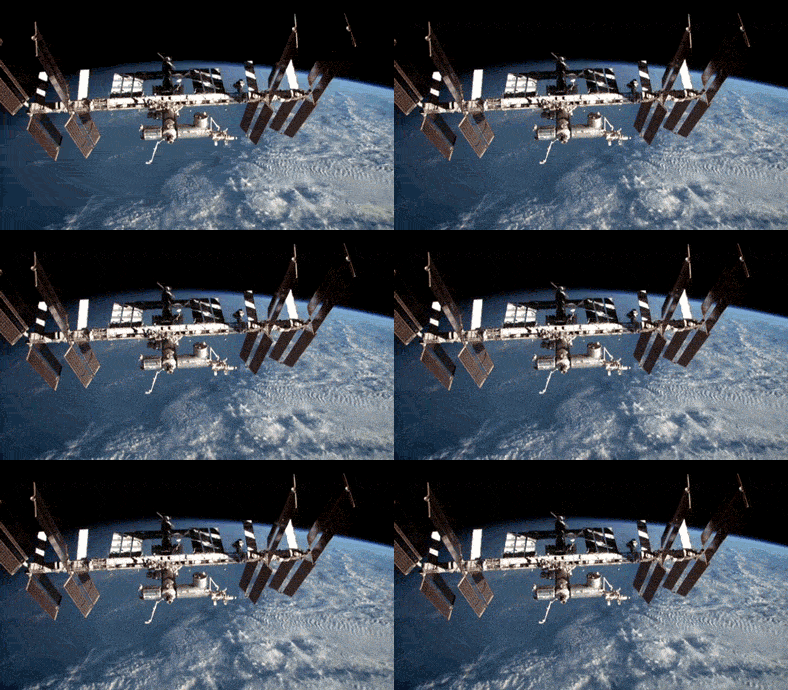
International Space Station (ISS). Animation Credit: NASA

One of two Russian resupply ships, the Progress 74 (74P), at the station is being readied for its departure in July. Cosmonaut Anatoly Ivanishin checked out navigation gear and packed trash inside the 74P that has been parked at the Pirs docking compartment since Dec. 6, 2019. The 74P will wrap up its seven-month cargo mission in early July for a fiery atmospheric disposal above the south Pacific.

He and fellow cosmonaut Ivan Vagner also ensured the upkeep of Russian life support systems. The duo later split up for an Earth photography session and the study of group dynamics between space crews and mission controllers.

Related links:

Expedition 63: https://www.nasa.gov/mission_pages/station/expeditions/expedition63/index.html

Commercial Crew Program: http://www.nasa.gov/commercialcrew

H-II Transfer Vehicle-9 (HTV-9): https://www.nasa.gov/feature/kounotori-htv-launches-arrivals-and-departures

Space bubbles: https://www.nasa.gov/mission_pages/station/research/experiments/explorer/Investigation.html?#id=1939

High-resolution binocular telescope: https://www.nasa.gov/mission_pages/station/research/experiments/explorer/Investigation.html?#id=8028

Kibo laboratory module: https://www.nasa.gov/mission_pages/station/structure/elements/japan-kibo-laboratory

Pirs docking compartment: https://www.nasa.gov/mission_pages/station/structure/elements/pirs-docking-compartment

Earth photography: https://www.energia.ru/en/iss/researches/study/09.html

Group dynamics: https://www.energia.ru/en/iss/researches/human/18.html

Space Station Research and Technology: https://www.nasa.gov/mission_pages/station/research/overview.html

International Space Station (ISS): https://www.nasa.gov/mission_pages/station/main/index.html

Image (mentioned), Animation (mentioned), Text, Credits: NASA/Mark Garcia.

Best regards, Orbiter.ch

Space Station 20th: Four Months Until the Start of Expedition 1


ISS - 20 Years on the International Space Station patch.

June 9, 2020

Crew trains in Russia; managers set Zvezda Service Module launch date; KSC readies hardware

Activities at multiple facilities in the United States, Russia and Kazakhstan continued in June 2000 in preparation for the Expedition 1 crew to take up residence aboard the International Space Station (ISS) four months later. The crew returned to Russia for a month-long training session, senior managers set the launch date for the next Russian module and at both the Baikonur Cosmodrome and the Kennedy Space Center (KSC), workers prepared the next elements for launch to continue assembly of ISS.
Above and middle: Shepherd and Gidzenko ingressing into training versions of
Orlan suits before an EVA training session in the Hydrolab at GCTC.
Bellow: Technicians lower Shepherd into the water.
 
Two views of Shepherd during a training session in the Hydrolab at GCTC
with a mockup of the Zvezda Service Module.
 
Training mockups of the Zarya (left) and Zvezda modules at GCTC.
 
Above: Expedition 1 crew of (left to right) Gidzenko, Krikalev and Shepherd training in the Zvezda mockup at GCTC. Middle: Krikalev (left) and Shepherd, with Gidzenko just out of view at right, training in the Zvezda mockup. Bellow: View inside the Zarya training mockup.

The Expedition 1 crew of Commander William M. Shepherd, Flight Engineer Sergei K. Krikalev, and Soyuz Commander Yuri P. Gidzenko and their backups Kenneth D. Bowersox, Mikhail V. Tyurin and Vladimir N. Dezhurov returned to Russia for four weeks of training between May 22 and June 16. In late May, they participated in the Crew Equipment Interface Test in the Zvezda module at Baikonur, their last look at the module before they took up residence once in orbit. Back at the Gagarin Cosmonaut Training Center (GCTC) in Star City outside Moscow, the crews trained on Soyuz-TM spacecraft systems and passed their exams on the Russian Segment radio communications system and onboard equipment control system. In GCTC’s Hydrolab, they participated with crewmembers of the STS-106 crew to train for the spacewalk planned for that mission, and trained for possible spacewalks during their long-duration expedition aboard ISS.

Above: Engineers install and test the solar arrays on Zvezda.
Middle: Weighing of Zvezda.
Bellow: Zvezda installed in its launch shroud.

Senior ISS managers met in Moscow on June 26 and confirmed the launch date for the next space station element, the Russian Zvezda Service Module, as July 12, 2000. Preparations for the launch of the module continued at Area 254 of the Baikonur Cosmodrome in Kazakhstan. Engineers installed and tested the module’s two solar arrays in early June followed by handrails and thermal blankets. They followed that on June 20 with pressurizing the module and closing its hatches in preparation for launch. Zvezda’s hatches remained closed until the STS-106 crew arrived in September. The engineers weighed the module and determined its center of mass and then placed it into its launch shroud. The Proton rocket for Zvezda’s launch arrived at Baikonur on May 28. Two other Proton launches took place on June 24 and July 5 to certify the modifications made to the rocket’s second stage following a launch failure in 1999. On June 22 flight controllers at NASA’s Johnson Space Center in Houston and at the Russian Flight Control Center in Korolev began a series of joint integrated simulations to prepare for Zvezda’s docking to ISS and integration with the Zarya and Unity modules.

Above: The P6 truss segment in the SSPF at KSC. Middle: Greene (left) and Mills during the P6 acceptance event.
Bellow: Technicians moving the High Gain Antenna prior to mating it with the Z1 truss in the SSPF.

NASA formally accepted the P6 Integrated Truss Segment from the Boeing Co. Jay H. Greene, deputy manager for the ISS Program, accepted the element at KSC’s Space Station Processing Facility (SSPF) from Joseph C. “Joe” Mills, deputy ISS program manager at Boeing. The handover followed an extensive review by an Acceptance Review Board that assessed all the engineering and testing results documents to ensure the element’s readiness for the next phase of prelaunch preparations. The 45-foot long P6 truss included two solar arrays, batteries and three radiators to provide power and cooling for the expanding space station. The P6 truss launched on the STS-97 mission in November 2000 and crews installed it atop the Z1 truss. Later in the assembly of ISS, after three other sets of solar arrays arrived with their truss segments, astronauts relocated the P6 element to the outboard end of the port truss. Elsewhere in the SSPF, engineers installed the high gain communications antenna onto the Z1 truss segment being prepared for launch aboard STS-92 in October 2000. And in KSC’s Orbiter Processing Facility, engineers began processing Space Shuttle Atlantis recently returned from the STS-101 flight for its next mission, STS-106 in September 2000.

To be continued…

Related article:

Space Station 20th: Spacewalking History
https://orbiterchspacenews.blogspot.com/2020/06/space-station-20th-spacewalking-history.html

Space Station 20th: Commercial Cargo and Crew
https://orbiterchspacenews.blogspot.com/2020/06/space-station-20th-commercial-cargo-and.html

Space Station 20th: Music on ISS
https://orbiterchspacenews.blogspot.com/2020/05/space-station-20th-music-on-iss.html

Space Station 20th – Space Flight Participants
https://orbiterchspacenews.blogspot.com/2020/05/space-station-20th-space-flight.html

Space Station 20th: Six Months Until Expedition 1
https://orbiterchspacenews.blogspot.com/2020/04/space-station-20th-six-months-until.html

Space Station 20th – Women and the Space Station
https://orbiterchspacenews.blogspot.com/2020/03/space-station-20th-women-and-space.html

Space Station 20th: Long-duration Missions
https://orbiterchspacenews.blogspot.com/2020/03/space-station-20th-long-duration.html

NASA Counts Down to Twenty Years of Continuous Human Presence on International Space Station
https://orbiterchspacenews.blogspot.com/2019/11/nasa-counts-down-to-twenty-years-of.html

20 memorable moments from the International Space Station
https://orbiterchspacenews.blogspot.com/2018/11/20-memorable-moments-from-international.html

Related links:

Expedition 1: https://www.nasa.gov/mission_pages/station/expeditions/expedition01/index.html

Crews and Expeditions: https://www.nasa.gov/subject/3545/crews-and-expeditions

International Space Station (ISS): https://www.nasa.gov/mission_pages/station/main/index.html

Images (mentioned), Text, Credits: NASA/Kelli Mars/JSC/John Uri.

Greetings, Orbiter.ch

Parking in a pandemic


ESA - Sentinel-2 Mission logo.

June 9, 2020

Parked aircraft

The coronavirus pandemic has brought the tourism and travel industry to a near-standstill, with nationwide lockdowns significantly impacting the aviation and maritime industry worldwide. Satellite images, captured by the Copernicus Sentinel-2 mission, show parked aircraft and anchored vessels in times of COVID-19.

Global aviation is facing its battle to survive, with most flights grounded since March owing to travel restrictions in place to contain the coronavirus pandemic. According to aviation industry researcher Cirium, the number of passenger jets in service is the lowest it has been in 26 years.

Parked planes

Managing large-scale storage poses a challenge for the industry, as airlines hunt for space on the ground for storage facilities. Taxiways, hangers and even runways at major airports around the world are being transformed into parking spaces for planes. These images captured by the Copernicus Sentinel-2 mission show the numerous parked planes on runways – even in remote airports such as Alice Springs in Australia.

Airport storage facilities are sometimes referred to as ‘boneyards’ owing to airlines sending retired aircraft to the desert. These boneyards are often located in dry and arid places as the climate means planes can be preserved in excellent condition before returning to service or being reused.

Teruel Airport in the Aragon province in Spain was built with this purpose in mind. According to a recent report in Reuters, the airport is hosting around 100 aircraft and the number of planes arriving per week to be parked in the airport has doubled since the start of the global pandemic.

Sentinel-2

Another sector heavily affected by the pandemic is the cruise ship industry. Major cruise lines have suspended operations to mitigate the spread of COVID-19. Cruise ship operators around the world have struggled to find open ports to disembark, while some were forced to stay anchored at sea for an extended period of time.

Manila Bay, in the Philippines, has been transformed into a parking lot for cruise ships. In this animation, around 20 vessels can be seen anchored off the coast of Manila Bay. Captured by the Copernicus Sentinel-2 mission, this animation contains a sequence of images captured on 22 April, 2 May and 22 May 2020.

Vessels docked in Manila Bay

According to Reuters, the cruise ships have been asked to wait in the Manila Bay anchorage area with hundreds of seafarers remaining on board awaiting clearance in order to return home. The famous Diamond Princess and Ruby Princess vessels are said to be among the fleet.

In order to learn more about space applications and the socio-economic impact of COVID-19, ESA and the European Commission recently unveiled the new ‘Rapid Action Coronavirus Earth observation’ dashboard, also known as RACE. The platform uses Earth observation satellite data to measure the impact of the coronavirus lockdown worldwide, and monitor post-lockdown recovery.

About the Copernicus Sentinels

The Copernicus Sentinels are a fleet of dedicated EU-owned satellites, designed to deliver the wealth of data and imagery that are central to the European Union's Copernicus environmental programme. The European Commission leads and coordinates this programme, to improve the management of the environment, safeguarding lives every day. ESA is in charge of the space component, responsible for developing the family of Copernicus Sentinel satellites on behalf of the European Union and ensuring the flow of data for the Copernicus services, while the operations of the Copernicus Sentinels have been entrusted to ESA and EUMETSAT.

Related article:

Planes have disappeared from the European sky
https://orbiterchspacenews.blogspot.com/2020/04/planes-have-disappeared-from-european.html

Related links:

Rapid Action Coronavirus Earth observation (RACE): https://race.esa.int/

Sentinel-2: http://www.esa.int/Applications/Observing_the_Earth/Copernicus/Sentinel-2/

Copernicus: http://www.esa.int/Applications/Observing_the_Earth/Copernicus

Cirium: https://www.cirium.com/thoughtcloud/tracking-the-in-storage-fleet-at-a-time-of-uncertainty/

Reuters: https://www.reuters.com/article/us-health-coronavirus-spain-planes/the-planes-in-spain-parked-neatly-on-the-plain-idUSKBN22O21M

Reuters: https://graphics.reuters.com/HEALTH-CORONAVIRUS/PHILIPPINES-CRUISESHIPS/xegvbkeaqpq/index.html?utm_source=twitter&utm_medium=Social

Images, Animation, Text, Credits: ESA/Pixabay/Contains modified Copernicus Sentinel data (2020), processed by ESA, CC BY-SA 3.0 IGO.

Greetings, Orbiter.ch