mercredi 30 mars 2022

Significant Solar Flare Erupts From Sun


NASA - Solar Dynamics Observatory (SDO) patch.


March 30, 2022

The Sun emitted a significant solar flare on March 30, 2022, peaking at 1:35 p.m. EST. NASA’s Solar Dynamics Observatory, which watches the Sun constantly, captured an image of the event.


Animation above: NASA’s Solar Dynamics Observatory captured this image of a solar flare – as seen in the bright flash in the top right portion of the image – on March 30, 2022. The image shows a subset of extreme ultraviolet light that highlights the extremely hot material in flares and which is colorized in yellow (AIA 171).

Solar flares are powerful bursts of energy. Flares and solar eruptions can impact radio communications, electric power grids, navigation signals, and pose risks to spacecraft and astronauts.

This flare is classified as an X-Class flare. X-class denotes the most intense flares, while the number provides more information about its strength. An X2 is twice as intense as an X1, an X3 is three times as intense, etc. More info on how flares are classified can be found here: https://www.swpc.noaa.gov/phenomena/solar-flares-radio-blackouts.

Solar Dynamics Observatory (SDO)

To see how such space weather may affect Earth, please visit NOAA’s Space Weather Prediction Center https://spaceweather.gov/, the U.S. government’s official source for space weather forecasts, watches, warnings, and alerts. NASA works as a research arm of the nation’s space weather effort. NASA observes the Sun and our space environment constantly with a fleet of spacecraft that study everything from the Sun’s activity to the solar atmosphere, and to the particles and magnetic fields in the space surrounding Earth.

Related links:

Space weather: https://www.nasa.gov/spaceweather

Solar Dynamics Observatory (SDO): http://nasa.gov/sdo

Animation (mentioned), Image, Text, Credits: NASA/Denise Hill.

Greetings, Orbiter.ch

Record-Setting NASA Astronaut, Crewmates Return from Space Station


ROSCOSMOS - Soyuz MS-19 Mission patch.


March 30, 2022

After extending the record for the longest single spaceflight in history by an American to 355 days, NASA astronaut Mark Vande Hei returned to Earth on Wednesday, March 30, along with Roscosmos cosmonauts Anton Shkaplerov and Pyotr Dubrov.

Soyuz MS-19 hatch closure

The trio departed the International Space Station at 3:21 a.m. EDT and made a safe, parachute-assisted landing at 7:28 a.m. (5:28 p.m. Kazakhstan time) southeast of the remote town of Dzhezkazgan, Kazakhstan.

"Mark's mission is not only record-breaking, but also paving the way for future human explorers on the Moon, Mars, and beyond," said NASA Administrator Bill Nelson. "Our astronauts make incredible sacrifices in the name of science, exploration, and cutting-edge technology development, not least among them time away from loved ones. NASA and the nation are proud to welcome Mark home and grateful for his incredible contributions throughout his year-long stay on the International Space Station."


Image above: NASA astronaut Mark Vande Hei returned to Earth on Wednesday, March 30, along with Roscosmos cosmonauts Anton Shkaplerov and Pyotr Dubrov. Image Credit: NASA Television.

Vande Hei’s extended mission will provide researchers the opportunity to observe the effects of long-duration spaceflight on humans as the agency plans to return to the Moon under the Artemis program and prepare for exploration of Mars.

Vande Hei launched April 9, 2021, alongside Russian cosmonauts Oleg Novitskiy and Pyotr Dubrov. His second journey into space of 355 days is the longest single spaceflight by a U.S. astronaut, previously held at 340 days, and gives him a lifetime total of 523 days in space. Dubrov also remained onboard for 355 days on his first spaceflight.

Soyuz MS-19 undocking and departure

Supporting NASA’s goals for future human landings on the Moon, Vande Hei completed approximately 5,680 orbits of the Earth and a journey of more than 150 million miles, roughly the equivalent of 312 trips to the Moon and back. He witnessed the arrival of 15 visiting spacecraft and new modules, and the departure of 14 visiting spacecraft.

Following post-landing medical checks, the crew will return to the recovery staging city in Karaganda, Kazakhstan, aboard Russian helicopters. Vande Hei will board a NASA plane bound for Cologne, Germany, for refueling prior to his return home. Shkaplerov and Dubrov will board a Gagarin Cosmonaut Training Center aircraft to return to their home in Star City, Russia.

Soyuz MS-19 landing

During his record mission, Vande Hei spent many hours on scientific activities aboard the space station, conducting everything from plant research to physical sciences studies.

With the undocking of the Soyuz MS-19 spacecraft with Vande Hei, Shkaplerov, and Dubrov aboard, Expedition 67 officially began aboard the station. NASA astronaut Tom Marshburn recently took over as station commander, and is joined by NASA astronauts Raja Chari and Kayla Barron, ESA (European Space Agency) astronaut Matthias Maurer, and Roscosmos cosmonauts Oleg Artemyev, Denis Matveev, and Sergey Korsakov.
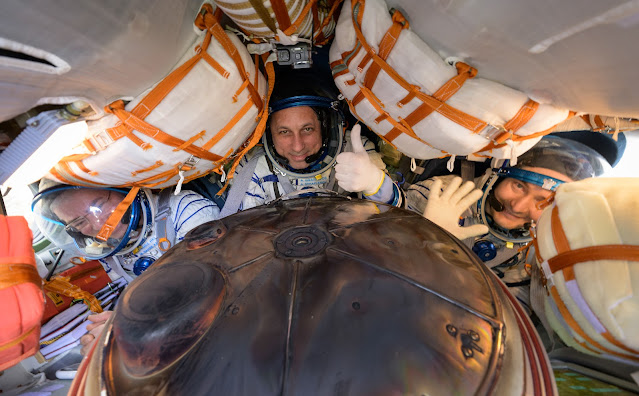

Image above: Record-setting NASA astronaut Mark Vande Hei, left, and cosmonauts Anton Shkaplerov, center, and Pyotr Dubrov of Rosccosmos are seen inside their Soyuz MS-19 spacecraft after landing in a remote area near the town of Zhezkazgan, Kazakhstan, Wednesday, March 30, 2022. Image Credits: NASA/Bill Ingalls.

Marshburn, Chari, Barron and Maurer will remain onboard until late April, when NASA astronauts Kjell Lindgren, Bob Hines, and Jessica Watkins, as well as ESA astronaut Samantha Cristoforetti launch to the station as part of NASA’s SpaceX Crew-4 mission.

Related links:

Expedition 66: https://www.nasa.gov/mission_pages/station/expeditions/future.html

Expedition 67: https://www.nasa.gov/mission_pages/station/expeditions/future.html

International Space Station (ISS): https://www.nasa.gov/mission_pages/station/main/index.html

Images (mentioned), Videos, Text, Credits: NASA/Joshua Finch/Gina Anderson/JSC/Dan Huot/NASA TV/SciNews.

Best regards, Orbiter.ch

mardi 29 mars 2022

NASA ‘Go’ for Artemis I Wet Dress Rehearsal


NASA - Artemis Exploration Mission 1 patch.


March 29, 2022

In a pre-test review on March 28, NASA gave the “go” to proceed with the Artemis I wet dress rehearsal scheduled for April 1-3. The approximately two-day test will run the Artemis I launch team through operations to load propellant into the rocket’s tanks, conduct a full launch countdown, demonstrate the ability to recycle the countdown clock, and also drain the tanks to give them an opportunity to practice the timelines and procedures they will use for launch.


Image above: NASA’s Space Launch System (SLS) rocket with the Orion spacecraft aboard is seen illuminated by spotlights atop a mobile launcher at Launch Complex 39B, Friday, March 18, 2022, after being rollout out to the launch pad for the first time at NASA’s Kennedy Space Center in Florida. Photo Credits: NASA/Joel Kowsky.

During the rehearsal, controllers will countdown to T-1 minutes and 30 seconds and pause to demonstrate the ability to hold for up to 3 minutes, then resume until 33 seconds before when launch would occur, then pause the countdown. Then they will recycle back to ten minutes before launch and conduct a second terminal countdown to approximately 9.3 seconds before launch, then end the countdown. Sometimes called a “scrub,” launch controllers may decide not to proceed with launch if a technical or weather issue arises during or prior to the countdown. At the end of the test, the team will drain the propellant to demonstrate the procedures that would be used during a launch scrub. After draining the tanks, the team will review the test data before setting an official target launch date.

NASA will provide a live video stream of the rocket and spacecraft at the launch pad beginning at Noon EDT on April 1 on the Kennedy Newsroom YouTube channel. In addition to updates on this blog, NASA also will provide operational updates on the Exploration Ground Systems Twitter account.

Related article:

Standing tall: Moon rocket milestone for Artemis
https://orbiterchspacenews.blogspot.com/2022/03/standing-tall-moon-rocket-milestone-for.html

NASA Readies Rocket for Artemis I Wet Dress Rehearsal
https://orbiterchspacenews.blogspot.com/2022/03/nasa-readies-rocket-for-artemis-i-wet.html

Related links:

Orion (spacecraft): https://www.esa.int/Science_Exploration/Human_and_Robotic_Exploration/Orion

Space Launch System (SLS): https://www.nasa.gov/exploration/systems/sls/index.html

Artemis progam: https://www.nasa.gov/artemisprogram

Image (mentioned), Text, Credit: NASA.

Greetings, Orbiter.ch

The first launch of Long March-6A


CASC - CZ-6A Y1 (Long March-6A) Mission patch.


March 29, 2022

Long March-6Acarrying Tiankun-2 (天鲲二) & Pujiang-2 (浦江二) liftoff

The first Long March-6A launch vehicle launched two satellites, Tiankun-2 (天鲲二) & Pujiang-2 (浦江二), from the Taiyuan Satellite Launch Center, Shanxi Province, northern China, on 29 March 2022, at 09:50 UTC (17:50 local time).

The first launch of Long March-6A

According to the China Aerospace Science and Technology Corporation (CASC), Long March-6A is a new generation medium-launch vehicle, with a liquid-propelled core booster and four solid-fuel side boosters, designed to send a payload of up to 4 tons into a 700km Sun-synchronous orbit.

Long March-6A (CZ-6A)

For more information about China Aerospace Science and Technology Corporation (CASC), visit: http://english.spacechina.com/n16421/index.html
 
Images, Video, Text, Credits: China Media Group(CMG)/China Central Television (CCTV)/China Aerospace Science and Technology Corporation (CASC)/SciNews/Orbiter.ch Aerospace/Roland Berga.

Best regards, Orbiter.ch

Station Crew Changes Commanders Live on NASA TV


ISS - Expedition 66 Mission patch.


March 29, 2022

NASA Television coverage of Russian cosmonaut Anton Shkaplerov’s hand over of the space station to NASA astronaut Tom Marshburn will begin at 9:45 a.m. EDT during a change of command ceremony. The event will air live on NASA TV, the NASA app, and the agency’s website.


Image above: NASA astronaut Tom Marshburn (above) assumes command of the International Space Station from cosmonaut Anton Shkaplerov. Image Credit: NASA.

Mark Vande Hei, along with Russian cosmonauts Anton Shkaplerov and Pyotr Dubrov, will close the hatch to the Soyuz MS-19 spacecraft to begin the journey back to Earth. The Soyuz will undock from the Rassvet module, heading for a parachute-assisted landing Wednesday, March 30, on the steppe of Kazakhstan, southeast of the remote town of Dzhezkazgan.

Coverage of the crew’s farewells, undocking, and landing will air live on NASA TV, the agency’s website, and the NASA app at the following times (all EDT):

- 11:30 p.m. Tuesday, March 29 – Farewells and hatch closure (at 12 a.m., Wednesday, March 30)
- 2:45 a.m. Wednesday, March 30 – Undocking (at 3:21 a.m.)
- 6:15 a.m. Wednesday, March 30 – Deorbit burn and landing (landing at 7:28 a.m. / - 5:28 p.m. Kazakhstan time)

Vande Hei and Dubrov launched April 9, 2021, on Soyuz MS-18, and will wrap up a 355-day mission spanning 5,680 orbits of Earth and more than 150 million miles. During the long-duration mission, Vande Hei broke the record for longest single spaceflight by an American astronaut, previously held at 340 days. Vande Hei will wrap up his second spaceflight with a total of 523 days in space. Shkaplerov launched on Soyuz MS-19 on Oct. 5, 2021. This was Dubrov’s first flight. Shkaplerov is ending his fourth mission with 708 cumulative days spent in space.


Image above: NASA astronaut and Expedition 66 Flight Engineer Mark Vande Hei peers at the Earth below from inside the seven-windowed cupola, the International Space Station's window to the world on Feb. 4, 2022. Just outside the cupola is the Soyuz MS-19 crew ship docked to the Rassvet module. Image Credit: NASA.

At the time of undocking, Expedition 67 will formally begin aboard the station, with new station Commander Tom Marshburn, NASA astronauts Raja Chari and Kayla Barron, ESA (European Space Agency) astronaut Matthias Maurer, and Roscosmos cosmonauts Oleg Artemyev, Denis Matveev, and Sergey Korsakov.

After landing, the Soyuz MS-19 crew will split up, as per standard crew return practice, with Vande Hei returning to his home in Houston, while the cosmonauts fly back to their training base in Star City, Russia.

Related links:

NASA TV: https://www.nasa.gov/live

Expedition 66: https://www.nasa.gov/mission_pages/station/expeditions/expedition66/index.html

Rassvet module: https://www.nasa.gov/mission_pages/station/structure/elements/rassvet

Space Station Research and Technology: https://www.nasa.gov/mission_pages/station/research/overview.html

International Space Station (ISS): https://www.nasa.gov/mission_pages/station/main/index.html

NASA/Mark Garcia.

SpaceX - Starship Could be Ready for an Orbital Flight in May


SpaceX - Starship Orbital Demo (SN-20) patch.


March 29, 2022

SpaceX has enjoyed a lot of wins in the past few years. In addition to successfully glide-testing and landing multiple Starship prototypes, they’ve rolled out its first Super Heavy boosters, test-fired the new Raptor Vacuum engines, and assembled the “Mechazilla” launch tower at Boca Chica, Texas. They also unveiled the first fully-furbished orbital test vehicle (SN20) that was stacked with a first stage booster for the first time on its launch pad (image below).

Starship at Boca Chica launch-pad

Given the prodigious rate of progress, few were surprised when Musk announced that the first orbital flight test could take place as soon as January 2022. Unfortunately, this date had to be pushed back to an environmental assessment and the usual bureaucratic rigmarole. However, Musk recently announced on Twitter that in light of his company’s success with the new Raptor engines, they could be ready to conduct the long-awaited orbital test flight this May.

The tweet was posted on Monday, March 21st, in response to a story by Michael Sheetz, a space reporter with CNBC. Sheetz cited a recent report (by Quilty Analytics) that showed how Russia’s decision to cut ties with the international space industry (in response to sanctions) would affect the U.S. space sector. This report indicates that SpaceX will be “the clear winner” as the absence of Russian launch services means more business will come their way.

Elon Musk on Twitter

According to Sheetz, this is exemplified by the recent announcement that OneWeb – a Starlink competitor – announced that it had terminated its launch agreement with Roscosmos and signed a deal with SpaceX. Musk responded via Twitter and said that he didn’t expect to see a dramatic increase in launch services for his company, which was already launching two-thirds of the world’s satellites.

According to their original plans, said Musk, SpaceX would account for 65% of the market share for launch services. The termination of Russian launch services was likely to increase this to 70%, only slightly higher. He added that this would not affect the development of the Starship, which could be ready for its long-awaited orbital test flight by May (at the earliest). This estimate is largely based on the production of the new Raptor 2 engine.

The Raptor 2 is an updated version of the Raptor 1 and is simpler and more powerful than the original. Production began in December 2021 at SpaceX’s new engine development facility near McGregor, Texas. At the annual Starship Update hosted in February, Musk spoke about the capabilities of the Raptor 2, which included 230 metric tons (510,000 lbs) of thrust at sea level. Based on their current production rates (7 per week as of March), Musk estimates that they will have 39 engines ready by April.

The engine compartment of the Starship, showing three Raptor engines. Image Credit: SpaceX

The is enough to equip one Super Heavy booster, which relies on 29 Raptor engines optimized for sea-level, and one Starship, which relies on three sea-level optimized and three vacuum-optimized engines. Add a few weeks to integrate them into the spacecraft, Musk added, and the entire system should be ready to fly by May at the earliest. But knowing Musk’s tendency to provide optimistic timetables, the flight may happen sometime this summer.

According to the flight plan filed with the FAA in May 2021, the orbital test flight will see the fully-stacked Starship and Super Heavy launch together and separate 170 seconds into flight. The booster will then perform a partial return and make a soft splashdown roughly 32 km (20 miles) offshore in the Gulf of Mexico. The Starship will then achieve an altitude of 200 km (~125 mi) above sea level before performing a targeted soft splashdown about 100 km (62 mi) off the coast of the Hawaiian island of Kauai.

If this test flight goes as planned, SpaceX will be ready to embark on its first commercial flights, including a lunar flyby planned for 2023 (the #dearMoon project). As part of NASA’s Artemis Program, the Starship was also selected to land astronauts on the Moon for the first time since the Apollo Era. This will be the Artemis III mission, which is currently scheduled to occur sometime in 2025.

Beyond that, the Starship and Super Heavy launch system are integral to SpaceX’s long-term goal of making regular trips to the Moon and Mars and establishing a permanent human presence there. As always, things may not be happening according to the original timeline. But they are coming together nicely!

Check out this latest animation of the Starship reaching Mars, courtesy of SpaceX:

Starship Animation

Related articles:

SpaceX rapidly stacks Starship and Super Heavy with ‘Mechazilla’
https://orbiterchspacenews.blogspot.com/2022/03/spacex-rapidly-stacks-starship-and.html

SpaceX is stacking its giant Starship
https://orbiterchspacenews.blogspot.com/2022/02/spacex-is-stacking-its-giant-starship.html

Related link:

SpaceX: https://www.spacex.com/

Images, Video, Text, Credits: SpaceX/Orbiter.ch Aerospace.

Greetings, Orbiter.ch

lundi 28 mars 2022

China Space Station (CSS) - Tianzhou-2 undocking and departure


CMS - China Manned Space logo.


March 28, 2022

Tianzhou-2 undocking

The Tianzhou-2 cargo spacecraft undocked from the Tianhe Core Module of the China Space Station on 27 March 2022, at 07:59 UTC (15:59 China Standard Time). According to China National Space Administration (CNSA), the Tianzhou-2 spacecraft is in good condition and will reenter into the atmosphere under ground control.

Tianzhou-2 undocking and departure

Tianzhou-2 (天舟二号) performed “China’s first fast automatic rendezvous and docking”, autonomously docking to the Tianhe Core Module (天和核心舱), the first and main component of the China Space Station (中国空间站), on 29 May 2021, at 21:01 UTC (30 May, at 05:01 China Standard Time).

Related articles & link:

CSS - Robotic Arm Transposition Test on China Space Station
https://orbiterchspacenews.blogspot.com/2022/01/css-robotic-arm-transposition-test-on.html

China Space Station - Shenzhou-13 astronauts complete second spacewalk
https://orbiterchspacenews.blogspot.com/2021/12/china-space-station-shenzhou-13_27.html

China Space Station - Shenzhou-13 mission’s second spacewalk begins
https://orbiterchspacenews.blogspot.com/2021/12/china-space-station-shenzhou-13.html

China Space Station - Shenzhou-13 crew space lecture highlights
https://orbiterchspacenews.blogspot.com/2021/12/china-space-station-shenzhou-13-crew.html

China Space Station - Shenzhou-13 astronauts complete first spacewalk
https://orbiterchspacenews.blogspot.com/2021/11/china-space-station-shenzhou-13.html

China Space Station - Astronaut Wang Yaping begins first spacewalk
https://orbiterchspacenews.blogspot.com/2021/11/china-space-station-astronaut-wang.html

What’s next for the China Space Station (CSS)
https://orbiterchspacenews.blogspot.com/2021/10/whats-next-for-china-space-station-css.html

China Space Station (CSS) - Shenzhou-13 hatch opening
https://orbiterchspacenews.blogspot.com/2021/10/china-space-station-css-shenzhou-13.html

China Space Station - Shenzhou-13 mission
https://orbiterchspacenews.blogspot.com/2021/10/china-space-station-shenzhou-13-mission.html

For more information about China National Space Administration (CNSA), visit: http://www.cnsa.gov.cn/
 
Image, Video, Text, Credits: China Media Group(CMG)/China Central Television (CCTV)/China National Space Administration (CNSA)/SciNews/Orbiter.ch Aerospace/Roland Berga.

Best regards, Orbiter.ch