mardi 20 avril 2021

Hubble Watches Cosmic Light Bend


NASA - Hubble Space Telescope patch.


April 20, 2021


This extraordinary image from the NASA/ESA Hubble Space Telescope of the galaxy cluster Abell 2813 (also known as ACO 2813) has an almost delicate beauty, which also illustrates the remarkable physics at work within it. The image spectacularly demonstrates the concept of gravitational lensing.

Among the tiny dots, spirals, and ovals that are the galaxies belonging to the cluster, there are several distinct crescent shapes. These curved arcs of light aren’t curved galaxies. They are strong examples of a phenomenon known as gravitational lensing.

Gravitational lensing occurs when an object’s mass causes light to bend. The curved crescents and “S” shapes are light from galaxies that lie beyond Abell 2813. The galaxy cluster has so much mass that it acts as a gravitational lens, bending light from more distant galaxies around it. These distortions can appear as many different shapes, such as long lines or arcs.

This visual evidence, that mass causes light to bend, is famously used as proof of Einstein’s theory of general relativity.

Hubble Space Telescope (HST)

The image is a compilation of observations taken with the Hubble Space Telescope’s Advanced Camera for Surveys and Wide Field Camera 3.

For more information about Hubble, visit:

http://hubblesite.org/

http://www.nasa.gov/hubble

http://www.spacetelescope.org/

Text Credits: European Space Agency (ESA)/NASA/Lynn Jenner/Image, Animation Credits: ESA/Hubble & NASA, D. Coe.

Greetings, Orbiter.ch

Crew-2 Astronauts Head to Space Station to Conduct Microgravity Science


SpaceX & NASA - Dragon Crew-2 Mission patch.


April 20, 2021

NASA’s SpaceX Crew-2 mission is set to launch four astronauts to the International Space Station aboard a SpaceX Crew Dragon on Earth Day, April 22. The four include NASA astronauts Shane Kimbrough and Megan McArthur and, a first for the Commercial Crew Program, two international partners, Japan Aerospace Exploration Agency (JAXA) astronaut Akihiko Hoshide and ESA (European Space Agency) astronaut Thomas Pesquet.

The Crew-2 astronauts will join the other members of Expedition 65, NASA astronaut Mark Vande Hei and cosmonauts Oleg Novitskiy and Pyotr Dubrov of Roscosmos, for a six-month mission conducting science experiments in low-Earth orbit. An important scientific focus on this expedition is continuing a series of Tissue Chips in Space studies. Tissue chips are small models of human organs containing multiple cell types that behave much the same as they do in the body.


Image above: NASA astronaut Kate Rubins conducts operations for the Cardinal Heart tissue chip investigation in December 2020. Image Credit: NASA.

These chips may make it possible to identify safe and effective therapeutics – drugs or vaccines – much more quickly than the standard process. In addition, many changes occurring in the human body during spaceflight resemble the onset and progression of aging and diseases on Earth but occur much more quickly in microgravity. Scientists use specialized tissue chips in space to model diseases that affect specific organs in the human body but that might take months or years to develop on Earth.

Tissue chips are one aspect of tissue engineering, which uses a combination of cells, engineering, and materials to restore, maintain, improve, or replace biological tissues. Tissues engineered on Earth require some sort of scaffold on which to grow and can only reach a thickness of at most 1 centimeter, or just over a quarter inch. But in microgravity, rather than growing in a flat layer, cells can grow into three dimensions that closely mimic tissues in the body.

“We know that cells communicate with each other and that this communication is critical for proper functioning,” says Liz Warren, senior program director at the ISS U.S. National Laboratory. “We don’t fully understand why, but in microgravity, cell-to-cell communication works differently than it does in a cell culture flask on Earth. Cells also aggregate or gather together differently in microgravity. These features allow cells to behave more like they do when inside the body. Thus, microgravity appears to provide a unique opportunity for tissue engineering.”


Animation above: This animation shows testing of the Roll-out Solar Array, or ROSA, from June 2017. The first solar panels with the new roll-out design travel to the space station on the Crew-2 launch. Animation Credit: NASA.

A partnership between the ISS National Lab and the National Institutes of Health’s National Center for Advancing Translational Sciences (NCATS) has sent tissue chips to the space station to analyze the effects of microgravity on human health and translate that to improvements on Earth. Investigations are using tissue chips to study aging of the immune system, lung immune response, musculoskeletal disease, kidney function, muscle loss or sarcopenia, and more.

All tissue chip investigations are assigned two flights, Warren explains, with a number of these experiments launching for the second time during Expedition 65. “The first flight is a validation of the system. The second flight is generally intended to test a therapeutic or therapeutics.”


Image above: NASA and Boeing workers lift solar arrays into flight support equipment on April 2, 2021, in the Space Station Processing Facility at NASA’s Kennedy Space Center in Florida. The 63- by- 20-foot solar arrays will launch to the International Space Station later this year. Image Credits: NASA/KSC.

Another important element of Crew-2’s mission is updating the station’s solar power system by installing the ISS Roll-out Solar Array (iROSA) – compact panels that roll open like a huge yoga mat. The technology development dates back to 2009, benefiting from dozens of NASA Small Business Innovation Research awards and later ground demonstrations. In 2017, the basic design underwent testing on the space station to determine its strength and durability. The Expedition 65 crew is scheduled to begin preparations for supplementing the station’s existing rigid panels this summer with the first pair of six new arrays.

One research investigation flying aboard Crew Dragon with Crew-2, CHIME, studies possible causes for suppressed immune response in microgravity. Microgravity may cause changes to the human immune system, a possible concern for long-term space travel. The CHIME investigation could help identify potential causes of immune system dysfunction and lead to ways to prevent or counteract it, helping space travelers as well as those with compromised immune systems on Earth.


Image above: Crew-2 members pictured during a training session at the SpaceX facility in Hawthorne, California. From left, Thomas Pesquet of the ESA (European Space Agency), NASA astronauts Megan McArthur and Shane Kimbrough, and Akihiko Hoshide of the Japan Aerospace Exploration Agency (JAXA). Image Credit: SpaceX.

Crew members remain incredibly busy between maintenance and upgrades to the station itself inside and out, daily activities to keep themselves healthy, and a full slate of scientific research – the station’s primary purpose. Adding more crew members aboard the microgravity laboratory increases the time available for scientific activities. The November 2020 addition of the Crew-1 team, NASA astronauts Michael Hopkins, Victor Glover, and Shannon Walker and JAXA astronaut Soichi Noguchi, to the Expedition 64 crew of cosmonauts Sergey Ryzhikov and Sergey Kud-Sverchkov and NASA astronaut Kate Rubins more than doubled crew hours spent on scientific research and support activities.

Crew-2’s Earth Day launch seems fitting, given that the space station contributes significantly to climate research. Expedition 65 astronauts join many others before them in recording our planet through the Crew Earth Observations (CEO) project. Overall, crew members have taken more than 1.5 million images of Earth, contributing to scientific research such as studies on artificial lighting at night, algal blooms, and the breakdown of Antarctic ice shelves.


Image above: Waters of the Red Sea off the northwest coastline of Saudi Arabia are home to some 260 coral reef species. This image was taken by space station crew members in November 2020 as part of the Crew Earth Observations (CEO) project. Image Credit: NASA.

When the members of Crew-2 return to Earth in the fall, they will have upped that image tally as well as the total number of hours spent on scientific activities in space. With astronauts already chosen for Crew-3 and Crew-4, the orbiting lab continues to rack up impressive results.

Related links:

Crew-1: https://www.nasa.gov/press-release/nasa-s-spacex-crew-1-astronauts-headed-to-international-space-station

Crew-2 mission: https://blogs.nasa.gov/commercialcrew/2021/01/29/nasa-spacex-to-launch-second-commercial-crew-rotation-mission-to-international-space-station/

Crew-3: https://www.nasa.gov/press-release/nasa-esa-choose-astronauts-for-spacex-crew-3-mission-to-space-station/

Crew-4: https://www.nasa.gov/press-release/nasa-assigns-astronauts-to-agency-s-spacex-crew-4-mission-to-space-station/

Commercial Crew Program: https://www.nasa.gov/exploration/commercial/crew/index.html

Tissue Chips in Space: https://www.nasa.gov/tissue-chips/

ISS U.S. National Laboratory: https://www.issnationallab.org/

Musculoskeletal disease: https://www.nasa.gov/mission_pages/station/research/experiments/explorer/Investigation.html?#id=7663

Muscle loss: https://www.nasa.gov/mission_pages/station/research/experiments/explorer/Investigation.html?#id=8313

Roll-out Solar Array (iROSA): https://www.nasa.gov/feature/new-solar-arrays-to-power-nasa-s-international-space-station-research

CHIME: https://www.nasa.gov/mission_pages/station/research/experiments/explorer/Investigation.html?#id=8323

Crew Earth Observations (CEO): https://www.nasa.gov/mission_pages/station/research/experiments/explorer/Investigation.html?#id=84

Spot the Station: https://spotthestation.nasa.gov/

Space Station Research and Technology: https://www.nasa.gov/mission_pages/station/research/overview.html

International Space Station (ISS): https://www.nasa.gov/mission_pages/station/main/index.html

Animation (mentioned), Images (mentioned), Text, Credits: NASA/Michael Johnson/JSC/International Space Station Program Research Office/Melissa Gaskill.

Best regards, Orbiter.ch

lundi 19 avril 2021

Exodus of civilization into space - Tsiolkovsky Galactic State. Part 9


Galactic State logo.


April 19, 2021

Preamble

Here the Ninth article of a series of articles by Ph.D. Morozov Sergey Lvovich, expert in chronology and calendar systems, as well as space biology and medicine, Parliamentarian of Asgardia (AMP) the first space Nation.

Ph.D. Morozov Sergey Lvovich

Tsiolkovsky Galactic State

“No one has seen God at any time (1:18). In the beginning was the Word, and the Word was with God, and the Word was God (1: 1). It was in the beginning with God (1: 2). Everything through Him began to be, and without Him nothing began to be that began to be (1: 3). " Gospel of John (1 chapter).


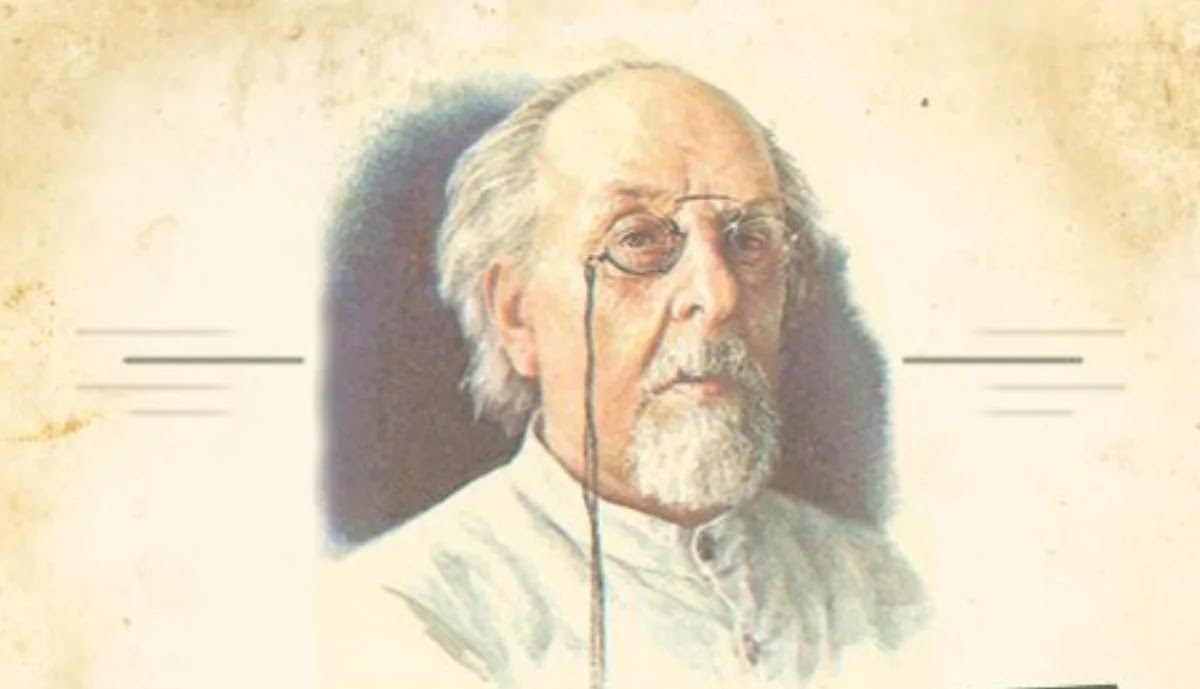
Image above: Konstantin Eduardovich Tsiolkovsky. 5 (17) September 1857, Izhevskoe, Ryazan province - 19 September 1935, Kaluga).

"Humanity will not remain forever on Earth, but, in pursuit of light and space, at first it timidly penetrates beyond the atmosphere, and then conquers the entire solar space." "The planet [Earth] is the cradle of the mind, but one cannot live in the cradle forever." K.E. Tsiolkovsky 1912.

Tsiolkovsky was born in 1857 exactly 100 years before the launch of the first artificial Earth satellite in 1957.


Image above: The world's first artificial satellite of the Earth. October 4, 1957 19:28:34 UTC. The simplest Sputnik-1 (PS-1).

Tsiolkovsky K.E. knew the biblical canons well: he was married to the daughter of a priest and taught at the Borovsk city diocesan school. He knew well the biblical history of the creation of the world from the first Act of Creation to the Last Judgment.

The text of the Torah-Bible says that:

- On the first day God created heaven, earth and light, and separated light from darkness;

- On the second day - created a firmament in the middle of the water, separated the water above the firmament from the water under the firmament, and called the firmament sky;

- On the third - land, seas and plants,

- On the fourth - the luminaries in the firmament of heaven,

- On the fifth - fish, reptiles and birds.

- Finally, on the sixth - the beasts of the earth, cattle, reptiles of the earth and man (Adam).

Creation of Adam. Michelangelo, 1511

The story ends with verses where it is said that the Creator “rested on the seventh day from all His deeds that He did”, and “God blessed the seventh day [Shabbat, that is, Saturday], and sanctified it, for on that day He rested from all His deeds, which God created and created ”(see Gen. 1: 1 - 2: 3).

The second chapter of the book of Genesis tells about the creation of the Garden of Eden and two trees in it: the tree of life and the tree of the knowledge of good and evil, about the first commandment given to man, Adam, not to eat the fruits of the tree of the knowledge of good and evil, and also contains a story about creation the woman of Eve from the rib of the man of Adam (see Genesis 2: 4–25).

Tsiolkovsky also knew what was told about the End of the World in the medieval "Apocalypse" or "The Revelation of John the Theologian", the last book of the New Testament, or the Gospel.

He knew well that the theologian Isaac Argir (1300/1310 - 1375), accepted in the Vatican, in 1373 calculated the date of the End of the World on the basis of clerical ideas of that time. For Christians, the date of the creation of the world is considered to be 5508 BC.

According to the clerical dogma, every day is considered by God to be 1000 years. Total: 7000 years were spent on the entire Creation of God to create the Earth and life on it. After that, the Day of Judgment, or the "Last Judgment", was to come, and then the End of the World.

7000 - 5508 = 1492 A.D. Gregorian calendar.

Michelangelo. The Last Judgment. 1537-1541. The Sistine Chapel

In Judaism, it is believed that the End of the World will occur in 6,000 years, starting from the hypothetical date of the creation of the world in 3760 BC. It is believed that on the 7th day of rest, God did not create anything. Therefore, unlike Christians, the 7th day of rest is not included in the number of days of the Creation of the world. The Jews calculate the end of the world by the formula:

6000 - 3760 = 2240 A.D. according to the Gregorian calendar.

The first coming of the Creator to Earth is considered the date of the Creation Act of the Earth itself and Life on it. On the Second Coming of God to Earth - on the Day of Judgment - the Creator will divide and judge “sinners” and “righteous”.

The Creator will send the “righteous” to “paradise”, or “the Kingdom of God”, or “the Kingdom of Heaven”, and the “sinners” to “Hell”, or the “Fiery Hyenna”.

"Hell" is a purely Jewish concept. The ancient Jews called the "Hell" the ever-burning dump of the city's sewage outside the city of Jerusalem, nicknamed "the fiery hyena." Geographically, it was located in the valley of Hinnom (hence the very word "Hyenna") to the southwest of Jerusalem. The stench that came from this valley later made it a symbol of "Horror" or "Hell" (Matt. 5:22).

The Bible says that the Garden of Eden was located in the city of Eden in Mesopotamia at the source of four rivers: the Tigris, Euphrates, Murat (Pison) and Araks (Gihon), - (Genesis: 2: 8-14).

Isaac Argir's prediction did not come true: in 1492 the End of the World did not come. The same will happen in 2240: the end of the world will not come in both cases, since the logic of these calculations is equally incorrect, they are both equally imperfect from the point of view of modern science.

Doctrine of Salvation

The image of the future in the works of Tsiolkovsky

Tsiolkovsky, from a different logical standpoint, recognized the existence of God as the Creator of the world, calling Him the "Cause" or "First Cause".

He thought of the cosmos as an endless phenomenon in space and time. At the same time, what is infinite for a particular person was of course for the Reason.

In Tsiolkovsky's theoanthropocentric system, the Cosmos is a single living organism, which did not contradict the project of its development by technogenic means.

Basically, his cosmic philosophy was a variant of the religious Doctrine of Salvation, which the author himself considered more optimistic than the previous religious versions of the Old and New Testaments.


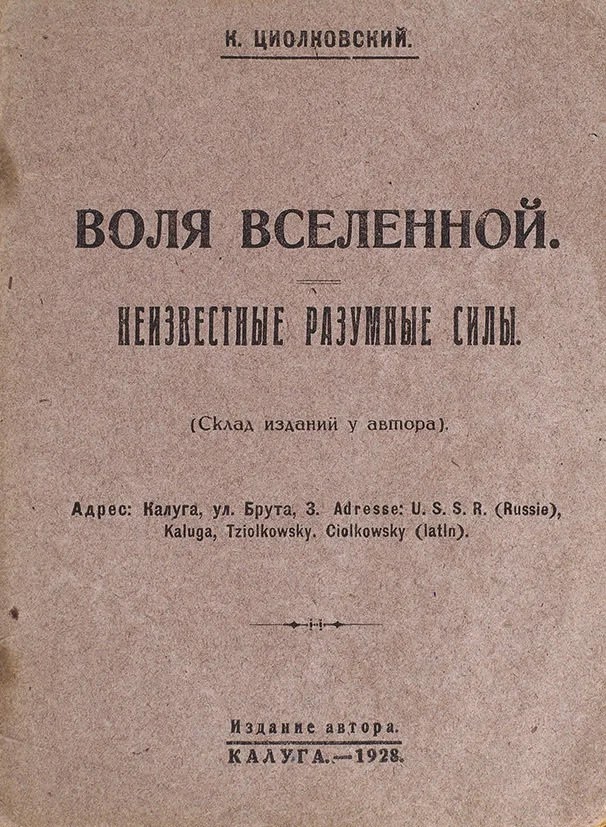
Image above: “Will of the Universe. Unknown Intelligent Forces. " Edition of the author, 1928.

Tsiolkovsky did not recognize the End of the World as the end of biological Life. He recognized the Exodus of civilization into boundless space and eternal life, as space is eternal, and with it. He recognized the end of the physical inorganic life of the next sun, the next planet, but not the phenomenon of the eternal biological life of the Earth's civilization.

“The luminaries cool down and deprive the planets of their life-giving light. Where will their inhabitants go then? “Death and its torments,” you say. How can this ever disappear? ... The suns are constantly burning, and this is even more often than their extinction. In a word, the dark suns are resurrected no less than the brilliant ones are extinguished. The life of each luminary is periodic and repeats itself many times. Likewise, the life of a group of luminaries, such as the Milky Way. " ...

The civilization of the Earth will be doomed by history to constantly move in search of new young suns in the Universe for its eternal prosperity.

In his main philosophical book “The Will of the Universe. Unknown intelligent forces ", Tsiolkovsky wrote:

“As if everything [in the world around us] depends on the will of a rational being, like a man.

It is clear that life, reason, and will was gradually engendered by nature. In the end, everything that is done has its source in times long past, when there was not even a trace of animals. Our will, our actions - present and future - are the result of times long past. And these were born from even earlier times.

Man is born by the Earth, the Earth by the Sun, the Sun originated from the thickening of a rarefied gaseous mass. This one is from even more rarefied matter, for example, from ether.

So, everything is generated by the Universe. She is the beginning of all things, everything depends on her. A person, or other higher being, and his will is only a manifestation of the will of the Universe.

If we manage to fulfill our will, it is only because the Universe allowed us to do it. It always has many ways and reasons to slow down our activity and manifest a different, higher will, although our will is only the will of the Universe. There is a complete likelihood that the will of the cosmos and on Earth will manifest itself in all the splendor of the highest mind.

Most people are completely ignorant and look at the universe in much the same way as animals.

We have a very wrong concept about the Mind of the Higher Beings [“Gods”?]. The intelligence and power of the higher beings who originated on the higher planets eliminate the embryonic life on other planets [with a lower level of development] and populate them with their [more perfect] offspring [that is, they are engaged in the colonization of planets suitable for higher life].

We are confident that the mature beings of the Universe have the means to transfer from planet to planet, to intervene in the life of lagging planets and to communicate with those who are as mature as they are.

The people of the Earth will someday unite, and they will all be governed by one Elected Council, under the leadership of a President elected by the council.

This will happen relatively soon. After a more significant period of time, our entire solar system will be abundantly populated. It will also be governed by an Elected Council with its own Chairman. It cannot be otherwise, as the mind requires it. All other planets and solar systems also unite.

The only difference is that most of them are quickly populated by a mature, ready-made generation and immediately establish their control. The Earth and our solar system had a long path of gradual suffering development. "

In my opinion (the autor, Morozov Sergey Lvovich), the Galactic State of Tsiolkovsky will be created.

The first step in this direction can be considered the creation in 2016 on October 12 in Paris by Dr. Igor Ashurbeyli of the space state of Asgardia. It legislatively (Decree No. 38 of December 18, 2019 and Decree No. 46 of September 1, 2020) approved as a state calendar by me, Sergey Morozov, a 13-month digital civil reference standard space calendar with the most accurate value of the duration of the reference tropical solar years: 31,556,925 seconds, or 365 whole and 31/128 days.


Image above: Ph.D. Morozov Sergey Lvovich at presentation of the Asgardian calendar at the First Asgardian Space Science and Investment Congress (ASIC) October 2019, Darmstadt, Germany.

The main feature of the new approach to time calculation is the theoretically and mathematically grounded reference leap formula - 31 leap days every 128 years.

Morozov's calendar constant: 31/128 days per year = 0.2421875 days / year = 20925 seconds / year.

Paving the road to living in space Asgardia's First Space Science and Investment Congress

14-16 October 2019. Conference center of best western, am Kavalleriesand 6, 64295 Darmstadt, Germany.

At the first Asgardia Space Science and Investment Congress (ASIC) in October 2019, Darmstadt, Germany, a significant event was held, which brought together many prominent figures in astronautics and discussed the conditions for its development and the latest promising discoveries.


Image above: Ph.D. Morozov Sergey Lvovich with prof. Ana Diaz Artiles from Texas A&M University, Department of Aerospace Engineering (USA).

The great scientist and thinker Konstantin Eduardovich Tsiolkovsky talked about space flights of people:

Until now, the "sobriety" of science has prevented interplanetary communications. Now this opinion is shaken even by scientists, but most of them are not yet piqued by new ideas and are either indifferent to them, or hostile.

Somewhat earlier, except for obvious dreamers, no one admitted the possibility of heavenly intercourse, especially travel outside the Earth. Therefore, the opinion was established that they were impossible.

We say: everything depends on us, but we ourselves are the creation of the Universe. Therefore, it is more correct to think and say that everything depends on the Universe.

We assume, and the Universe [God?] Disposes as it wants, without ceremony destroying our plans and even destroying the entire planet with all its intelligent beings".

Conclusion: Joseph Stalin's mistake


Image above: Chairman of the Council of Ministers of the USSR, Joseph Vissarionovich Stalin December 18, 1878 - March 5, 1953.


Image above: Certificate of graduation from I. Dzhugashvili of the Gori Theological School (1894).


Image above: Party card of Joseph Vissarionovich Stalin No. 0000002, 1936.

Stalin did not like the work of K.E. Tsiolkovsky: “The Will of the Universe. Unknown Intelligent Forces. " Therefore, he canceled the decision to publish the complete collected works of K.E. Tsiolkovsky for his 75th birthday in 1932.

In the author's reasoning about the "Mind of the Higher Beings", the "atheist-seminarian" Stalin saw an open "smuggling" of the idea of ​​God. And the "Doctrine of Salvation" itself seemed to Stalin too religious, very similar to the Christian idea of ​​Christ the Savior.

The dialectics of the Ice Eras, Periods and Epochs, as the reason for natural selection, became known only in 1941 after the works of Milankovitch, which not everyone knows today.

Even today not everyone knows about the multiple changes of flora and fauna in the geochronological history of the Earth. And the conclusion that man, as an ordinary species, can disappear as a result of natural "Darwinian" selection from the Earth's surface, with the next change of flora and fauna, is still perceived with difficulty today.

But this is a real scientific conclusion and forecast for the not so distant future.

Our future in this sense is predetermined and we have no choice. Civilization will still have to leave the Earth if it does not want to die from another deadly virus, for example, or a new serious cold snap.

Tsiolkovsky K.E. was more perspicacious than Stalin. Humanity has no other meaning of existence on Earth, except for the construction of flotillas of Homeostatic arks and the construction of a Galactic state in space. “The Earth is the cradle of Reason, but one cannot live forever in the Cradle”, which will inevitably disappear sooner or later anyway.


Next article: "Extraterrestrial astronautical socio-economic formation".

Related articles:

Exodus of civilization into space - Symbol of the End of the XXI century. Part 8
https://orbiterchspacenews.blogspot.com/2021/04/exodus-of-civilization-into-space_16.html

Exodus of civilization into space - Stopping the process of increasing value added. Part 7
https://orbiterchspacenews.blogspot.com/2021/04/exodus-of-civilization-into-space_14.html

Exodus of civilization into space - The sixth socio-economic formation of civilization. Part 6
https://orbiterchspacenews.blogspot.com/2021/04/exodus-of-civilization-into-space-sixth.html

Exodus of civilization into space - Space man. Part 5
https://orbiterchspacenews.blogspot.com/2021/04/exodus-of-civilization-into-space-space.html

Exodus of civilization into space - Biological End of the World. Part 4
https://orbiterchspacenews.blogspot.com/2021/04/exodus-of-civilization-into-space_7.html

Exodus of civilization into space - Geochronological Ice Ages, periods, eras. Part 3
https://orbiterchspacenews.blogspot.com/2021/04/exodus-of-civilization-into-space_5.html

Exodus of civilization into space - Astrophysical End of the World. Part 2
https://orbiterchspacenews.blogspot.com/2021/04/exodus-of-civilization-into-space.html

The ideology of space expansion - Space calendar. Part 1
https://orbiterchspacenews.blogspot.com/2021/03/the-ideology-of-space-expansion-space.html

Related links:

About Ph.D. Morozov Sergey Lvovich: https://zen.yandex.ru/media/id/5fbb90753e3ad265054f930a/ob-avtore-kanala-5fbd2bf80b4af80149fb12c2

Original article in Russian on Zen.Yandex:
https://zen.yandex.ru/media/id/5fbb90753e3ad265054f930a/ishod-civilizacii-v-kosmos-chast-9--galakticheskoe-gosudarstvo-ciolkovskogo-5fccc0efc26ad131b65b7fe3

Asgardia website: https://asgardia.space/

Author: Ph.D. Morozov Sergey Lvovich / Zen.Yandex. Editor / Translation: Roland Berga. 

Greetings, Orbiter.ch

Station Crew Busy Ahead of Thursday SpaceX Crew Launch


ISS - Expedition 65 Mission patch.


April 19, 2021

The next crew to launch to the International Space Station is counting down to liftoff this Thursday from the Kennedy Space Center in Florida. They will be greeted less than 24 hours later by the seven Expedition 65 crew members residing aboard the orbiting lab.

The SpaceX Crew Dragon Endeavour sits atop the Falcon 9 rocket at the launch pad ready to carry four Commercial Crew astronauts to the space station. The SpaceX Crew-2 quartet is comprised of Commander Shane Kimbrough and Pilot Megan McArthur, both NASA astronauts, and Mission Specialists Akihiko Hoshide of the Japan Aerospace Exploration Agency (JAXA) and Thomas Pesquet of the European Space Agency (ESA).


Image above: The four SpaceX Crew-2 astronauts are pictured during a dress rehearsal at the Kennedy Space Center in Florida. The Crew Dragon vehicle is atop the Falcon 9 rocket at the launch pad. Image Credits: NASA/SpaceX.

They are set to launch on Thursday at 6:11 a.m. EDT and dock to the Harmony module’s forward-facing international docking adapter at 5:30 a.m. on Friday. NASA TV will broadcast the Crew-2 mission continuously from launch to docking beginning Thursday at 2 a.m.

Waiting for the Crew-2 astronauts is station Commander Shannon Walker of NASA along with her Crew-1 crewmates Michael Hopkins and Victor Glover of NASA and Soichi Noguchi of JAXA. The orbiting lab’s newest trio, with NASA astronaut Mark Vande Hei and Roscosmos cosmonauts Oleg Novitskiy and Pyotr Dubrov, will also be onboard the station to greet the SpaceX Crew-2 foursome.

International Space Station (ISS). Animation Credit: ESA

There is still plenty of research and maintenance occurring on the station as NASA and SpaceX gear up for this Thursday’s launch. Walker serviced the Human Research Facility rack and updated software on the KERMIT microscope that can be operated by station astronauts or scientists on the ground. Hopkins swapped fuel canisters inside the Combustion Integrated Rack.

Vande Hei and Glover worked throughout Monday cleaning ventilation systems and crew quarters. Noguchi transferred oxygen to tanks inside the U.S. Quest airlock. Novitskiy and Dubrov, the two cosmonauts, worked on Soyuz crew ship cargo transfers and lab familiarization activities.

Related links:

NASA TV: https://www.nasa.gov/multimedia/nasatv/index.html

Expedition 65: https://www.nasa.gov/mission_pages/station/expeditions/expedition65/index.html

Commercial Crew: https://blogs.nasa.gov/commercialcrew/

Harmony module: https://www.nasa.gov/mission_pages/station/structure/elements/harmony

Human Research Facility: https://www.nasa.gov/mission_pages/station/research/experiments/explorer/Facility.html?#id=58

KERMIT microscope: https://www.nasa.gov/mission_pages/station/research/experiments/explorer/Facility.html?#id=8120

Combustion Integrated Rack: https://www.nasa.gov/mission_pages/station/research/experiments/explorer/Facility.html?#id=317

U.S. Quest airlock: https://www.nasa.gov/mission_pages/station/structure/elements/joint-quest-airlock

Space Station Research and Technology: https://www.nasa.gov/mission_pages/station/research/overview.html

International Space Station (ISS): https://www.nasa.gov/mission_pages/station/main/index.html

Image (mentioned), Animation (mentioned), Text, Credits: NASA/Mark Garcia.

Best regards, Orbiter.ch

Earth Day Connections: NASA Study Predicts Less Saharan Dust in Future Winds


NASA Goddard Space Flight Center logo.


Apr 19, 2021

During 2020, global average surface temperatures were the hottest on record, tying with 2016 as the warmest recorded year. Last year was also the most active hurricane season to date, with many storms quickly intensifying. Temperature and weather systems each interact with, and are influenced by, a multitude of Earth systems, each affected by the warming climate. One of those is the global transport of massive dust plumes from one continent to another.

In June 2020, a “Godzilla” dust plume travelled from the Sahara, the planet’s largest, hottest desert, across the Atlantic ocean to North America. While this eye-catching plume made headlines, NASA scientists, using a combination of satellite data and computer models, predict that Africa’s annual dust plumes will actually shrink to a 20,000-year minimum over the next century as a result of climate change and ocean warming.

The Sahara Desert is 3,600,000 square miles (9,200,000 square kilometers) of arid land stretched across the northern half of Africa, coming in just slightly smaller in size than the continental United States. Upwards of 60 million tons of its nutrient-laden mineral dust are lifted into the atmosphere each year, creating a massive layer of hot, dusty air that winds carry across the Atlantic to deliver those nutrients to the ocean and vegetation in South America and the Caribbean.

Recent NASA research outlines the domino-like connections between factors beyond the desert’s borders and the development of dust plumes. These start with temperature differences between the North and South Atlantic, which then impact the region’s consistent east to west winds as well as a tropical band of relatively high rainfall located near the Equator, both of which impact the annual dust plumes. Supported by NASA’s Modeling, Analysis, and Prediction (MAP) Program, and Radiation Sciences Program, the scientists used their new understanding of these relationships to forecast a more substantial reduction in dust activity than previous studies had predicted based on anticipated climate warming.

Warmer Ocean Temperatures May Decrease Saharan Dust Crossing the Atlantic

Video above: Every year millions of tons of dust from the Sahara Desert are swirled up into the atmosphere by easterly trade winds, and carried across the Atlantic. The plumes can make their way from the African continent as far as the Amazon rainforest, where they fertilize plant life. Video Credits: NASA's Goddard Space Flight Center.

A Dusty Past

“From ground observations and satellite observations, we see African dust variability,” said Tianle Yuan, atmospheric scientist at NASA's Goddard Space Flight Center in Greenbelt, Maryland. “In fact, it can change quite a bit, from month to month, day to day, year to year, even decade to decade.”

Recent dust estimates are derived from data collected by NASA satellite missions, including Terra, Aqua, and Cloud-Aerosol Lidar and Infrared Pathfinder Satellite Observation (CALIPSO), a joint mission between NASA and the French space agency, Centre National d'Etudes Spatiales.

The researchers were also interested in seeing if the relationship between global average temperature and Saharan dust activity occurred in the past. Geological records going back thousands of years help reveal past precipitation and nutrient levels as the Sahara went through dramatic environmental shifts.

The peak of Saharan dust transport to the eastern side of the Americas took place roughly between 12,000 to 17,000 years ago, at the end of the last Ice Age. Then began the African Humid Period, during which the vast expanse of desert was speckled with lakes, vegetation and human habitation. The increased moisture and plant-life stabilized the ground and minimized dust plumes.

“The Sahara Desert was relatively wet back then,” said Yuan. North African sediment cores off the coast and pollen records show that there was more rainfall and vegetation present. “Dust was much rarer.”


Image above: Warmer Ocean Temperatures May Decrease Saharan Dust Crossing the Atlantic. Image Credits: NASA's Goddard Space Flight Center.

Though dust transport has increased since then, the research team found that both natural processes and human activity are now likely driving Earth back toward a dust minimum as climate warms.

Sea surface temperatures directly impact wind speeds, so when the northern Atlantic warms relative to the south Atlantic, the trade winds that blow the dust from east to west become weaker. As a result, the slower winds pick up and transport less dust from the Sahara.

In addition to carrying less dust, the weakened winds also allow the band of steady rain that traverses the tropics to drift north over more of the desert, which dampens the dust and keeps it from getting swept away. Less dust in the air, which can reflect sunshine away from Earth’s surface like a sunshield, means more sunlight and heat reach the ocean, warming it further. All together this creates a feedback loop of warm sea surface temperatures leading to reduced dust, and reduced dust in turn contributing to additional warming, combining to impact climate, air quality, and storm and hurricane formation.

From Dust to Dust Impacts

“Dust plays a major role in the Earth system,” said Hongbin Yu, an atmospheric researcher at Goddard. “A decrease of dust as the climate warms may have profound influences on a variety of phenomena, but these potential impacts may be good or bad.”

On its journey across the Atlantic, Saharan dust sprinkles into the ocean, feeding the marine life, and similarly plant life once it makes landfall. Minerals like iron and phosphorus in the dust act as a fertilizer for the Amazon rainforest, Earth’s largest and most biodiverse tropical forest. Rains wash many of these valuable nutrients from the soil into the Amazon river basin, making the nutrient delivery from Africa important for maintaining healthy vegetation.

Though African dust transport plays an important role in the genesis of soils and sustaining vegetation, Yu says there are some negative effects because the increase in nutrients can lead to harmful algal blooms off the coast of Florida, and coral reef sicknesses and death linked to dust deposition.

Residents in the Caribbean could also see some benefits as less dust means better air quality. Breathing in dust is particularly hazardous for children, the elderly, and those with respiratory conditions such as asthma. That led a team from NASA Earth Applied Sciences Program to develop an early-warning system for Puerto Rico that now provide three days of lead time before a Saharan dust storm reaches the island, giving doctors and public health officials time to prepare and work with meteorologists on air quality alerts. They use data from the Moderate Resolution Imaging Spectroradiometers (MODIS) on NASA's Terra and Aqua satellites, the Advanced Baseline Imager (ABI) instrument aboard the National Oceanic and Atmospheric Administration (NOAA) Geostationary Operational Environmental Satellite (GOES-16 EAST), and the Visible Infrared Imaging Radiometer Suite (VIIRS) on the joint NASA/NOAA Suomi NPP satellite were employed to help detect the advancing Saharan dust plume before it reached islands like Puerto Rico this past year, so that at-risk communities could prepare for the potentially adverse health effects.

Will the Dust Settle?

“The final piece of the story is looking to the future,” said Yuan. “We want to know what the Sahara dust will be, given the climate change picture we are painting. But directly predicting dust activity is really hard because it involves a lot of processes.”

With projected global warming, the research team used model data from the Coupled Model Intercomparison Project 5 (CMIP5) that indicate at least a 30% reduction in Saharan dust activity from current levels over the next 20 to 50 years, and a continued decline beyond that.

“The minimum humans experienced during the African Humid Period will likely be surpassed because of climate change,” Yuan says of the dust levels during the African Humid Period. As the plumes of dust decline, so will their impacts on vegetation an ocean away.

Related article:

NASA-NOAA’s Suomi NPP Satellite Analyzes Saharan Dust Aerosol Blanket
https://orbiterchspacenews.blogspot.com/2020/06/nasa-noaas-suomi-npp-satellite-analyzes.html

Related links:

Cloud-Aerosol Lidar and Infrared Pathfinder Satellite Observation (CALIPSO): https://www-calipso.larc.nasa.gov/

Centre National d'Etudes Spatiales (CNES): https://cnes.fr/en

Moderate Resolution Imaging Spectroradiometers (MODIS): https://modis.gsfc.nasa.gov/

Geostationary Operational Environmental Satellite (GOES-16 EAST): https://www.star.nesdis.noaa.gov/GOES/index.php

Visible Infrared Imaging Radiometer Suite (VIIRS): https://ncc.nesdis.noaa.gov/VIIRS/

NASA/NOAA Suomi NPP: http://www.nasa.gov/mission_pages/NPP/main/index.html

Coupled Model Intercomparison Project 5 (CMIP5): https://pcmdi.llnl.gov/mips/cmip5/

Image (mentioned), Video (mentioned), Text, Credits: NASA/Ellen Gray/Earth Science News Team/By Lara Streiff.

Greetings, Orbiter.ch

NASA’s Ingenuity Mars Helicopter Succeeds in Historic First Flight


NASA - Ingenuity Mars Helicopter logo.


Apr 19, 2021

Monday, NASA’s Ingenuity Mars Helicopter became the first aircraft in history to make a powered, controlled flight on another planet. The Ingenuity team at the agency’s Jet Propulsion Laboratory in Southern California confirmed the flight succeeded after receiving data from the helicopter via NASA’s Perseverance Mars rover at 6:46 a.m. EDT (3:46 a.m. PDT).


Image above: NASA’s Ingenuity Mars Helicopter captured this shot as it hovered over the Martian surface on April 19, 2021, during the first instance of powered, controlled flight on another planet. It used its navigation camera, which autonomously tracks the ground during flight. Image Credits: NASA/JPL-Caltech.

“Ingenuity is the latest in a long and storied tradition of NASA projects achieving a space exploration goal once thought impossible,” said acting NASA Administrator Steve Jurczyk. “The X-15 was a pathfinder for the space shuttle. Mars Pathfinder and its Sojourner rover did the same for three generations of Mars rovers. We don’t know exactly where Ingenuity will lead us, but today’s results indicate the sky – at least on Mars – may not be the limit.”

The solar-powered helicopter first became airborne at 3:34 a.m. EDT (12:34 a.m. PDT) – 12:33 Local Mean Solar Time (Mars time) – a time the Ingenuity team determined would have optimal energy and flight conditions. Altimeter data indicate Ingenuity climbed to its prescribed maximum altitude of 10 feet (3 meters) and maintained a stable hover for 30 seconds. It then descended, touching back down on the surface of Mars after logging a total of 39.1 seconds of flight. Additional details on the test are expected in upcoming downlinks.


Animation above: Ingenuity Mars Helicopter's blades are made of a lightweight carbon fiber foam core to provide lift in the thin Mars atmosphere. Animation Credits: NASA/JPL-Caltech.

Ingenuity’s initial flight demonstration was autonomous – piloted by onboard guidance, navigation, and control systems running algorithms developed by the team at JPL. Because data must be sent to and returned from the Red Planet over hundreds of millions of miles using orbiting satellites and NASA’s Deep Space Network, Ingenuity cannot be flown with a joystick, and its flight was not observable from Earth in real time.

NASA Associate Administrator for Science Thomas Zurbuchen announced the name for the Martian airfield on which the flight took place.

“Now, 117 years after the Wright brothers succeeded in making the first flight on our planet, NASA’s Ingenuity helicopter has succeeded in performing this amazing feat on another world,” Zurbuchen said. “While these two iconic moments in aviation history may be separated by time and 173 million miles of space, they now will forever be linked. As an homage to the two innovative bicycle makers from Dayton, this first of many airfields on other worlds will now be known as Wright Brothers Field, in recognition of the ingenuity and innovation that continue to propel exploration.”

Ingenuity’s chief pilot, Håvard Grip, announced that the International Civil Aviation Organization (ICAO) – the United Nations’ civil aviation agency – presented NASA and the Federal Aviation Administration with official ICAO designator IGY, call-sign INGENUITY.

Ingenuity’s First Flight Confirmed by Mission Control

These details will be included officially in the next edition of ICAO’s publication Designators for Aircraft Operating Agencies, Aeronautical Authorities and Services. The location of the flight has also been given the ceremonial location designation JZRO for Jezero Crater.

As one of NASA’s technology demonstration projects, the 19.3-inch-tall (49-centimeter-tall) Ingenuity Mars Helicopter contains no science instruments inside its tissue-box-size fuselage. Instead, the 4-pound (1.8-kg) rotorcraft is intended to demonstrate whether future exploration of the Red Planet could include an aerial perspective.

This first flight was full of unknowns. The Red Planet has a significantly lower gravity – one-third that of Earth’s – and an extremely thin atmosphere with only 1% the pressure at the surface compared to our planet. This means there are relatively few air molecules with which Ingenuity’s two 4-foot-wide (1.2-meter-wide) rotor blades can interact to achieve flight. The helicopter contains unique components, as well as off-the-shelf-commercial parts – many from the smartphone industry – that were tested in deep space for the first time with this mission.

First Video of NASA’s Ingenuity Mars Helicopter in Flight, Includes Takeoff and Landing

Video above: In this video captured by NASA’s Perseverance rover, the agency's Ingenuity Mars Helicopter took the first powered, controlled flight on another planet on April 19, 2021. Video Credits: NASA/JPL-Caltech/ASU/MSSS.

“The Mars Helicopter project has gone from ‘blue sky’ feasibility study to workable engineering concept to achieving the first flight on another world in a little over six years,” said Michael Watkins, director of JPL. “That this project has achieved such a historic first is testimony to the innovation and doggedness of our team here at JPL, as well as at NASA’s Langley and Ames Research Centers, and our industry partners. It’s a shining example of the kind of technology push that thrives at JPL and fits well with NASA’s exploration goals.”

Parked about 211 feet (64.3 meters) away at Van Zyl Overlook during Ingenuity’s historic first flight, the Perseverance rover not only acted as a communications relay between the helicopter and Earth, but also chronicled the flight operations with its cameras. The pictures from the rover’s Mastcam-Z and Navcam imagers will provide additional data on the helicopter’s flight.  

Image above: This image from NASA’s Perseverance rover shows the agency’s Ingenuity Mars Helicopter right after it successfully completed a high-speed spin-up test. It was captured by the Mastcam-Z instrument on Perseverance on April 16, 2021, (the 55th sol, or Martian day, of the rover’s mission). The image has been slightly processed (stretched and cropped). Image Credits: NASA/JPL-Caltech.

“We have been thinking for so long about having our Wright brothers moment on Mars, and here it is,” said MiMi Aung, project manager of the Ingenuity Mars Helicopter at JPL. “We will take a moment to celebrate our success and then take a cue from Orville and Wilbur regarding what to do next. History shows they got back to work – to learn as much as they could about their new aircraft – and so will we.”

Perseverance touched down with Ingenuity attached to its belly on Feb. 18. Deployed to the surface of Jezero Crater on April 3, Ingenuity is currently on the 16th sol, or Martian day, of its 30-sol (31-Earth day) flight test window. Over the next three sols, the helicopter team will receive and analyze all data and imagery from the test and formulate a plan for the second experimental test flight, scheduled for no earlier than April 22. If the helicopter survives the second flight test, the Ingenuity team will consider how best to expand the flight profile.

More About Ingenuity

JPL, which built Ingenuity, also manages the technology demonstration project for NASA. It is supported by NASA’s Science, Aeronautics, and Space Technology mission directorates. The agency’s Ames Research Center in California’s Silicon Valley and Langley Research Center in Hampton, Virginia, provided significant flight performance analysis and technical assistance during Ingenuity’s development.

Dave Lavery is the program executive for the Ingenuity Mars Helicopter, MiMi Aung is the project manager, and Bob Balaram is chief engineer.

For more information about Ingenuity:

https://go.nasa.gov/ingenuity-press-kit and https://mars.nasa.gov/technology/helicopter

More About Perseverance

A key objective for Perseverance’s mission on Mars is astrobiology, including the search for signs of ancient microbial life. The rover will characterize the planet’s geology and past climate, pave the way for human exploration of the Red Planet, and be the first mission to collect and cache Martian rock and regolith (broken rock and dust).

Subsequent NASA missions, in cooperation with ESA (European Space Agency), would send spacecraft to Mars to collect these sealed samples from the surface and return them to Earth for in-depth analysis.

JPL built and manages operations of the Perseverance rover. JPL is managed for NASA by Caltech in Pasadena, California.

Images (mentioned), Animation (mentioned), Videos, Text, Credits: NASA/Karen Northon/Alana Johnson/Grey Hautaluoma/JPL/DC Agle/NASA TV/SciNews.

Best regards, Orbiter.ch

How space science is combating climate change


ESA - ASIM Mission patch.


April 19, 2021

If you have been following International Space Station news, you know that hundreds of scientific experiments are performed in low-Earth orbit and the pace is only increasing. This is great news for scientists, especially those that have been preparing for years to send their experiment to the orbital outpost, but what does it mean for people on Earth?

Thunderstorm seen from Space Station

If you are not into plasma nanoparticles, subjective time measurement in microgravity or traveling to Mars in the future, what benefit does space science have for you?

Potentially a lot. Experiments performed on the International Space Station could in fact help save our planet. All one needs to do is look beyond the initial outcomes and ask: "How can this information be useful in other areas?"

ASIM

The Atmosphere-Space Interactions Monitor or ASIM was installed on the Space Station in 2018. The collection of optical cameras, photometers and an X- and gamma-ray detector is designed to look for electrical discharges originating from stormy weather that extends above thunderstorms into the upper atmosphere.

Storm hunter infographics

The experiment has been very successful in describing elements that are associated with thunderstorms, such as ‘blue jets’, ‘elves’ and ‘sprites’ that we cannot observe and research from the Earth’s surface. It also captured the presence of short bursts of gamma rays, that are actually formed within electrical lightning flashes.

Dissecting the anatomy of a thunderstorm is extremely interesting for those studying fundamental physics, but it can also provide valuable insights to scientists studying climate change.

Thunderstorms and climate

Thunderstorms are formed when hot air rises and comes in contact with colder layers of air in the upper atmosphere. This airflow takes with it any particles and greenhouse gasses present in the lower regions of the Earth’s atmosphere.

Electrical discharges in a thundercloud have a chemical effect on the gases in the air, and cause higher concentrations of ozone and nitrous oxide, greenhouse gases that at are at the root of climate change.

Nitrous oxide is the third strongest greenhouse gas after carbon dioxide and methane, and has the strongest global warming potential. What is worse is that, the negative effects of these gases are even more pronounced at the higher altitudes of a thunderstorm.

One type of electrical discharge that is responsible for these chemical changes is the ‘blue streamer corona’. The presence of these coronas can influence the chemical balance of the atmosphere, now and in the future. Not much was known about this phenomenon before, but through ASIM, the coronas can now be measured from low-Earth orbit and eventually applied to climate models.

Studying thunderstorms through the ASIM will give us better insights into the progression and the effects of climate change, with strongest impact on tropical regions.

As Francisco Gordillo-Vazquez, senior staff scientist at the Institute of Astrophysics of Andalusia (IAA-CSIC) and part of the international ASIM team says: “Fundamental understanding and knowledge can have tremendous and unsuspected practical benefits. Missions like ASIM are quite cheap when compared to commercial space programs. The knowledge learnt from this programme will help create solid foundations for future space instruments to build upon.”

This research will be hugely beneficial in the fight against climate change, especially as a warmer climate can also cause more thunderstorms to occur in the first place. The more we can understand, the more we will be able to avoid negative effects.

Related links:

Atmosphere-Space Interactions Monitor (ASIM): http://www.esa.int/Science_Exploration/Human_and_Robotic_Exploration/Research/Atmosphere_Space_Interactions_Monitor

Institute of Astrophysics of Andalusia (IAA-CSIC): https://www.iaa.csic.es/en

Images, Text, Credits: ESA/NASA.

Greetings, Orbiter.ch