jeudi 29 avril 2021

SpaceX Starlink 25 launch


SpaceX - Falcon 9 / Starlink Mission patch.


April 29, 2021

SpaceX Starlink 25 launch

A SpaceX Falcon 9 rocket launched 60 Starlink satellites (Starlink-25) from Space Launch Complex 40 (SLC-40) at Cape Canaveral Space Force Station, Florida, on 29 April 2021, at 03:44 UTC (28 April, 23:44 EDT).


SpaceX Starlink 25 launch & Falcon 9 first stage landing, 29 April 2021

Following stage separation, Falcon 9’s first stage landed on the “Just Read the Instructions” droneship, stationed in the Atlantic Ocean. Falcon 9’s first stage (B1060) previously supported six missions: GPS-III Space Vehicle 03, Turksat 5A and four Starlink missions.

Related links:

SpaceX: https://www.spacex.com/

Starlink: https://www.starlink.com/
 
Image, Video, Text, Credits: SpaceX/SciNews/Orbiter.ch Aerospace/Roland Berga.

Greetings, Orbiter.ch

With Goals Met, NASA to Push Envelope with Ingenuity Mars Helicopter


NASA - Ingenuity Mars Helicopter logo.


April 29, 2021

Now that NASA’s Ingenuity Mars Helicopter has accomplished the goal of achieving powered, controlled flight of an aircraft on the Red Planet, and with data from its most recent flight test, on April 25, the technology demonstration project has met or surpassed all of its technical objectives. The Ingenuity team now will push its performance envelope on Mars.


Image above: NASA’s Perseverance Mars rover is visible in the upper left corner of this image the agency’s Ingenuity Mars Helicopter took during its third flight, on April 25, 2021. The helicopter was flying at an altitude of 16 feet (5 meters) and roughly 279 feet (85 meters) from the rover at the time. Image Credits: NASA/JPL-Caltech.

The fourth Ingenuity flight from Wright Brothers Field, the name for the Martian airfield on which the flight took place, is scheduled to take off Thursday, April 29, at 10:12 a.m. EDT (7:12 a.m. PDT, 12:30 p.m. local Mars time), with the first data expected back at NASA’s Jet Propulsion Laboratory in Southern California at 1:21 p.m. EDT (10:21 a.m. PDT).

“From millions of miles away, Ingenuity checked all the technical boxes we had at NASA about the possibility of powered, controlled flight at the Red Planet,” said Lori Glaze, director of NASA’s Planetary Science Division. “Future Mars exploration missions can now confidently consider the added capability an aerial exploration may bring to a science mission.”

The Ingenuity team had three objectives to accomplish to declare the technology demo a complete success: They completed the first objective about six years ago when the team demonstrated in the 25-foot-diameter space simulator chamber of JPL that powered, controlled flight in the thin atmosphere of Mars was more than a theoretical exercise. The second objective – to fly on Mars – was met when Ingenuity flew for the first time on April 19. The team surpassed the last major objective with the third flight, when Ingenuity rose 16 feet (5 meters), flying downrange 164 feet (50 meters) and back at a top speed of 6.6 feet per second (2 meters per second), augmenting the rich collection of knowledge the team has gained during its test flight campaign.


Image above: NASA’s Perseverance Mars rover is visible in the upper left corner of this image the agency’s Ingenuity Mars Helicopter took during its third flight, on April 25, 2021. The helicopter was flying at an altitude of 16 feet (5 meters) and roughly 279 feet (85 meters) from the rover at the time. Image Credits: NASA/JPL-Caltech.

“When Ingenuity’s landing legs touched down after that third flight, we knew we had accumulated more than enough data to help engineers design future generations of Mars helicopters,” said J. “Bob” Balaram, Ingenuity chief engineer at JPL. “Now we plan to extend our range, speed, and duration to gain further performance insight.”

Flight Four sets out to demonstrate the potential value of that aerial perspective. The flight test will begin with Ingenuity climbing to an altitude of 16 feet (5 meters) and then heading south, flying over rocks, sand ripples, and small impact craters for 276 feet (84 meters). As it flies, the rotorcraft will use its downward-looking navigation camera to collect images of the surface every 4 feet (1.2 meters) from that point until it travels a total of 436 feet (133 meters) downrange. Then, Ingenuity will go into a hover and take images with its color camera before heading back to Wright Brothers Field.

Perseverance Rover watch Ingenuity Mars Helicopter. Animation Credits: NASA/JPL-Caltech

“To achieve the distance necessary for this scouting flight, we’re going to break our own Mars records set during flight three,” said Johnny Lam, backup pilot for the Ingenuity Mars Helicopter at JPL. “We’re upping the time airborne from 80 seconds to 117, increasing our max airspeed from 2 meters per second to 3.5 (4.5 mph to 8), and more than doubling our total range.”

After receiving the data from the fourth flight, the Ingenuity team will consider its plan for the fifth flight.

“We have been kicking around several options regarding what a flight five could look like,” said Balaram. “But ask me about what they entail after a successful flight four. The team remains committed to building our flight experience one step at a time.”

More About Ingenuity

The Ingenuity Mars Helicopter was built by JPL, which also manages the technology demonstration project for NASA Headquarters. It is supported by NASA’s Science, Aeronautics Research, and Space Technology mission directorates. NASA’s Ames Research Center in California’s Silicon Valley, and NASA’s Langley Research Center in Hampton, Virginia, provided significant flight performance analysis and technical assistance during Ingenuity’s development. AeroVironment Inc., Qualcomm, and SolAero also provided design assistance and major vehicle components. Lockheed Martin Space designed and manufactured the Mars Helicopter Delivery System.

At NASA Headquarters, Dave Lavery is the program executive for the Ingenuity Mars Helicopter. At JPL, MiMi Aung is the project manager and Bob Balaram is chief engineer.

For more information about Ingenuity, go to:

https://go.nasa.gov/ingenuity-press-kit and https://mars.nasa.gov/technology/helicopter

More About Perseverance

A key objective for Perseverance’s mission on Mars is astrobiology, including the search for signs of ancient microbial life. The rover will characterize the planet’s geology and past climate, pave the way for human exploration of the Red Planet, and be the first mission to collect and cache Martian rock and regolith (broken rock and dust).

Subsequent NASA missions, in cooperation with ESA (European Space Agency), would send spacecraft to Mars to collect these sealed samples from the surface and return them to Earth for in-depth analysis.

The Mars 2020 Perseverance mission is part of NASA’s Moon to Mars exploration approach, which includes Artemis missions to the Moon that will help prepare for human exploration of the Red Planet.

JPL, which is managed for NASA by Caltech in Pasadena, California, built and manages operations of the Perseverance rover.

For more about Perseverance, go to:

https://nasa.gov/perseverance and https://mars.nasa.gov/mars2020/

Images (mentioned), Animation (mentioned), Text, Credits: NASA/Alana Johnson/Karen Fox/JPL/DC Agle.

Best regards, Orbiter.ch

SpaceX Starship SN15 1st test flight expected soon


SpaceX - Starship (unofficial) patch.


April 29, 2021


Image above: Starship prototype – SN15 – undergoing a cryogenic test earlier this month (April, 2021)- at SpaceX’s South Texas site. Image via SpaceX.

SpaceX is developing Starship – which it calls a “fully reusable transportation system designed to carry both crew and cargo to Earth orbit, the moon, Mars and beyond” – and NASA has chosen this system as the moon lander for its crewed Artemis program, , designed to carry the first man since the 1970s, and first woman ever, to the moon in this decade. The final system will be paired with a giant SpaceX rocket booster known as Super Heavy. SpaceX is testing its latest Starship prototype this week at its South Texas site, Starbase. The prototype – SN15 (Serial No. 15) – underwent its first static fire test on Monday, April 26, 2021 and a second static fire test on Tuesday. During those tests, the craft stayed on the ground while its three Raptor engines ignited briefly. But Starship isn’t designed to stay anchored to Earth. The big test is the high-altitude test, in which it’ll soar about 6.2 miles (10 km) upwards. SpaceX hasn’t yet announced an official launch date, but it’s rumored it might even take place sometime today, April 29 (there’ve been some official road closures in the area).

    Starship SN15 static fire completed, preparing for flight later this week

    — Elon Musk (@elonmusk) April 27, 2021

SN15 will be the 5th Starship prototype to attempt this upward flight in less than five months. The four before it – SN8-SN11 – all flew well until the very end, when each exploded in a dramatic show of fire. SN10 even landed in one piece, in fact, but blew up about eight minutes later. SN11’s launch occurred about a month ago on March 30, soaring to its maximum altitude as planned, then exploding upon landing due to a “plumbing problem,” SpaceX founder and CEO Elon Musk announced a week later. Essentially, there was too much methane in the combustion chamber and the pressure was therefore too high.

SpaceX has built a reputation for persevering through failure, and it has the funds and resources to continue building prototypes and trying again. Both Starship and Super Heavy will be fully and rapidly reusable, potentially cutting the cost of spaceflight dramatically, SpaceX founder and CEO Elon Musk has said.

SpaceX expects Starship and Super Heavy to be up and running soon; the date often mentioned for the final system to be fully operational is 2023. The Artemis program has the stated goal of returning humans to the moon – specifically to the moon’s south pole region – by 2024, although many believe that goal is not feasible.


Animation above: Starship prototype rocket SN9 exploded on impact after a high-altitude test flight on February 2, 2021. Image via SpaceX/ CNBC.

According to Elon Musk, SpaceX’s reason for jumping from SN11 to SN15 is that it was built at the same time as SN12, SN13, and SN14, but with major improvements. For that reason, SpaceX engineers have decided to run with SN15 rather than finish building SN12–SN14, which the engineers already know are outdated at this point. It’s expected that a similar scrapping will happen with Starships SN18 and SN19. SN20 will likely have another set of major upgrades, and SpaceX currently has the ambitious goal of flying SN20 to orbit with Super Heavy before July.

SN15’s first static fire came just three days after the launch of Crew-2, SpaceX’s second operational crewed mission to the International Space Station (ISS) for NASA. The Falcon 9 rocket carrying a Crew Dragon capsule lit up the predawn skies over historic pad 39A at NASA’s Kennedy Space Center in Florida, blasting off at 5:49 a.m. Eastern (09:49 UTC). It docked with the ISS early April 24.

SpaceX: https://www.spacex.com/

Image (mentioned), Animation (mentioned), Text, Credits: SpaceX/EarthSky/Via Space.com.

Greetings, Orbiter.ch

Vega’s first launch this year


ARIANESPACE - Vega Flight VV18 Mission poster.


April 29, 2021

Vega liftoff on flight VV18

Liftoff of Vega from Europe’s Spaceport in French Guiana came at 02:50 BST on 29 April (03:50 CEST; 22:50 local time on 28 April) to deliver Pléiades Neo-3 and five auxiliary payloads into their respective orbits.

On this flight, Vega made use of part of its ESA-developed Small Spacecraft Mission Service (SSMS) multiple payload adapter. The SSMS is a modular lightweight carbon-fibre structure, which can accommodate multiple light satellites with a mass of 1–500 kg.

The flexibility of the SSMS system allows spare capacity on Vega to be used to launch small satellites piggyback to the main customer payload. Using more than one burn of the upper stage means that they can be delivered into different orbits too.

Vega launches Pléiades Neo 3

Europe’s first use of the SSMS was a rideshare mission in September last year, carrying 53 small satellites. This demonstrated Vega’s new service to offer affordable routine access to space for multiple light satellites.

With a liftoff mass of 920 kg, Earth observation satellite Pléiades Neo-3 was the first to be released into its target Sun-synchronous orbit about 54 minutes into the mission.

This was followed about 47 minutes later by the coordinated release of Norway’s Norsat-3 microsatellite and four CubeSats: Bravo, two Lemur-2 satellites and Tyvak-128A.

Complying with debris regulations to help keep space clean, Vega’s upper stage fired a final time to ensure direct reentry and burn up high in the atmosphere over the ocean.

Pléiades Neo 3 satellite

The Vega launch system is Europe’s way of launching light satellites to multiple orbits in a single launch. Following the loss of Vega’s previous mission, flight VV17, an Independent Inquiry Commission appointed by Arianespace and ESA, formulated a road map for a robust Vega return to flight.

Avio, industrial prime contractor for the Vega launcher, under the direction of Arianespace and ESA followed all recommendations on launch vehicle production and launch preparations. Today’s flight VV18, represents a successful return to operations of Vega.

“I’m pleased to see Vega is back in business and thank our teams in ESA, together with Arianespace, Avio and suppliers for their hard work to arrive at this point. This flight shows Vega’s versatility. It delivered one main satellite and made use of spare capacity to deploy five additional satellites to a separate orbit,” commented Daniel Neuenschwander, Director of Space Transportation at ESA.

About SSMS

Artist's view of Vega VV16 with SSMS

The Small Spacecraft Mission Service (SSMS) dispenser has a modular design that can be adapted for different launch requirements. It can provide launch opportunities for light satellites with an overall mass ranging from 1 kg CubeSats up to 500 kg minisatellites. SAB Aerospace designed and manufactured this modular dispenser for ESA’s Vega prime contractor Avio.

Related links:

Vega: http://www.esa.int/Enabling_Support/Space_Transportation/Vega

ARIANESPACE:  https://www.arianespace.com/

Images, Video, Text, Credits: ESA/CNES/Arianespace/SciNews.

Greetings, Orbiter.ch

mercredi 28 avril 2021

The ideology of space expansion - The question of pregnancy and childbirth in zero gravity. Part 17.4


Childbirth in space logo.


April 28, 2021

Preamble

Here the seventeenth (at the request of the author, this article is published before part 14) article of a series of articles by Ph.D. Morozov Sergey Lvovich, expert in chronology and calendar systems, as well as space biology and medicine, Parliamentarian of Asgardia (AMP) the first space Nation.

Ph.D. Morozov Sergey Lvovich

The question of pregnancy and childbirth in zero gravity

American astronauts Nancy Davis and Mark Lee flew STS 47 in 1991 in the same crew. They got married allegedly "secretly" from the leadership of NASA to the flight into Earth's orbit. Spent their first honey week in space. After three years, they parted. There were no children.

(About the families of cosmonauts and astronauts. Vasily Lesnikov) https://proza.ru/2015/03/04/625

According to NASA, sexual dysfunction in male astronauts who worked in zero gravity on the shuttle was observed in 63% of cases, and in women - in 80%.

Of the 45 American women who have been in orbit, none of them have subsequently managed to become pregnant and give birth. Why?

It is believed that in orbit in women in the absence of Earth's gravity, the course of menstruation is disturbed - menstrual blood is not evacuated from the uterine cavity through the vagina and can enter the abdominal cavity through the fallopian tubes, which, as a rule, is complicated by peritonitis.

Therefore, with the help of hormonal contraceptives, menstruation is blocked for the entire flight (criterion of hormonal sterilization or hormonal imitation of pregnancy).

But this tends to increase blood clotting in female astronauts and have an increased risk of thrombosis after 3-4 months of continuous use of these hormonal contraceptives. There is an absolute limit to the use of these hormonal drugs (thrombus formation criterion).

Specifically on the ISS in 2018, flight engineer-astronaut Serena Aunyon-Chancellor developed a blood clot in one of the vessels of the neck, which created great problems with a threat to the life and health of the astronaut.

She immediately wanted, probably, to be urgently evacuated to Earth for free. As a pretext, the toilet on the American segment of the ISS was apparently broken. By all indications, it turned out that it was broken by the woman who was the last to enter the serviceable booth. The name of this woman astronaut is Serena Aunion. Further, she allegedly made a scandal for her American crew, concluding with his speech that "she immediately wants to get home from this disgusted station." Then someone drilled a hole on the Russian segment of the ISS and an air leak began. The hole was found and repaired.

https://zen.yandex.ru/media/rodopi84/kto-prosverlil-dyru-na-mks-v-18m-godu-svedeniia-nachinaiut-prosachivatsia-so-vremenem-607eeabea1709244147c4d1c 


Image above: Space crew members while in orbit (2018). Serena Auñon is the extreme woman on the right. photo: NASA.

A recently published work by scientists from King's College London in npj Microgravity explores a very important but often overlooked topic of hygiene for female astronauts. Researchers have studied the issue of stopping menstrual flow by medication during space flights.

Traditionally, during long missions, female astronauts take a combination of pills called combined oral contraceptives. It is a hormonal drug that suppresses the onset of menstruation by inhibiting the development and release of the egg.

For research missions in the near future, which will last at least three years, women will need to take about 1,100 tablets with them, and this is the additional weight on the ship and the complexity of disposing of the packaging during the flight, where every extra gram will count.

The proposed space calendar is very convenient for women who use contraceptive pills in space, since it has exactly 28 days in each month (see the Asgardia website).

All birth control pills are designed for a 28-day cycle

All combined oral hormonal contraceptives are taken cyclically. The duration of the cycle is equal to one obstetric (lunar) month, and is 28 days. The cosmic calendar in this regard is an ideal purely "feminine" calendar. https://ananinv.ru/rekomendacii-po-primeneniyu-kontraceptivov

It works in automatic mode simultaneously, in parallel, at once in all time zones of the Earth with an accuracy of the seventh decimal place in the range of up to milliseconds.

It is synchronized by an atomic clock and is designed to operate autonomously on all objects in outer space for internal time synchronization between them with a high degree of accuracy.

However, for long flights (a year or more), these hormonal drugs are undesirable, both by the criterion of thrombus formation and by the criterion of hormonal sterilization, which can become irreversible, that is, the reproduction of eggs in an astronaut by her own ovaries can subsequently be completely suppressed or inadequate.

For this reason, women are practically absent among the "record holders" for the duration of their stay in space in zero gravity. There is only one exception.

Christina Hammock Koch is the only female astronaut in the world who has been in space in zero gravity for 328 days 13 hours 58 minutes (10.9 months) in 2020.

NASA Astronaut Christina Hammock Koch. Image Credit: NASA

Without artificial earth-level gravity, most likely, in space, the permanent residence of women in microgravity (weightlessness) conditions is physically impossible, that is, de facto, it is almost impossible to continue the human race as a species, without creating Homeostatic arks (stationary and mobile) with an artificial earth level. gravity.

Normal cyclical ovarian function (known as "menses") appears to be impossible without normal gravity at Earth's level. The suppression of their activity by hormones (hormonal sterilization) is harmful to the woman's body and her fertile function and blood clotting processes.

Fertility is a term that refers to the ability to reproduce healthy offspring. It also applies to a man, but most often the term is mentioned when talking about female reproductive capabilities.

Prolonged hormonal sterilization is likely to lead to permanent infertility, an increased risk of blood clots and death (from stroke or heart attack). It is quite significant that practically no female astronaut, after several long flights into space, was unable to get pregnant and give birth.

There is a high risk of pathological infertility, early menopause and aging, as well as cancer of the female reproductive system.

Elon Musk's project. Interplanetary reusable transport ship Starship - as one of the "engines" of space industrialization of the XXI century

In the Elon Musk project: the Starship interplanetary reusable transport ship is not a mobile main ship - since it does not have a common shipboard artificial gravity system.

It is not intended for permanent residence in space. This is a purely transport reusable passenger (for 100 passengers) or a purely transport reusable cargo or tanker version (or a combined reusable transport-cargo-passenger) spacecraft of a fundamentally new universal servicing reusable transport class, conventionally called by us - the Mercury class.

The passengers of this ship are in a state of microgravity (weightlessness) in the main phase of flight between some two objects.

In principle, I. Mask's transport reusable ship can successfully accommodate short-radius unloading centrifuges. They are inferior: it is difficult to deliver on them. But they are not intended for this. This is a simple, useful private solution for long-haul flights for crew members and passengers. https://youtu.be/9pfg7pfAGKw

In its role, Elon Musk's transport ship is similar to an airplane on Earth. It is fundamentally necessary for servicing the space settlements of civilization that reside permanently in the Universe on the GC (stationary and mobile).

There is a spectacular concept of a transport ship with artificial gravity "under Elon Musk", but not Elon Musk himself (SpaceX Starship with artificial gravity concept. This is an unofficial concept created by us and not SpaceX or Elon Musk.) - https://youtu.be/Nk7BjoDtCpM. But Elon Musk's attitude towards him is unknown.


SpaceX Artificial Gravity Starship concept. This is an unofficial concept created by us and not SpaceX or Elon Musk.https: //www.youtube.com/watch? V = Nk7BjoDtCpM. Apr 16 2021.

SpaceX Artificial Gravity Starship concept

In this classification, the Earth belongs to stationary GCs with a natural gravity of 1.0 g. Therefore, the Earth does not need to add artificial gravity through the gravitational effect of centrifuges.

The Earth in the truest sense of the word is the "cradle" of humanity. In this cradle, humanity was born as a species. But one cannot live forever in this cradle, since it itself is not eternal by definition. About this K.E. Tsiolkovsky wrote directly back in 1912 (from the book Outside the Earth, 1920):

"Humanity will not remain forever on Earth, but, in pursuit of light and space, at first it timidly penetrates beyond the atmosphere, and then conquers the entire solar space."

"The planet is the cradle of the mind, but you cannot live in the cradle forever."

Elon Musk's project: Starship interplanetary reusable transport ship

Were there any attempts to conceive a person in space (?)

(Alina Ilizarova Space pregnancy. 30.05.2019.https://medaboutme.ru/articles/kosmicheskaya_beremennost/)

(Andrey Stepanov. 2016 - 02 - 25 09:00:00. Sex and human reproduction in space. https://glagolas.livejournal.com/138412.html).

(Dmitry Mart. Seeds from space. The famous scientist Galina Nechitailo told how they were obtained. ih-poluchali-606eb558ddcafc70a93eb7e6).

According to indirect data, there were allegedly attempts to conceive a person in orbit. So, for example, on the shuttle "Discovery" in 1984, a two-seat centrifuge (short radius?) Was allegedly installed to simulate gravity, in which two astronauts had to copulate in order to obtain a conception of a child in space conditions. It was allegedly about astronauts Judith Resnick and Richard Mallein.

It is known that the astronaut Judith Reznik immediately after landing was urgently taken to the hospital with uterine bleeding, where she was treated for two months. Reznik herself explained this by stress and overload.

Finally, the flight fee for Reznik and her alleged sex partner Mallein was allegedly $ 200,000 more than the rest of the Discovery crew received. It is no longer possible to find out anything from Reznik herself - she died in 1986 in an explosion after the launch of the Challenger shuttle.

Judith Resnick and Richard Mullein - Crew of Discovery in 1984

In the USSR, as a research cosmonaut, Svetlana Savitskaya flew in 1982 on the Soyuz T-7 spacecraft and the Salyut-7 orbital station. For the first time in history, a mixed crew was aboard the spacecraft: cosmonauts Leonid Popov and Alexander Serebrov went into orbit together with Savitskaya.

Savitskaya Pilot-Cosmonaut of the USSR (1982), the only woman-cosmonaut Twice Hero of the Soviet Union (1982, 1984).

Irina Pronina, cosmonaut, backup for Svetlana Savitskaya

It was planned that Irina Rudolfovna Pronina, Savitskaya's backup during the 1982 flight, would also fly into space in 1984, but she was replaced by a man - Alexander Serebrov. After this flight, a real scandal erupted in the press.

Cosmonaut Svetlana Savitskaya

The French newspaper Le Figaro wrote an article saying that the Soviet cosmonauts set up an experiment and tried to have sex in space. Partner Savitskaya, according to the publication, was one of her colleagues.


Image above: The crew of the Salyut-7 orbital station: Leonid Popov, Alexander Serebrov, Svetlana Savitskaya. Image source: website 24smi.org

This sensational information was allegedly provided to the newspaper by some "high-ranking officials in the space industry of the USSR." However, the Soviet side did not comment on this information in any way, and Savitskaya herself always categorically refused to talk on this topic.


Image above: Svetlana Savitskaya was the first woman in the world to go into outer space (spacewalk).

Before conceiving for the first time in orbit, many animal experiments were done. So, for example, on the ISS they tried to grow newts from caviar. Normally, the eggs are divided first into 2 cells, then 4, then 8, etc. And in orbit, instead of 4, it turned out 3, or instead of 8 - 5. These are gross developmental disorders. Even then, it was assumed that in a person this would lead to spontaneous abortion in the early stages, that is, to miscarriage.

Gravity obviously creates a key developmental gradient in embryogenesis - "head-legs", along which the entire process of embryogenesis takes place from conception to the birth of a full-fledged individual.

The probable reason for the failure of experiments with embryogenesis is the absence of gravity, which is necessary for the formation of the cell cytoskeleton and the division spindle. Roughly speaking, without gravity, cells cannot understand which of them will become the "head" and which will become the "back" (or "tail") of the future individual.
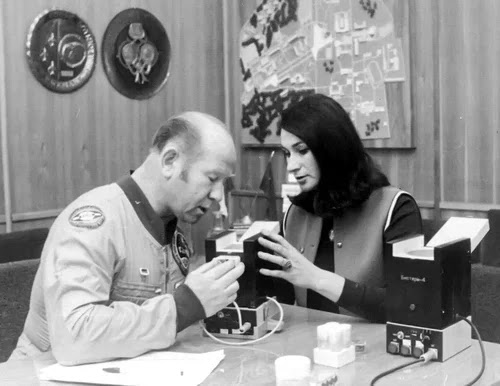

Image above: Pilot-cosmonaut, twice Hero of the Soviet Union Alexei Leonov and Doctor of Biological Sciences, head of biological programs at orbital stations at RSC Energia Galina Nechitailo discuss upcoming biological experiments in orbit.

In NASA, therefore, it is forbidden for women to make space flights in zero gravity in a state of pregnancy received on Earth. Female astronauts are specially tested for latent pregnancy 10 days before the flight.

Weightlessness, as a physiological state, cannot be considered "normal" in any of the parameters. This condition is abnormal. Pregnancy and childbirth proceed normally only under conditions of gravity, either in a natural form on Earth, or in an equivalent artificial form on the GC.

Pregnancy and childbirth in zero gravity is a question that is more reminiscent of an extreme situation today, the consequences of which cannot be predicted in advance. (Ogneva I.V., Guryeva T.S., Sychev V.N., Orlov O.I. Embryological research in space // Aerospace sphere. 2021. №1 (106) P. 34-43).


Image above: Children born in a stationary GC on the Moon are likely to become. the first real space people in the history of civilization...

Read soon: Exodus of civilization into space - Comparison of plans of NASA and Roscosmos. Part 14

Related articles:

Colonization of the Moon - The source of the power, wealth and power of civilization in the Universe. Part 17.3
https://orbiterchspacenews.blogspot.com/2021/04/colonization-of-moon-source-of-power.html

Space manned industrialization of the XXI century - the golden age of civilization. Part 17.2
https://orbiterchspacenews.blogspot.com/2021/04/space-manned-industrialization-of-xxi.html

Exodus of civilization into space - Humanity's strategy to create stationary and mobile Homeostatic arks. Part 17.1
https://orbiterchspacenews.blogspot.com/2021/04/exodus-of-civilization-into-space_21.html

Exodus of civilization into space - Tsiolkovsky Galactic State. Part 9
https://orbiterchspacenews.blogspot.com/2021/04/exodus-of-civilization-into-space_19.html

Exodus of civilization into space - Symbol of the End of the XXI century. Part 8
https://orbiterchspacenews.blogspot.com/2021/04/exodus-of-civilization-into-space_16.html

Exodus of civilization into space - Stopping the process of increasing value added. Part 7
https://orbiterchspacenews.blogspot.com/2021/04/exodus-of-civilization-into-space_14.html

Exodus of civilization into space - The sixth socio-economic formation of civilization. Part 6
https://orbiterchspacenews.blogspot.com/2021/04/exodus-of-civilization-into-space-sixth.html

Exodus of civilization into space - Space man. Part 5
https://orbiterchspacenews.blogspot.com/2021/04/exodus-of-civilization-into-space-space.html

Exodus of civilization into space - Biological End of the World. Part 4
https://orbiterchspacenews.blogspot.com/2021/04/exodus-of-civilization-into-space_7.html

Exodus of civilization into space - Geochronological Ice Ages, periods, eras. Part 3
https://orbiterchspacenews.blogspot.com/2021/04/exodus-of-civilization-into-space_5.html

Exodus of civilization into space - Astrophysical End of the World. Part 2
https://orbiterchspacenews.blogspot.com/2021/04/exodus-of-civilization-into-space.html

The ideology of space expansion - Space calendar. Part 1
https://orbiterchspacenews.blogspot.com/2021/03/the-ideology-of-space-expansion-space.html

Related links:

About Ph.D. Morozov Sergey Lvovich: https://zen.yandex.ru/media/id/5fbb90753e3ad265054f930a/ob-avtore-kanala-5fbd2bf80b4af80149fb12c2

Original article in Russian on Zen.Yandex:
https://zen.yandex.ru/media/id/5fbb90753e3ad265054f930a/ishod-civilizacii-v-kosmos-chast-17-strategiia-chelovechestva-po-sozdaniiu-stacionarnyh-i-mobilnyh-gomeostaticheskih-kovchegov-606467c1fa23f523d376a218

Asgardia website: https://asgardia.space/

Author: Ph.D. Morozov Sergey Lvovich / Zen.Yandex. Editor / Translation: Roland Berga. 

Best regards, Orbiter.ch

NASA Remembers Michael Collins


NASA logo.


April 28, 2021

Former NASA astronaut Michael Collins passed away on April 28, 2021.

Astronaut Michael Collins, Apollo 11 command module pilot. Image Credit: NASA

“Today the nation lost a true pioneer and lifelong advocate for exploration in astronaut Michael Collins," said acting NASA Administrator Steve Jurczyk. "As pilot of the Apollo 11 command module – some called him ‘the loneliest man in history’ – while his colleagues walked on the Moon for the first time, he helped our nation achieve a defining milestone. He also distinguished himself in the Gemini Program and as an Air Force pilot.

“Michael remained a tireless promoter of space. ‘Exploration is not a choice, really, it’s an imperative,’ he said. Intensely thoughtful about his experience in orbit, he added, ‘What would be worth recording is what kind of civilization we Earthlings created and whether or not we ventured out into other parts of the galaxy.’ "

The following is a statement from the Collins family:

“We regret to share that our beloved father and grandfather passed away today, after a valiant battle with cancer. He spent his final days peacefully, with his family by his side. Mike always faced the challenges of life with grace and humility, and faced this, his final challenge, in the same way. We will miss him terribly. Yet we also know how lucky Mike felt to have lived the life he did. We will honor his wish for us to celebrate, not mourn, that life. Please join us in fondly and joyfully remembering his sharp wit, his quiet sense of purpose, and his wise perspective, gained both from looking back at Earth from the vantage of space and gazing across calm waters from the deck of his fishing boat.”

For more information about Collins and his NASA career, visit: https://www.nasa.gov/michael-collins/

Image (mentioned), Text, Credit: NASA.

R.I.P.; Orbiter.ch

Cargo Ship Departs as SpaceX Crew-1 Mission Nears End


ISS - Expedition 65 Mission patch.


April 28, 2021

A trash-packed Russian cargo craft departed the International Space Station on Tuesday night. Four astronauts are also nearing the end of their mission amidst a variety of human research taking place on the orbiting lab today.

After being docked to the station for just over a year, Russia’s ISS Progress 75 (75P) resupply ship undocked from the Zvezda service module’s aft port filled with trash and discarded gear. The 75P backed away from Zvezda during the automated maneuver that began at 7:11 p.m. EDT. It will orbit Earth on its own until Wednesday night before burning up safely above the southern Pacific Ocean.


Image above: The 11-member crew aboard the station is actually a combination of three different crews: the Soyuz MS-18 crew in the back row, SpaceX Crew-2 in the middle row, and the four SpaceX Crew-1 astronauts in the far left and right corners. Image Credit: NASA TV.

Four SpaceX Crew-1 astronauts are targeting Saturday for their return to Earth and splashdown in the Gulf of Mexico off the coast of Florida. NASA and SpaceX managers continue to monitor the weather at the splashdown site.

The SpaceX Crew Dragon Endeavour is planned to undock from the Harmony module’s space-facing international docking adapter on Friday at 5:55 p.m. EDT. Astronaut Michael Hopkins will command the ride home alongside Pilot Victor Glover and Mission Specialists Shannon Walker and Soichi Noguchi. They are due to splashdown the next day at 11:36 a.m. NASA TV will begin its continuous live coverage at 3:30 p.m. on Friday.


Image above: Constant Gardening on the Space Station. Astronauts on the International Space Station recently enjoyed a fresh supply of leafy greens, thanks in large part to the efforts of Expedition 64 crew member Michael Hopkins. NASA’s SpaceX Crew-1 mission commander took the lead on conducting four Vegetable Production System (Veggie) experiments, with the last two wrapping up after an April 13 harvest. VEG-03K and VEG-03L tested a new space crop, ‘Amara’ mustard, and a previously grown crop, ‘Extra Dwarf’ pak choi. They were grown for 64 days, the longest leafy greens have grown on station. Image Credit: NASA.

Staying behind on the station is Commander Akihiko Hoshide and his Crew-2 crewmates Shane Kimbrough and Megan McArthur of NASA and Thomas Pesquet of the European Space Agency. They will live and work in space until October with NASA astronaut Mark Vande Hei and Roscosmos cosmonauts Oleg Novitskiy and Pyotr Dubrov who rode to the station on April 9 aboard the Soyuz MS-18 crew ship.

International Space Station (ISS). Animation Credit: ESA

During the crew handover activities, the orbital residents still had time for space science today. The crew collected blood and urine samples for the Phospho-Aging study that is researching space-caused muscle and bone atrophy. They are also taking note of how improving a space diet can impact mission success. Finally, they explored how weightlessness affects grip and movement as well as future spacecraft and robotic piloting techniques.

Related article:

Progress MS-14 will spend a day in autonomous flight
https://orbiterchspacenews.blogspot.com/2021/04/progress-ms-14-will-spend-day-in.html

Related links:

NASA TV: https://www.nasa.gov/multimedia/nasatv/index.html

Expedition 65: https://www.nasa.gov/mission_pages/station/expeditions/expedition65/index.html

SpaceX Crew-1: https://go.nasa.gov/38QJ2PI

Zvezda service module: https://www.nasa.gov/mission_pages/station/structure/elements/zvezda-service-module.html

Harmony module: https://www.nasa.gov/mission_pages/station/structure/elements/harmony

Phospho-Aging study: https://www.nasa.gov/mission_pages/station/research/experiments/explorer/Investigation.html?#id=8278

Space diet: https://www.nasa.gov/mission_pages/station/research/experiments/explorer/Investigation.html?#id=7870

Vegetable Production System (Veggie) experiments: https://www.nasa.gov/content/growing-plants-in-space

Grip and movement: https://www.nasa.gov/mission_pages/station/research/experiments/explorer/Investigation.html?#id=1188

Piloting techniques: https://www.energia.ru/en/iss/researches/human/24.html

Space Station Research and Technology: https://www.nasa.gov/mission_pages/station/research/overview.html

International Space Station (ISS): https://www.nasa.gov/mission_pages/station/main/index.html

Animation (mentioned), Images (mentioned), Text, Credits: NASA/Mark Garcia/Yvette Smith.

Best regards, Orbiter.ch