mardi 4 mai 2021

Swiss Air Force - Passed test for our pilots to flying outside office hours


Swiss Air Force roundel.


May 4, 2021

The operations command tested the responsiveness of the air police on Thursday during a test alert at Payerne air base. Successful exercise, says the command.


Image above: The full-scale test made it possible to verify the intervention capacity of the pilots, the personnel of the air defense engagement center and the Payerne air base, as well as that of the on-call service of other services of the Army. Image Credits: 20min/Simon Glauser.

The Swiss Air Force has been ensuring the security of Swiss airspace 24 hours a day, 7 days a week since January of this year. To test this availability in the field, the army carried out an unannounced check in the form of a take-off on alert (Quick Reaction Alert, QRA) at Payerne at 8:15 p.m. on Thursday.

This testing of the various QRA mechanisms and processes was deliberately scheduled outside of normal airbase operating hours, in order to verify the readiness of the various on-call services under realistic conditions.

Take off in 15 minutes

After the alarm sounded, two F / A-18s stationed at Payerne were to take off within the allotted time, that is to say within 15 minutes. The full-scale test made it possible to simultaneously verify, in addition to the intervention capacity of the pilots, also that of the personnel of the air defense engagement center and the Payerne air base, as well as that of the organizations' on-call service partners such as the Army Logistics Base (BLA) and the Army Command Assistance Base (BAC).

Push the Limit - Swiss Air Force Tribute

After reaching the affected area on time, the pilots carried out regular air police training. The results are being evaluated and the processes will be improved and adapted accordingly.

Alarm drills outside of normal hours will remain exceptional. However, they are essential for building knowledge and improving the organization, the DDPS General Secretariat said in a statement on passed Friday.

Related article:

No F/A-18 outside office hours: http://orbiterchspacenews.blogspot.ch/2014/02/no-fa-18-outside-office-hours.html

Find several Swiss Air Force planes for Flight Simulator X (CD version of FSX) for free download here: https://simulators.jimdo.com/

Image (mentioned), Text, Credits: ATS/Orbiter.ch Aerospace/Roland Berga/Video: Army Cinematographic Service/Music: Evanescence - Bring Me To Life.

Greetings, Orbiter.ch

NA64 sets bounds on how much new X bosons could change the electron’s magnetism


CERN - European Organization for Nuclear Research logo.


May 4, 2021

The result cannot explain an apparent tension with the Standard Model in the electron’s magnetic moment

The NA64 experiment. (Image: CERN)

The Standard Model of particle physics is alive and well. But it is not complete, so physicists continue to search for new particles and forces that could help complete the model and also explain some tensions with the model – or “anomalies” – in the behaviour of known particles. In a paper accepted for publication in Physical Review Letters, the NA64 collaboration describes how a search for new unknown particles – lightweight “X bosons” that could carry a new force – has allowed it to set bounds on how much these particles could contribute to a fundamental property of the electron, in which an apparent anomaly has recently emerged.

The property in question is the anomalous magnetic moment. The magnetic moment of a particle is a measure of how the particle interacts with a magnetic field. The anomalous magnetic moment is the part of the magnetic moment caused by the interaction of the particle with “virtual” particles that continually pop into and out of existence. These virtual particles comprise all the known particles, predicted by the Standard Model, but they could also include particles never before observed. Therefore, a difference between the Standard Model prediction of the anomalous magnetic moment of a particle and a high-precision measurement of this property could be a sign of new physics in the form of new particles or forces.

The most striking example of such an anomaly is the muon’s anomalous magnetic moment, for which Fermilab in the US recently announced a difference with theory at a significance level of 4.2 standard deviations – just a little below the 5 standard deviations required to claim a discovery of new physics. But there is another example, although at a lower significance level: the Standard Model’s prediction of the electron’s anomalous magnetic moment, based on the measurement of the fundamental constant of nature that sets the strength of the electromagnetic force, differs from the direct experimental measurement at a level of 1.6 or 2.4 standard deviations, depending on which of two measurements of the fundamental constant is used.

Like other anomalies, this anomaly may fade away as more measurements are made or as theoretical predictions improve, but it could also be an early indication of new physics, so it is worth investigating. In its new study, the NA64 collaboration set out to investigate whether new lightweight X bosons could contribute to the electron’s anomalous magnetic moment and explain this apparent anomaly.

NA64 is a fixed-target experiment that directs an electron beam of 100-150 GeV energy, generated using a secondary beamline from the Super Proton Synchrotron, onto a target to look for new particles produced by collisions between the beam’s electrons and the target’s atomic nuclei. In the new study, the NA64 team searched for lightweight X bosons by looking for the “missing” collision energy they would carry away. This energy can be identified by analysing the energy budget of the collisions.

Analysing data collected in 2016, 2017 and 2018, which in total corresponded to about three hundred billion electrons hitting the target, the NA64 researchers were able to set bounds on the strength of the interaction of X bosons with an electron and, as a result, on the contributions of these particles to the electron’s anomalous magnetic moment. They found that X bosons with a mass below 1 GeV could contribute at most between one part in a quadrillion and one part in ten trillions, depending on the X boson’s mass.

“These contributions are too small to explain the current anomaly in the electron’s anomalous magnetic moment,” says NA64 spokesperson Sergei Gninenko. “But the fact that NA64 reached an experimental sensitivity that is better than the current accuracy of the direct measurements of the electron’s anomalous magnetic moment, and of recent high-precision measurements of the fine-structure constant, is amazing. It shows that NA64 is well placed to search for new physics, and not only in the electron’s anomalous magnetic moment.”

Note:

CERN, the European Organization for Nuclear Research, is one of the world’s largest and most respected centres for scientific research. Its business is fundamental physics, finding out what the Universe is made of and how it works. At CERN, the world’s largest and most complex scientific instruments are used to study the basic constituents of matter — the fundamental particles. By studying what happens when these particles collide, physicists learn about the laws of Nature.

The instruments used at CERN are particle accelerators and detectors. Accelerators boost beams of particles to high energies before they are made to collide with each other or with stationary targets. Detectors observe and record the results of these collisions.

Founded in 1954, the CERN Laboratory sits astride the Franco–Swiss border near Geneva. It was one of Europe’s first joint ventures and now has 23 Member States.

Related links:

Physical Review Letters: https://journals.aps.org/prl/accepted/a507bYcfO0110d7b20ef08017217eb9202c10f0c1

Fermilab: https://news.fnal.gov/2021/04/first-results-from-fermilabs-muon-g-2-experiment-strengthen-evidence-of-new-physics/

Standard Model: https://home.cern/science/physics/standard-model

NA64: https://home.cern/science/experiments/na64

Super Proton Synchrotron (SPS): https://home.cern/science/accelerators/super-proton-synchrotron

For more information about European Organization for Nuclear Research (CERN), Visit: https://home.cern/

Image (mentioned), Text, Credits: CERN/By Ana Lopes.

Greetings, Orbiter.ch

lundi 3 mai 2021

Exodus of civilization into space - Apocalypse; View from the UK. Part 15


The sun will become a red giant.


May 3, 2021

Preamble

Here the fifteenth article of a series of articles by Ph.D. Morozov Sergey Lvovich, expert in chronology and calendar systems, as well as space biology and medicine, Parliamentarian of Asgardia (AMP) the first space Nation.

Ph.D. Morozov Sergey Lvovich

British physicist confirms the end of life on Earth

Death of the Earth

Completion of the Sun's life cycle will lead to the death of all life on planet Earth, to the absolute End of the World. This is the conclusion reached by the British physicist, researcher at the Royal Society of London, professor at the University of Manchester Brian Cox.

Professor Brian Cox, speaking at the Royal Institution, London, 26 November 2009

When the End of the World will happen and what it will be like, the scientist told the BBC program "Wonders of the Universe" on January 26, 2021.

The main source of life at the moment is approximately in the middle of its life cycle. The star burns about 600 million tons of hydrogen every second.

“This process is not endless - 5.5 billion years will pass, and the Sun will approach the end of its life cycle,” the specialist explained. Hydrogen reserves will run out, and then the final stage of the Sun's life will begin, which will result in catastrophic consequences for the Earth. At this moment, the core of the star will begin to expand rapidly, and the additional heat will force the outer layers of the Sun to increase. As a result, the luminary will fill the entire horizon, and all life on the planet will perish under its heat.

The death of civilization

"The end of the world for the Earth will come when the sun stops its vital activity," said physicist Brian Cox. He noted that the Sun has already passed half of its life cycle.

The sun acts as a source of life for the Earth thanks to light and heat, and those, in turn, are released due to the combustion of hydrogen. But after 5.5 billion years, the reserves of hydrogen on the star will run out. Then the "end" will come for the Earth.

After the disappearance of hydrogen reserves, the star will not go out idle, but will begin to collapse from the inside, starting from the core. The outer layers of the Sun will begin to expand, it will heat up, which will cause the temperature on the Earth to rise. Because of this, life on our planet will become impossible, and all living things will perish.

After a while, the Sun will turn into a red giant, and this will be its last phase of life. In this case, the star will significantly increase in size.

Previously, NASA stated that when the Sun becomes a red giant, it will become 2,000 times brighter. Survival of the Earth will be absolutely impossible.

“Ultimately the Sun will explode, and all that remains of our once magnificent star is a small, faintly glowing ember,” said Brian Cox.

The Earth will most likely not live up to this moment. And if he does, it will be in the form of scorched and barren stones that will witness the dying pangs of the Sun.

The sun has remained unchanged for 4.5 billion years. It melts 600 million tons of hydrogen into helium every second. This solar energy is the foundation of life on Earth. But when the supply of hydrogen runs out, the star will begin to die, and this event will have catastrophic consequences.

"Gradually, our planet will become hotter and hotter, so that the last perfect day will come on Earth, but in the end the existence of all life will become impossible," the physicist described the last day of life on Earth.

After the destruction of the solar core, the additional heat it generates will cause the outer layers of the Sun to expand (the Sun will become a red giant), and this process will burn the Earth. In 5.5 billion years, the Sun will explode, throwing a huge amount of gas and dust into space, forming a giant nebula, the professor explained. Then the Sun will turn into a brown dwarf - this is the final phase of the star's life, the physicist writes in the Express.

When there is no hydrogen left on the Sun, it will enter the final stage of its life - the core will begin to collapse, additional heat will be released, which will cause the outer layers of the Sun to expand.

Hot Earth

The consequences will be felt by the Earth - it will become hotter, and at some point life on the blue planet will become impossible, and everything will perish.

Stones

The water and atmosphere of the Earth will boil away, leaving nothing but charred lifeless stones. The sun will "grow so much that it fills the entire horizon." This will be the last phase of the life of the Earth, the Apocalypse.

But long before this moment, all flora and fauna on Earth will perish, since the Earth will leave the zone of most favored biological life much earlier. There will be no liquid water in the Earth's atmosphere. The earth will come out of a habitable zone or a habitable zone, a habitable zone (HZ).

In astronomy, this is a conditional area in space, determined from the calculation that the conditions on the surface of the planets in it will be very close to the conditions that will ensure the existence of water in the liquid phase.

Our commentary: for this state of absence of water in liquid form on the surface of the Earth, the civilization of people on Earth must be prepared in advance by the creation of flotillas of Homeostatic Arks (GC) - special spaceships on which it will be rescued in the vastness of the Universe within the framework of the Sixth CEF (Social and Economic-Formations).

The term "Homeostatic Ark" (2018) was first introduced by Sergey Lvovich Morozov in articles and in a monograph.
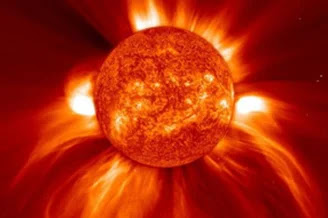
The sun is a red giant

Related articles:

Exodus of civilization into space - Comparison of plans of NASA and Roscosmos. Part 14
https://orbiterchspacenews.blogspot.com/2021/05/exodus-of-civilization-into-space.html

The ideology of space expansion - The question of pregnancy and childbirth in zero gravity. Part 17.4
https://orbiterchspacenews.blogspot.com/2021/04/the-ideology-of-space-expansion.html

Colonization of the Moon - The source of the power, wealth and power of civilization in the Universe. Part 17.3
https://orbiterchspacenews.blogspot.com/2021/04/colonization-of-moon-source-of-power.html

Space manned industrialization of the XXI century - the golden age of civilization. Part 17.2
https://orbiterchspacenews.blogspot.com/2021/04/space-manned-industrialization-of-xxi.html

Exodus of civilization into space - Humanity's strategy to create stationary and mobile Homeostatic arks. Part 17.1
https://orbiterchspacenews.blogspot.com/2021/04/exodus-of-civilization-into-space_21.html

Exodus of civilization into space - Tsiolkovsky Galactic State. Part 9
https://orbiterchspacenews.blogspot.com/2021/04/exodus-of-civilization-into-space_19.html

Exodus of civilization into space - Symbol of the End of the XXI century. Part 8
https://orbiterchspacenews.blogspot.com/2021/04/exodus-of-civilization-into-space_16.html

Exodus of civilization into space - Stopping the process of increasing value added. Part 7
https://orbiterchspacenews.blogspot.com/2021/04/exodus-of-civilization-into-space_14.html

Exodus of civilization into space - The sixth socio-economic formation of civilization. Part 6
https://orbiterchspacenews.blogspot.com/2021/04/exodus-of-civilization-into-space-sixth.html

Exodus of civilization into space - Space man. Part 5
https://orbiterchspacenews.blogspot.com/2021/04/exodus-of-civilization-into-space-space.html

Exodus of civilization into space - Biological End of the World. Part 4
https://orbiterchspacenews.blogspot.com/2021/04/exodus-of-civilization-into-space_7.html

Exodus of civilization into space - Geochronological Ice Ages, periods, eras. Part 3
https://orbiterchspacenews.blogspot.com/2021/04/exodus-of-civilization-into-space_5.html

Exodus of civilization into space - Astrophysical End of the World. Part 2
https://orbiterchspacenews.blogspot.com/2021/04/exodus-of-civilization-into-space.html

The ideology of space expansion - Space calendar. Part 1
https://orbiterchspacenews.blogspot.com/2021/03/the-ideology-of-space-expansion-space.html

Related links:

About Ph.D. Morozov Sergey Lvovich: https://zen.yandex.ru/media/id/5fbb90753e3ad265054f930a/ob-avtore-kanala-5fbd2bf80b4af80149fb12c2

Original article in Russian on Zen.Yandex:
https://zen.yandex.ru/media/id/5fbb90753e3ad265054f930a/ishod-civilizacii-v-kosmos-chast-15--apokalipsis-vzgliad-iz-velikobritanii-6034d12d2dc5795636ccbfdd

Asgardia website: https://asgardia.space/

Author: Ph.D. Morozov Sergey Lvovich / Zen.Yandex. Editor / Translation: Roland Berga. 

Best regards, Orbiter.ch

China Space Station


China Space Station - Tianhe Core Module (天和核心舱) patch.


May 3, 2021

Tianhe Core Module (天和核心舱)

The Tianhe core module is presented by its designers and as a 1:1 model at the China Science and Technology Museum.  The Tianhe Core Module (天和核心舱) is the first and main component of the China Space Station (中国空间站).

Inside the Tianhe core module

The China Space Station will have onboard nine international scientific experiments selected by the United Nations Office for Outer Space Affairs (UNOOSA), in cooperation with the China Manned Space Agency (CMSA).

International scientific experiments onboard the China Space Station

The Tianhe Core Module (天和核心舱) is the first and main component of the China Space Station (中国空间站). 

Related article:

CASC - Long March-5B Y2 launches the Tianhe Core Module
https://orbiterchspacenews.blogspot.com/2021/04/casc-long-march-5b-y2-launches-tianhe.html

For more information about China Aerospace Science and Technology Corporation (CASC), visit: http://english.spacechina.com/n16421/index.html

For more information about China National Space Administration (CNSA), visit: http://www.cnsa.gov.cn/

Image, Videos, Text, Credits: China Central Television (CCTV)/China National Space Administration (CNSA)/United Nations Office for Outer Space Affairs (UNOOSA)/China Manned Space Agency (CMSA)/Music: Space Navigator by Sarah, The Illstrumentalist courtesy of YouTube Audio Library/SciNews/Orbiter.ch Aerospace/Roland Berga.

Greetings, Orbiter.ch

Crew Staying in Space Until October for Research Mission


ISS - Expedition 65 Mission patch.


May 3, 2021

The seven-member Expedition 65 crew aboard the International Space Station will be orbiting Earth until October after watching the SpaceX Crew-1 astronauts depart over the weekend. The five astronauts and two cosmonauts staying behind prepared for the next SpaceX Cargo mission and researched a variety of space phenomena today.

NASA and SpaceX are targeting June 3 for the launch of the next Cargo Dragon mission to resupply the orbital lab. NASA Flight Engineer Shane Kimbrough and station Commander Akihiko Hoshide of the Japan Aerospace Exploration Agency began getting the station ready for the upcoming space shipment. The duo organized the Permanent Multipurpose Module and the Kibo laboratory module today to make room for the new cargo.


Image above: NASA astronaut Megan McArthur is at the robotics workstation participating in Canadarm2 robotic arm training. Image Credit: NASA.

Monday’s science activities ran the gamut of robotics, human research and drug development. Research on the orbiting lab can improve the health of humans on and off the Earth, benefit a range of industries, and advance the commercialization of space.

The Astrobee robotic assistants were flying around inside Kibo testing automated rendezvous techniques as Kimbrough monitored the activities. Flight Engineer Thomas Pesquet of the European Space Agency wore a virtual reality headset and reached for virtual objects to help scientists understand how weightlessness affects the central nervous system.

International Space Station (ISS). Animation Credit: ESA

NASA Flight Engineer Megan McArthur cleaned up the Microgravity Science Glovebox after closing out the Transparent Alloys physics study. Flight Engineer Mark Vande Hei of NASA checked out emergency hardware then set up gear for an immune system study that may promote the development of new vaccines and drugs to treat diseases.

Related article:

NASA Invites Media to Next SpaceX Cargo Launch to Space Station
https://www.nasa.gov/press-release/nasa-invites-media-to-next-spacex-cargo-launch-to-space-station

Related links:

Expedition 65: https://www.nasa.gov/mission_pages/station/expeditions/expedition65/index.html

Permanent Multipurpose Module: https://www.nasa.gov/mission_pages/station/structure/elements/permanent-multipurpose-module

Kibo laboratory module: https://www.nasa.gov/mission_pages/station/structure/elements/japan-kibo-laboratory

Astrobee: https://www.nasa.gov/mission_pages/station/research/experiments/explorer/Investigation.html?#id=7841

Central nervous system: https://www.nasa.gov/mission_pages/station/research/experiments/explorer/Investigation.html?#id=2038

Microgravity Science Glovebox: https://www.nasa.gov/mission_pages/station/research/experiments/explorer/Facility.html?#id=341

Transparent Alloys: https://www.nasa.gov/mission_pages/station/research/experiments/explorer/Investigation.html?#id=8215

Immune system study: https://www.nasa.gov/mission_pages/station/research/experiments/explorer/Investigation.html?#id=7818

Space Station Research and Technology: https://www.nasa.gov/mission_pages/station/research/overview.html

International Space Station (ISS): https://www.nasa.gov/mission_pages/station/main/index.html

Image (mentioned), Animation (mentioned), Text, Credits: NASA/Mark Garcia.

Best regards, Orbiter.ch

dimanche 2 mai 2021

Asteroid Gaspra


ROSCOSMOS logo.


May 2, 2021

The asteroid belt is the region between Mars and Jupiter, where the bulk of all asteroids in the solar system is concentrated. Hundreds of thousands of them have been discovered to date. Therefore, the violent imagination of science fiction writers presents this area as an insurmountable obstacle for spaceships that risked flying over it. However, by earthly standards, the asteroid belt is quite empty, since for us the distances between asteroids are enormous and amount to hundreds of thousands of kilometers.

Asteroid Gaspra. Photo of the Galileo spacecraft 1991.

In 1973, Pioneer 10 became the first spacecraft to cross the asteroid belt. Since then, several spacecraft have flown by without incident on the way to the outer planets of the solar system, and the orbits of known asteroids are now being laid down in flight programs. The first asteroid explored by a spacecraft was the asteroid (951) Gaspra.

It was discovered by the Russian astronomer G.N. Neuymin in 1916 in the Crimea and named after the Crimean village of Gaspra. In 1989, the Galileo spacecraft was launched to explore Jupiter and its moons. In 1991, the device, flying through the asteroid belt, approached Gaspra as close as possible. Then several dozen photographs were transmitted to the Earth, the nearest of which were taken from a distance of 5,300 km. Galileo managed to photograph about 80% of the asteroid's surface.


Image above: Gaspra (top), Deimos (left), Phobos (right). Gaspra (top), Deimos (left), Phobos (right).

Gaspra has an elongated, irregular shape with dimensions of 18 × 10 × 9 km. It is comparable in size to the Mars satellite Deimos. On the surface of the asteroid, many small impact craters and ditches up to 2.5 km long and up to 300 m wide were found. Gaspra belongs to the S-class asteroids. Its surface, with an average density of 2.7 g / cm³, is rich in olivine and pyroxene.

Scientists were puzzled by the presence on Gaspra of a large amount of regolith (debris that covers the surface of atmospheric planets, satellites and small cosmic bodies). It is possible that Gaspra received an additional amount of regolith during a cosmic collision that formed the Flora family, to which Gaspra is attributed.

Galileo spacecraft flew closer to Amalthea - Moon of Jupiter

Some researchers believe that it was this family that was the source of the cosmic body that fell to Earth 65 million years ago and caused the mass extinction of many animal species, including dinosaurs. 

Related links:

ROSCOSMOS Press Release: https://www.roscosmos.ru/30942/

Moscow Planetarium: https://www.roscosmos.ru/tag/moskovskiy-planetariy/

Asteroid: https://www.roscosmos.ru/tag/asteroid/

Images (NASA), Text, Credits: ROSCOSMOS/Orbiter.ch Aerospace/Roland Berga.

Best regards, Orbiter.ch

Crew-1 Makes Nighttime Splashdown, Ends Mission


SpaceX & NASA - Dragon Crew-1 Mission patch.


May 2, 2021

Astronauts Michael Hopkins, Victor Glover, and Shannon Walker of NASA, and Soichi Noguchi of the Japan Aerospace Exploration Agency (JAXA) splashed down safely in the SpaceX Crew Dragon Resilience in the Gulf of Mexico off the coast of Panama City, Florida, at 2:56 a.m. EDT after 168 days in space. The return marks the end of the first crew rotation mission to the International Space Station of the Crew Dragon spacecraft developed in partnership between NASA and SpaceX as a part of the agency’s Commercial Crew Program.


Image above: NASA astronauts Shannon Walker, left, Victor Glover, Mike Hopkins, and Japan Aerospace Exploration Agency (JAXA) astronaut Soichi Noguchi, right are seen inside the SpaceX Crew Dragon Resilience spacecraft onboard the SpaceX GO Navigator recovery ship shortly after landing in the Gulf of Mexico off the coast of Panama City, Florida, at 2:56 a.m. EDT May 2, 2021. Image Credits: NASA/Bill Ingalls.

Teams on the Go Navigator recovery ship, including two fast boats, now are in the process of securing Crew Dragon and ensuring the spacecraft is safe for the recovery effort. As the fast boat teams complete their work, the recovery ship will move into position to hoist Crew Dragon onto the main deck of Go Navigator with the astronauts inside. Once on the main deck, the crew will be taken out of the spacecraft and receive medical checks before a helicopter ride to Pensacola to board a plane for Houston.

SpaceX Crew-1: “Resilience” Crew Dragon Splashdown

NASA’s SpaceX Crew-1 mission launched Nov. 15, 2020, on a Falcon 9 rocket from the agency’s Kennedy Space Center in Florida. The astronauts named the spacecraft Resilience, in honor of their families, colleagues, and fellow citizens and highlighting the dedication displayed by the teams involved with the mission and demonstrating that there is no limit to what humans can achieve when they work together. Crew Dragon Resilience docked to the Harmony module’s forward port of the space station Nov. 16, nearly 27 hours after liftoff.


Image above: A night-vision camera captures the SpaceX Crew Dragon parachuting to splashdown in the Gulf of Mexico as fast boats arrive to retrieve the crew. Image Credit: NASA TV.

Hopkins has now spent a total of 335 days in space during two spaceflights; he conducted three spacewalks during this mission for a total of five in his career. It was Glover’s first spaceflight, during which he conducted four spacewalks during the 168 days. It was Walker’s second spaceflight, bringing her total time in space to 331 days. Noguchi conducted one spacewalk, for a total of four spacewalks during his three total spaceflights; he has spent a total of 345 days in space.

Related article:

Crew-1 Undocks From Station and Heads for Splashdown
https://orbiterchspacenews.blogspot.com/2021/05/crew-1-undocks-from-station-and-heads.html

Related links:

Crew-1: https://www.nasa.gov/crew-1

Commercial Crew: https://www.nasa.gov/exploration/commercial/crew/index.html

International Space Station (ISS): https://www.nasa.gov/mission_pages/station/main/index.html

Images (mentioned), Video, Text, Credits: NASA/Mark Garcia/NASA TV/SciNews.

Greetings, Orbiter.ch