mercredi 23 juin 2021

Exodus of civilization into space - American Jobs Plan. Part 18.4


Space Expansion logo.


 June 23, 2021

Preamble

Here the eighteenth (18.4) article of a series of articles by Ph.D. Morozov Sergey Lvovich, expert in chronology and calendar systems, as well as space biology and medicine, Parliamentarian of Asgardia (AMP) the first space Nation.

Ph.D. Morozov Sergey Lvovich

It is on Earth that space technologies need to be introduced first of all now, as the US government did, which proposed an ambitious social plan on March 31, 2021: "American Jobs Plan".

This plan should provide 19 million jobs. $ 2 to $ 5 trillion investment over 15 years in environmental space programs on Earth. Strategic US transition from fossil fuels to green electrification of the entire country.

The future belongs to efficient storage systems for large amounts of energy and large solar power plants. A good example is a power plant that was recently opened in Dubai. It generates electricity at a cost of about 4 to 5 cents per kilowatt. It is cheaper than getting energy from fossil sources.

All countries of the world should follow this example of the United States, and then the 21st century will become an unprecedented "golden age" of space industrialization and cooperation for countries and states throughout the history of human civilization.

Billionaire Jeff Bezos will fly into space on July 20, 2021 in his own New Shepard spacecraft

The flight is scheduled for July 20. The company said that Bezos (two brothers) will fly with the third (the winner of the auction). Blue Origin successfully completed 15 New Shepard test flights, the last in mid-April 2021.

(https://yandex.ru/search/?lr=200&text=безос%20полетит%20в%20июле%202021)

A place in the same spaceship with the founder of Amazon, the richest man in the world, Jeff Bezos, was auctioned for $ 28 million. This was reported by the company Blue Origin, which held the auction.

“Blue Origin has completed an online auction for # 1 in New Shepard, raising $ 28 million. About 7,600 people from 159 countries registered to participate in the auction, ”the company’s representatives are quoted by the 360 ​​TV company.

The name of the winner of the auction is not yet known, it will be announced within a few weeks. The first two space tourists will be the Bezos brothers.

Billionaire Jeff Bezos

Private space company Blue Origin was created by Amazon founder Jeff Bezos in 2000.

In the USA and in the West in general, billionaires (Richard Branson, Elon Musk, Jeff Bezos, etc.) create new space technologies, are the creators and agents of progress.

In Russia and throughout the post-Soviet space, billionaires create only yachts for personal use. This is the only reason why Russia does not have the means to develop new space technologies. You can't fly into space on yachts.

Gennady Krivoschapov believes: "The Russian military-industrial complex and space are doomed to degradation."

Gennady Fedorovich Krivoshchapov took part in the preparation and launches of the Soyuz spacecraft, led a team of adjusters of a test stand 1 (one) kilometer long. He is proud of the fact that two 50-ton monoliths with a gap tolerance of 0.5 millimeters were docked under his command.

"Until a political and public verdict on changing the direction of the country's development is adopted, all attempts to solve problems by technical means are deliberately futile."

(https://newizv.ru/interview/01-06-2021/gennadiy-krivoschapov-rossiyskiy-vpk-i-kosmos-obrecheny-na-degradatsiyu)

According to Andrei Ionin, an independent expert in the space industry, in Russia it is possible to create a body similar to, for example, the US Space Council, which could set national goals based on government priorities.

It is extremely important to give specific tasks, providing them with long-term financial resources, as well as to develop international cooperation and intensify inter-sectoral interaction.

(https://iz.ru/1150451/dmitrii-laru/mnogopoliarnaia-zvezda-rf-namerena-sokhranit-status-kosmicheskoi-derzhavy)

Therefore, Russia will have to cooperate in creating the GC either with China, at least, or with a wider range of financially and economically powerful countries of the EU and the United States?

Without GC systems (stationary and mobile), the duration of the stay of people in space will be limited to periods from 6 to 11 months, as is the case today on the ISS, for medical reasons.

This is somewhat reminiscent of abandoning the use of the toilet on the Apollo spacecraft in favor of diapers. The flights of American astronauts to the moon in diapers still amaze the whole world and cause many to doubt the reality of these flights in principle.

GK systems are key to the modern exploration of the enormous potential of the Universe.

All countries will be divided into two principal groups:

Some will permanently live in space on the GC in conditions of healthy artificial gravity of the earth's level (1.0g), that is, will be full-fledged "space people", while others will be temporary visitors "in diapers" in conditions of pathological weightlessness?

What group will Russia be in? Will Russia officially become a full-fledged modern prosperous "space state" like the UAE, like a "national idea"?

Without the adoption of the state space program SELENOSTRATEGY, without reorganization ("without sharpening") under this program of the entire economic and political life of the country, including in changing, perhaps, the Basic Law for this space task ?, - Russia can simply disappear from the stage of history Land with their oligarchs and their yachts in the next 10 years?

"Over the past 10 years, on average, Russia has grown 8 times slower than the world economy as a whole. The Russian oligarchic economy is sinking in a swamp of stagnation. The current size of GDP in 2018 exceeded the level of 2008 by slightly more than 4%."

"Having gone through two recessions in 10 years, on average, Russia grew at 0.4% per year - 8 times slower than the global economy as a whole, adding, according to the World Bank, 31.2%."

"This (2018) year, Russia will be in 166th place in the world in terms of growth," says Yakov Mirkin, Head of the Capital Markets Department at IMEMO RAN: The IMF predicts 1.7% with a slowdown to 1.5% in the next 5 years.

"This is one third slower than developed countries are growing (2.4% and 2.2% in 2018-19), half the indicators of the world economy as a whole (3.9% for the next two years) and almost three times worse than developing countries whose growth the fund estimates at 4.9% this year and 5.1% next. "

“Almost 80% of the working-age population does not have the skills and competencies to work in modern markets. At the same time, 50% of Russian scientists, 52% of top managers, 54% of IT specialists and 49% of engineering workers would like to leave the country and work abroad. "

"Every year, 100 thousand people leave the country, of which 70% are" intellectual migration ", highly qualified specialists, according to the RANEPA."

"At the end of 2017, funding for science was cut to a minimum in 10 years, to 377.9 billion rubles. This is three times less than the state spends on providing the apparatus of officials and state authorities (1.2 trillion rubles) and 13 times less army and police (almost 5 trillion rubles). "

"Everything is set up for braking, for redundancy, for carving out a shrinking pie." The number of those wishing to share it has doubled over the past 20 years: the army of officials has grown from 2.4 million people in 1995 to 5.3 million, according to BCG.

At the same time, only 15% of the population is employed in small business versus 40% in India, 52% in Brazil, 63% in Germany and 80% in China. "

With this trend, it seems that only those who do not produce anything, but only actively "divide" the emaciated budget and the dying "small business", will remain.

A radical reorganization of the state economic system from above is a common thing in history: in England it happened in 1533 under King Henry VIII; in Russia - in 1700 under Tsar Peter I; and under Empress Catherine II - in 1764.

If the timely "economic reorganization from above" was delayed, then they received the same result, but through the "revolution from below":

In 1640 - through the revolution in England (Oliver Cromwell); in 1789 - the Great French Revolution (Maximilian Robespierre-Napoleon Bonaparte); in 1917 - the Great October Revolution in Russia (Lenin-Trotsky-Stalin).

Can Russia today economically transform itself "from above" into a full-fledged "space state" in the sense that its main social goal should officially be the massive colonization of outer space?

All developed countries have taken this path since April 6, 2020 - with the Executive Order on Encouraging International Support for the Recovery and Use of Space Resources (Executive Order on Encouraging International Support for the Recovery and Use of Space Resources).

This is an American "Decree" - not an initiative of Russia, it is an active scientifically grounded international initiative - a challenge by the United States to the entire world community.

Will Russia either take measures of an adequate economic response and internal reorganization to this initiative-challenge to the United States, or will it ignore and lag behind the United States in the historical perspective?

How much will Russia have enough political and economic flexibility for adequate self-organization and adjustment for fundamentally new important world space tasks, for the transformation from today's stagnation and 116th place in the world ranking in terms of growth rates into a modern prosperous "space state"?

In this case, the space department of D. Rogozin in the new "Space Russia" should be recognized as the state leading, priority, key core? How is the "national idea"?

Roscosmos will become the main ideological and production core of the "space state" Russia? What is Russia's "national idea"?

All other economic indicators of Russia will have to keep their count from the economic events in Roscosmos?

Should the oligarchs and their yachts remain as a top priority in the past?

Head of Roscosmos Dmitry Rogozin. Photo from "Yandex. Pictures"

Should the entire sublunary world as part of the UN gradually come to a similar target space priority setting for its national economies and national programs?

Will it be a modern scientific state and interstate international approach to the problem of space colonization, and not the "extravagant exotic" of only individual billionaires - Elon Musk, Jeff Bezos and Richard Branson?

(https://thinktanks.by/publication/2018/09/20/za-10-let-v-srednem-rossiya-rosla-v-8-raz-medlennee-chem-mirovaya-ekonomika-v-tselom.html)

Related articles:

Exodus of civilization into space - The space age of civilization began its new Third stage (civil). Part 18.3
https://orbiterchspacenews.blogspot.com/2021/06/exodus-of-civilization-into-space-space.html

Exodus of civilization into space - Selenic Strategy - Ideology of the UN in the XXI Century. Part 18.2
https://orbiterchspacenews.blogspot.com/2021/05/exodus-of-civilization-into-space_31.html

Exodus of civilization into space - Selenic Strategy - UN Ideology in the XXI Century. Part 18.1
https://orbiterchspacenews.blogspot.com/2021/05/exodus-of-civilization-into-space_25.html

Space Toilet and Problems of Intestinal Stick Infection. Part 17.7
https://orbiterchspacenews.blogspot.com/2021/05/space-toilet-and-problems-of-intestinal.html

Three Historical Stages of Cosmonautics Development. Part 17.6
https://orbiterchspacenews.blogspot.com/2021/05/three-historical-stages-of-cosmonautics.html

Brief Background to Selenopolitics (Industrial Colonization of the Moon). Part 17.5
https://orbiterchspacenews.blogspot.com/2021/05/brief-background-to-selenopolitics.html

Exodus of civilization into space - Creation of the first ever mobile homeostatic ark (HA) in the USA. Part 16
https://orbiterchspacenews.blogspot.com/2021/05/exodus-of-civilization-into-space_5.html

Exodus of civilization into space - Apocalypse; View from the UK. Part 15
https://orbiterchspacenews.blogspot.com/2021/05/exodus-of-civilization-into-space_3.html

Exodus of civilization into space - Comparison of plans of NASA and Roscosmos. Part 14
https://orbiterchspacenews.blogspot.com/2021/05/exodus-of-civilization-into-space.html

The ideology of space expansion - The question of pregnancy and childbirth in zero gravity. Part 17.4
https://orbiterchspacenews.blogspot.com/2021/04/the-ideology-of-space-expansion.html

Colonization of the Moon - The source of the power, wealth and power of civilization in the Universe. Part 17.3
https://orbiterchspacenews.blogspot.com/2021/04/colonization-of-moon-source-of-power.html

Space manned industrialization of the XXI century - the golden age of civilization. Part 17.2
https://orbiterchspacenews.blogspot.com/2021/04/space-manned-industrialization-of-xxi.html

Exodus of civilization into space - Humanity's strategy to create stationary and mobile Homeostatic arks. Part 17.1
https://orbiterchspacenews.blogspot.com/2021/04/exodus-of-civilization-into-space_21.html

Exodus of civilization into space - Tsiolkovsky Galactic State. Part 9
https://orbiterchspacenews.blogspot.com/2021/04/exodus-of-civilization-into-space_19.html

Exodus of civilization into space - Symbol of the End of the XXI century. Part 8
https://orbiterchspacenews.blogspot.com/2021/04/exodus-of-civilization-into-space_16.html

Exodus of civilization into space - Stopping the process of increasing value added. Part 7
https://orbiterchspacenews.blogspot.com/2021/04/exodus-of-civilization-into-space_14.html

Exodus of civilization into space - The sixth socio-economic formation of civilization. Part 6
https://orbiterchspacenews.blogspot.com/2021/04/exodus-of-civilization-into-space-sixth.html

Exodus of civilization into space - Space man. Part 5
https://orbiterchspacenews.blogspot.com/2021/04/exodus-of-civilization-into-space-space.html

Exodus of civilization into space - Biological End of the World. Part 4
https://orbiterchspacenews.blogspot.com/2021/04/exodus-of-civilization-into-space_7.html

Exodus of civilization into space - Geochronological Ice Ages, periods, eras. Part 3
https://orbiterchspacenews.blogspot.com/2021/04/exodus-of-civilization-into-space_5.html

Exodus of civilization into space - Astrophysical End of the World. Part 2
https://orbiterchspacenews.blogspot.com/2021/04/exodus-of-civilization-into-space.html

The ideology of space expansion - Space calendar. Part 1
https://orbiterchspacenews.blogspot.com/2021/03/the-ideology-of-space-expansion-space.html

Related links:

About Ph.D. Morozov Sergey Lvovich: https://zen.yandex.ru/media/id/5fbb90753e3ad265054f930a/ob-avtore-kanala-5fbd2bf80b4af80149fb12c2

Original article in Russian on Zen.Yandex:
https://zen.yandex.ru/media/id/5fbb90753e3ad265054f930a/ishod-civilizacii-v-kosmos-chast-18-selenostrategiia-ideologiia-oon-v-xxi-veke-60a51f9b9582641d181888d9

Asgardia website: https://asgardia.space/

Author: Ph.D. Morozov Sergey Lvovich / Zen.Yandex. Editor / Translation: Roland Berga. 

Best regards, Orbiter.ch

mardi 22 juin 2021

Crew Looks to Friday Spacewalk, Cargo Ship Swap Next Week


ISS - Expedition 65 Mission patch.


June 22, 2021

The Expedition 65 crew continued its space research activities today while two astronauts prepared for their third spacewalk in less than two weeks. The International Space Station will also see a U.S. cargo craft depart and a Russian one launch on the same day next week.

International Space Station (ISS). Animation Credit: NASA

NASA Flight Engineer Mark Vande Hei strapped himself to an exercise cycle and attached sensors to himself on Tuesday morning for a workout study measuring aerobic capacity in space. NASA Flight Engineer Megan McArthur explored how bacteria is affected by microgravity and ways to counteract harmful changes.

Eye checks were back on the schedule for four astronauts on Tuesday afternoon. Commander Akihiko Hoshide and Vande Hei took turns operating medical imaging gear and scanned the eyes of astronauts Shane Kimbrough and Thomas Pesquet. A variety of eye exams take place on the station helping researchers understand how weightlessness impacts an astronaut’s vision.


Image above: Spacewalkers (from left) Shane Kimbrough and Thomas Pesquet work to complete the installation of a roll out solar array on June 20, 2021. Image credit: NASA TV.

Kimbrough and Pesquet are also getting ready for more solar array installation work on the outside of the orbiting lab. The duo reviewed procedures today for installing a second roll out solar array on the station’s Port-6 truss structure. The veteran spacewalkers will set their spacesuits to battery power at 8 a.m. EDT on Friday signifying the official start of their third excursion in 9 days. Live coverage on NASA TV starts at 6:30 a.m. on the agency’s website and the NASA app.


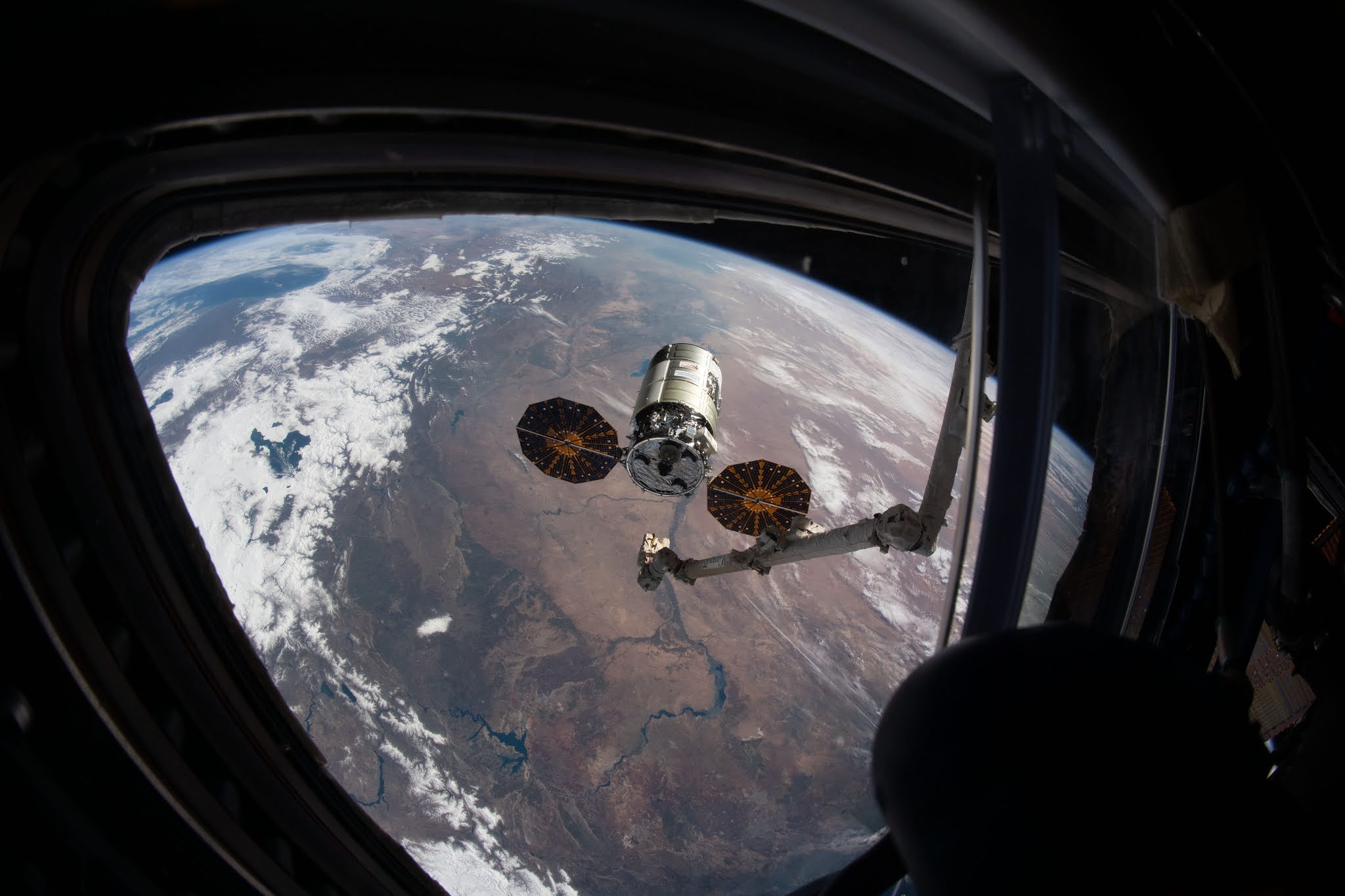
Image above: The Cygnus space freighter from Northrop Grumman is pictured moments before its capture with the Canadarm2 robotic arm. Cygnus and the International Space Station were both orbiting 263 miles above Turkey in this photograph taken from inside the cupola. Image Credit: JSC.

Hoshide and Vande Hei spent some time Tuesday morning loading Northrop Grumman’s Cygnus space freighter ahead of its departure scheduled for July 29 at 12:25 p.m. Russia’s ISS Progress 78 resupply ship will launch the same day at 7:27 p.m. and dock to the station two days later at 9:02 p.m.

Roscosmos cosmonaut Oleg Novitskiy packed the ISS Progress 77 resupply ship readying the vehicle for its undocking in late July. The veteran cosmonaut also trapped clouds of particles using both neon and argon gas for a plasma crystal experiment. Russian Flight Engineer Pyotr Dubrov had an exercise test on a treadmill today then serviced a variety of communications and life support hardware.

Related articles:

NASA to Air Third Spacewalk to Install New Station Solar Arrays
https://www.nasa.gov/press-release/nasa-to-air-third-spacewalk-to-install-new-station-solar-arrays

NASA to Air Northrop Grumman Cygnus Departure from Space Station
https://www.nasa.gov/press-release/nasa-to-air-northrop-grumman-cygnus-departure-from-space-station

Related links:

Expedition 65: https://www.nasa.gov/mission_pages/station/expeditions/expedition65/index.html

Measuring aerobic capacity in space: https://www.nasa.gov/mission_pages/station/research/experiments/explorer/Investigation.html?#id=644

Port-6 truss structure: https://www.nasa.gov/mission_pages/station/structure/elements/truss-structure

Plasma crystal: https://www.energia.ru/en/iss/researches/process/02.html

Space Station Research and Technology: https://www.nasa.gov/mission_pages/station/research/overview.html

International Space Station (ISS): https://www.nasa.gov/mission_pages/station/main/index.html

Images (mentioned), Animation (mentioned), Text, Credits: NASA/Mark Garcia.

Best regards, Orbiter.ch

My Favorite Martian Image: Jezero Crater’s ‘Delta Scarp’


NASA - Mars 2020 Perseverance Rover logo.


Jun 22, 2021

A Perseverance rover scientist’s favorite shot from the young Mars mission provides a new angle on an old and intriguing surface feature.


Image above: Perseverance scientist Olivia Sun was excited to see certain geologic features in imagery of Jezero Crater’s “Delta Scarp” because they provide evidence of a watery past. Image Credits: NASA/JPL-Caltech/LANL/CNES/CNRS/ASU/MSSS.

Ask any space explorer, and they’ll have a favorite image or two from their mission. For Apollo 8’s Bill Anders, it was a picture looking back at the Earth from near the Moon. Astronaut Randy Bresnik prizes a photo of an aurora he took while aboard the International Space Station. And for Vivian Sun, a scientist at NASA’s Jet Propulsion Laboratory in Southern California, it’s an image NASA’s Perseverance Mars rover took of one of Jezero Crater’s escarpments (long, steep slopes at the edge of a plateau) – so far away but yet so tantalizingly close.

Sun knows that close-ups of what the rover’s science team has named the “Delta Scarp” and its conglomerates (coarse-grained pebbles mixed with sand turned to rock) and cross-bedding (tilted layers of sedimentary rock) may, at first glance, seem like something only a geologist could love. But, the co-lead of Perseverance’s first science campaign wants to assure you that whatever it may lack in cinematic panache, this Martian mosaic makes up for in geologic importance.


Image above: This composite image of Jezero Crater’s “Delta Scarp” was generated using data from the Perseverance rover’s Remote Microscopic Imager and Mastcam-Z camera. Image Credit: RMI: NASA/JPL-Caltech/LANL/CNES/CNRS/ASU/MSSS Image Credits: Mastcam-Z: NASA/JPL-Caltech/ASU/MSSS.

“I’ve been studying Jezero Crater for years and must have looked at orbital images of the Delta Scarp over a thousand times,” said Sun. “But you can only learn so much from orbit, and when this image of the scarp came down to Earth from the rover after landing, it literally took my breath away. This is a favorite because for the first time I could see actual evidence of the conglomerates and cross-bedding we had hypothesized.”

Conglomerates are cemented together in a watery environment, and cross-bedding can be evidence of water movement recorded by waves or ripples of loose sediment the water passed over long ago. Both features are precisely the kind Sun and the science team hoped to find in Jezero. About 3.8 billion years ago, the crater was likely home to a body of water the size of Lake Tahoe, along with a river and a fan-shaped delta formed by sedimentary deposits from that river.


 Perseverance  Rover. Animation Credits: NASA/JPL-Caltech

“We’ve known for a while that billions of years ago the Jezero’s Delta Scarp was home to a rushing river,” said Sun. “Now we know we’ll be able to see evidence of this river system up close, getting a better idea of its size and strength of the water rushing through it. And because the river deposited sediments and other material at the scarp from not only inside Jezero but outside as well, it should be an amazing location to look for signs of ancient life.”

The mission expects to explore the Delta Scarp region during Perseverance’s second science campaign, sometime next year. At present, the rover is in the opening days of its first science campaign, exploring a 1.5-square-mile (4-square-kilometer) patch of crater floor that may contain Jezero’s deepest (and most ancient) layers of exposed bedrock, along with other intriguing geologic features. It is during this initial campaign that they’ll collect the first samples from another planet for return to Earth by a future mission.


Image above: This annotated image of Mars’ Jezero Crater depicts the location of NASA’s Perseverance rover (yellow dot) and the field of view of its Remote Microscopic Imager (RMI) camera when it took a series of images of the “Delta Scarp” on March 17, 2021. Image Credits: NASA/JPL-Caltech/University of Arizona.

As for Sun’s favorite picture, it shows a 377-foot-wide (115-meter-wide) portion of the scarp. It was stitched together from five images taken by the rover’s Remote Microscopic Imager (RMI) camera on March 17, 2021 (the 26th Martian day, or sol of the mission), from 1.4 miles (2.25 kilometers) away.

Part of the SuperCam instrument, the RMI can spot an object the size of softball from nearly a mile away, allowing scientists to take images of details from long distances. It can also observe dust grains as small as four-thousandths of an inch (100 microns). Perched atop the rover’s mast, SuperCam’s 12-pound (5.6-kilogram) sensor head can perform five types of analyses to study Mars’ geology and help scientists choose which rocks the rover should sample in its search for signs of ancient microbial life.

More About the Mission

A key objective for Perseverance’s mission on Mars is astrobiology, including the search for signs of ancient microbial life. The rover will characterize the planet’s geology and past climate, pave the way for human exploration of the Red Planet, and be the first mission to collect and cache Martian rock and regolith (broken rock and dust).

Subsequent NASA missions, in cooperation with ESA (European Space Agency), would send spacecraft to Mars to collect these sealed samples from the surface and return them to Earth for in-depth analysis.

The Mars 2020 Perseverance mission is part of NASA’s Moon to Mars exploration approach, which includes Artemis missions to the Moon that will help prepare for human exploration of the Red Planet.

JPL, which is managed for NASA by Caltech in Pasadena, California, built and manages operations of the Perseverance rover.

For more about Perseverance:

https://mars.nasa.gov/mars2020/

https://nasa.gov/perseverance

Images (mentioned), Animation (mentioned), Text, Credits: NASA/Tony Greicius/Karen Fox/Alana Johnson/JPL/DC Agle.

Greetings, Orbiter.ch

lundi 21 juin 2021

ISS orbit will be increased by almost 1 km during the correction on June 24


ROSCOSMOS - Russian Vehicles patch.


June 21, 2021

The orbital altitude of the International Space Station on June 24, 2021 is planned to be increased by 890 meters using the engines of the Progress MS-16 transport cargo vehicle.

International Space Station (ISS). Image Credit: NASA

According to preliminary data from the ballistic and navigation support service of the TsNIIMash Flight Control Center (part of the Roscosmos State Corporation), at 05:25 Moscow time, a command will be issued and the engines of the Progress MS-16 spacecraft will be turned on, which will operate for 466 seconds. The impulse value is 0.5 m / s. The average altitude of the station's orbit will be about 420.26 km above the Earth's surface.

ISS orbit parameters after the corrective maneuver:

- Orbital period: 92.92 min;
- Orbital inclination: 51.66 degrees;
- Minimum orbit altitude: 419.27 km;
- Maximum orbital altitude: 439.32 km.

Planned orbit correction is carried out in order to form ballistic conditions before the launch of the American CST-100 Starliner (Boe-OFT 2) spacecraft, the Soyuz MS-19 manned transport vehicle and the landing of the Soyuz MS-18 descent vehicle.

At the moment, a crew consisting of Roscosmos cosmonauts Oleg Novitsky, Peter Dubrov and NASA astronaut Mark Vande Hai, who arrived on April 9, 2021 on the Soyuz MS-18 spacecraft, as well as crew members of the Crew Dragon spacecraft NASA astronauts Shane Kimbrow are working at the International Space Station and Megan MacArthur, ESA astronaut Tom Peske and Japan Aerospace Exploration Agency astronaut Akihiko Hoshide.

ROSCOSMOS Press Release: https://www.roscosmos.ru/31550/

International Space Station (ISS): https://www.roscosmos.ru/tag/mks/

Image (mentioned), Text, Credits: ROSCOSMOS/Orbiter.ch Aerospace/Roland Berga.

Greetings, Orbiter.ch

Astronauts Look to Friday Spacewalk after Roll Out Solar Array Installation


ISS - Expedition 65 Mission patch.


June 21, 2021

The International Space Station has a new solar array that was installed during Sunday’s spacewalk by Expedition 65 astronauts Shane Kimbrough and Thomas Pesquet. The duo will conduct a third spacewalk on Friday to install a second solar array.

The first ISS Roll-Out Solar Array (iROSA) was successfully installed and deployed during a spacewalk on Sunday and is performing well. Ground teams will continue to collect data on its performance and compare it to last year’s information, calculating the total power gained.


Image above: Spacewalker Thomas Pesquet of ESA (European Space Agency) works to complete the installation of a roll out solar array on the International Space Station’s Port-6 truss structure. Image Credit: NASA TV.

Kimbrough and Pesquet completed the solar array installation work and began configuring a second iROSA during Sunday’s six-hour and 28-minute spacewalk. The duo now turns its attention to Friday’s excursion to install the second iROSA on the opposite side of the Port-6 truss structure where the first solar array is installed. NASA TV, on the agency’s website, and the NASA app, will start its live coverage at 6:30 a.m. with the spacewalk set to begin at 8 a.m. when the veteran spacewalkers set their U.S. spacesuits to battery power.

The spacewalking duo joined NASA Flight Engineers Megan McArthur and Mark Vande Hei for a conference with ground specialists. Then Kimbrough and Pesquet serviced some spacesuit components and organized tools for Friday’s upcoming spacewalk. McArthur and Vande Hei will once again assist the pair in and out of their spacesuits and provide robotics support on Friday.


Image above: Spacewalker Shane Kimbrough of NASA works to complete the installation of a roll out solar array on the International Space Station’s Port-6 truss structure. Image Credit: NASA TV.

Research still continued aboard the orbital lab today as the crew explored pharmaceuticals, protein crystals and the human eye.

Commander Akihiko Hoshide serviced samples inside the Microgravity Science Glovebox for a study that explores freeze-drying as a way to preserve medicines for long periods of time. Kimbrough peered through a microscope looking at samples for the Real-Time Protein Crystal Growth experiment which could lead to new disease therapies on Earth.


Image above: The 60-foot-long roll out solar arrays are seen deploying as the space station soared over the United States in a process that took about 6 minutes. Image Credit: NASA TV.

Vande Hei took on the crew medical officer role today and scanned the eyes of McArthur using medical imaging hardware. The eye exams take place regularly on the station since astronauts have reported vision issues after living in space for months.

The two Roscosmos flight engineers, cosmonauts Oleg Novitskiy and Pyotr Dubrov, split their day between science and maintenance activities. Novitskiy explored plasma crystals first then photographed the condition of the Pirs docking compartment ahead of its departure later this summer. Dubrov checked communications gear and worked Russian life support hardware.

Related article:

Spacewalkers Complete First Roll Out Solar Array Installation
https://orbiterchspacenews.blogspot.com/2021/06/spacewalkers-complete-first-roll-out.html

Related links:

Expedition 65: https://www.nasa.gov/mission_pages/station/expeditions/expedition65/index.html

ISS Roll-Out Solar Array (iROSA): https://www.nasa.gov/feature/new-solar-arrays-to-power-nasa-s-international-space-station-research

Port-6 truss structure: https://www.nasa.gov/mission_pages/station/structure/elements/truss-structure

Microgravity Science Glovebox: https://www.nasa.gov/mission_pages/station/research/experiments/explorer/Facility.html?#id=341

Preserve medicines: https://www.nasa.gov/mission_pages/station/research/experiments/explorer/Investigation.html?#id=8329

Real-Time Protein Crystal Growth: https://www.nasa.gov/mission_pages/station/research/experiments/explorer/Investigation.html?#id=8073

Plasma crystals: https://www.energia.ru/en/iss/researches/process/02.html

Pirs docking compartment: https://www.nasa.gov/mission_pages/station/structure/elements/pirs-docking-compartment

Space Station Research and Technology: https://www.nasa.gov/mission_pages/station/research/overview.html

International Space Station (ISS): https://www.nasa.gov/mission_pages/station/main/index.html

Images (mentioned), Text, Credits: NASA/Mark Garcia.

Best regards, Orbiter.ch

New sea-level monitoring satellite goes live


ESA - Sentinel-6 Mission logo.


June 21, 2021

Following liftoff last November and more than six months spent carefully calibrating the most advanced mission dedicated to measuring sea-level rise, Copernicus Sentinel-6 Michael Freilich is now operational – meaning that its data are available to climate researchers, ocean-weather forecasts and other data users.

Copernicus Sentinel-6 radar altimeter

Sentinel-6 is one of the European Union’s family of Copernicus missions but its implementation is the result of an exceptional cooperation between the European Commission ESA, Eumetsat, NASA and NOAA, with contribution from the CNES French space agency. The mission comprises two identical satellites launched five years apart: Copernicus Sentinel-6 Michael Freilich launched on 21 November 2020 and Copernicus Sentinel-6B, which will be launched in 2025.

Sea-level rise is a key indicator of climate change so accurately monitoring the changing height of the sea surface over decades is essential for climate science, for policy-making and, ultimately, for protecting the lives of those in low-lying regions at risk.

Improvement of Sentinel-6 significant wave height with respect to Jason-3

Using the latest radar altimetry technology, developed by ESA, this new mission will advance the long-term record of sea-surface height measurements that began in 1992 by the French–US Topex-Poseidon satellite and then the Jason series of satellite missions.

Sentinel-6 Michael Freilich will soon pick up the baton and extend this dataset – a dataset that is the ‘gold standard’ for climate studies.

Julia Figa Saldana, ocean altimetry programme manager at Eumetsat, said, “We have been flying Copernicus Sentinel-6 Michael Freilich on the same orbit as the current altimetry reference mission, Jason-3, for the past six months so that the satellites have the same ‘view’ of the ocean.

“Experts from around the world have collaborated intensively over the past six months, despite the workplace constraints caused by the coronavirus pandemic, to cross-calibrate their data to ensure accuracy. The data are now being processed at Eumetsat in Darmstadt, Germany, from where the satellite is also being controlled, and from where the data are released to ocean and weather forecasting users.”

Improvement of Sentinel-6 range noise with respect to Jason-3

Craig Donlon, ESA’s Sentinel-6 mission scientist, said, “Building on a long line of European heritage dual-frequency altimeter missions, Sentinel-6’s Poseidon-4 altimeter was designed to bring new high-resolution Ku- band synthetic aperture radar measurements into the altimetry reference time series.

“To manage the transition from Jason-3’s lower resolution measurements to Sentinel-6’s high-resolution products with confidence, Poseidon-4 acquires both conventional low-resolution measurements simultaneously with high-resolution synthetic aperture radar measurements. The high-resolution products will be available later this year. We are really pleased to see that the data from Sentinel-6 show great performance based on validation by independent measurements on the ground.”


Image above: This map shows sea level measured by the Sentinel-6 Michael Freilich satellite from June 5 to 15. Red areas are regions where sea level is higher than normal, and blue areas indicate areas where it’s lower than normal.

The Permanent Facility for Altimetry Calibration on the island of Crete in Greece is home to a transponder (CND1) that is key to this validation, ensuring that Sentinel-6’s low-resolution data are the same as that of Jason-3. The transponder receives the Sentinel-6 radar signal, which is amplified and transmitted back to the satellite providing a well-characterised external calibration source.

Dr Donlon explained, “Measurements from the CDN1 transponder show that the absolute difference between measurements from Sentinel-6 and Jason-3 is less than 2 mm, which is remarkable for two independent satellites operating at an altitude of 1330 km.

“Establishing the differences between Sentinel-6 and Jason-3 is important if stability in the sea-level rise time series from satellite altimetry is to be maintained with low uncertainties.”

Sentinel-6 and Jason-3 tandem

Nadya Vinogradova-Shiffer, NASA program scientist for Sentinel-6 Michael Freilich, said, “The release of this data marks the beginning of a new Sentinel era of ocean satellite altimetry for the NASA science community and the international Ocean Surface Topography Science Team, who are excited, ready, and eager to expand nearly three decades of discoveries in ocean and climate science.”

As of 22 June 2021, two data streams of low-resolution sea-surface height are available to the public. The first is available within hours of Sentinel-6’s Poseidon-4 altimeter collecting it and the second stream comes a couple of days after it is acquired. The difference in when the products become available balances accuracy with delivery timeliness for tasks like forecasting the weather or helping to monitor the formation of hurricanes.

The third data stream, which is slated for distribution later this year or early next year, will be the most accurate.

European Commission’s Director for Space, Matthias Petschke, said, “Preparing our resilience and adapting to sea-level rise as an effect of climate change is a top priority in the decades to come, as part of the European Green Deal. From scenarios published in 2015 for Cop21, we can observe that the sea-level rise phenomenon is accelerating faster than expected. It will affect our EU coasts in decades to come, this is a certainty, and this is critical for some European countries.

“Jason missions, in the past, and now Copernicus Sentinel-6, are unique solutions to give us accurate information on this trend, observing and monitoring it accurately, as well revealing this alarming acceleration of the rise.”

Related links:

Permanent Facility for Altimetry Calibration: https://www.esa.int/ESA_Multimedia/Videos/2018/05/Monitoring_sea_level_change_from_a_mountain_top#.YMtPyaA89Jw.link

Sentinel-6: https://www.esa.int/Applications/Observing_the_Earth/Copernicus/Sentinel-6

Copernicus: https://www.esa.int/Applications/Observing_the_Earth/Copernicus

Images, Graphics, Video, Credits: ESA/ATG medialab/CLS/NASA Earth Observatory.

Greetings, Orbiter.ch

dimanche 20 juin 2021

Mission Stardust and Comet Wild 2


Moscow Planetarium logo.


June 20, 2021

Comets, according to scientists, retained in their composition the primary matter in which it was found during the formation of the solar system 4.5 billion years ago. The cometary matter, consisting of primary stardust, is possibly a relic of the earliest stage in the development of the solar system. Therefore, for a comprehensive study of cometary matter, NASA developed a special program in 1995.

The object of research was the short-period comet Wild 2 (81P / Wild), discovered by the Swiss astronomer Paul Wild in 1978. And already in 1999 the automatic interplanetary probe "Stardust" was launched to the comet.


Image above: The nucleus of Comet Wild 2 (81P / Wild). Photo of the probe "Stardust", 2004.

In 2004, "Stardust" approached the comet at a distance of 240 km. After that, her detailed photographs were taken and samples of the substance from the coma and tail were collected, which were returned to Earth in the landing capsule. It turned out that the dimensions of the comet's nucleus are 5.5 × 4 × 3.3 km, with an average density of 0.6 g / cm3, since the bulk of the comet's nucleus is a conglomerate of ice blocks of water, nitrogen, carbon dioxide and carbon monoxide with many voids cemented with silicate stone substance.


 Stardust probe

The main thing that surprised the scientists after processing the data obtained was the predominance of olivine (Mg, Fe) 2 [SiO4] in the cometary rocks. According to the conditions of formation on Earth, olivine belongs to deep-seated high-temperature minerals with a melting point of 1400–1600° C. No less surprising was the presence in the rocks of the comet of crystals of osbornite (titanium nitride with the formula TiN) - a very rare mineral found first in meteorites and much later on Earth. The crystallization temperature of this mineral is 1700° C.

Orbit of Comet Wild 2 (81P / Wild)

Thus, the data obtained by the Stardust mission make it possible to assert that comets contain matter formed at a wide variety of temperatures and throughout the entire space of the solar system, and the source material of comets, apparently, was formed both before and after the formation of the solar system.

Source: Moscow Planetarium.

Related links:

ROSCOSMOS Press Release: https://www.roscosmos.ru/31531/

Moscow Planetarium: https://www.roscosmos.ru/tag/moskovskiy-planetariy/

For more information about Stardust mission, visit: https://www.jpl.nasa.gov/missions/stardust

Images, Text, Credits: ROSCOSMOS/Moscow Planetarium/NASA/Orbiter.ch Aerospace/Roland Berga.

Greetings, Orbiter.ch